
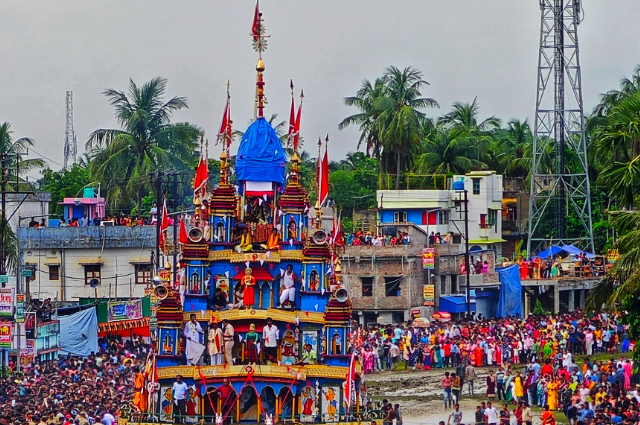
Year after year, the roads in Puri, Odisha, witness one of the greatest religious festivals of India, the Rath Yatra of Lord Jagannath. Millions of people gather in order to watch the three massive wooden chariots that carry Lord Jagannath, accompanied by his brother, Balabhadra and sister, Subhadra. What makes this festival so unique is the fact that the massive wooden chariots are rebuilt every year, following the traditional pattern of construction handed down from generations.
Therefore, this festival not only is a religious procession but also a splendid example of traditional engineering.
The three chariots are unique in many respects. The first one is of Lord Jagannath, whose chariot name is Nandighosh, which is about 45 feet high and has 16 wheels. The second one is of Lord Balabhadra, also called Taladhwaja, which is about 44 feet high and has 14 wheels, while the third one belongs to Subhadra,ra whose chariot is Darpadalana with 12 wheels.
The chariots are built some time before the festival. Specially chosen timbers are acquired in an organised and traditional manner. Skilled carpenters are then tasked with transforming the timber into movable huge structures. This is done in accordance with specifications that are preset rather than designing the chariots afresh each year. It takes a lot of expertise to do so.
That is why the chariots are fascinating from an engineering point of view. The chariots should not only be durable enough to be able to support the sacred figures on top of them, but also to endure the stresses caused by their movement along the busy streets. At the same time, all their elements should interact with each other in order to make such huge buildings moveable. Thus, the craftspeople should have a clear understanding of how wood, balance, weight, joints, wheels and durability work together.
The production process of the chariots is very different from the industrial one that we know today. Rather than manufacturing the same structures in a factory and keeping them for later use, Puri builds them anew every year.
Wood is another integral element in this tradition. The timber that is used to build the chariots is collected according to preplanned strategies with regard to forests and governmental departments. It has been said that the timber travels along the river Mahanadi, but this is a simplified idea of the procurement of timber, and it cannot be confined to one secret river route only. The fact of significance is the system that enables the transport of the appropriate timber to Puri.
After the wooden structures are created, they get their second life in the form of paint and decorations. Artists from various domains are engaged in this work on the chariots. For instance, one of the crafts of the Pipili village, the applique art, is applied in the decoration of Lord Jagannath's chariots. Thus, there appears another link between religious tradition and artistic traditions of the region.
Among the highly symbolic rituals is Chhera Pahara, carried out by the Gajapati Maharaja of Puri. The person is seen as the king of Puri, and his task is to sweep the platforms of all three chariots. The idea of this ritual lies in the fact that even the king is a servant before the god and therefore equal to everybody else. Hence, this ritual symbolises humility and equality before the God Jagannath.
And finally, the moment which all the devotees are waiting for arrives. Big ropes are tied to the chariots, and people start dragging them down the Bada Danda, which means the Grand Road in Puri. Moving the chariots takes a lot of time and effort. However, the main point of the festival is in moving the chariots. The god who usually lives within the temple appears on the street.
The destination point of this journey is the temple of Gundicha. It is situated about two miles away from the Jagannath Temple. The Gods reside in this temple for some days during their annual journey before starting their journey back, which is called Bahuda Yatra. Thus, the journey does not just signify a journey from one point to another but also becomes an essential part of the religious myth associated with the God Jagannath.
This journey has more importance than just being a huge vehicle parade. It signifies the survival of traditional art in a time where everything else revolves around machines and mass production. The craftsmen who create the chariots not only build vehicles but also maintain the traditions that have been passed down through generations.
The festival thus involves people from diverse occupations and social groupings. Carpenters, painters, weavers, priests, temple servants, and other worshippers form part of the crowd at this event. In other words, a cultural phenomenon comes into being that unifies religion, craftsmanship, engineering, and participation of the community.
Perhaps the most outstanding characteristic of this event is its cyclic renewal. The chariots are constructed for a specific purpose; they serve for it and then are finally broken down. However, the technology needed to construct them lives on from year to year since it is transmitted from one generation to another.
This means that the Rath Yatra festival in Puri is not only a tradition of religious origins. This festival serves as living proof of how human knowledge can be preserved without becoming a relic of the past. Year after year, the old technology is utilised to create such objects that may carry divine images through a crowd of thousands.
While our world becomes more automated and computerised, where design is followed by production on an industrial scale, the chariots of Puri are a reminder of the fact that engineering does not have to start from a machine. In some cases, engineering starts with knowledge that has been carried through generations, kept alive and put to use just once.
References:
- https://odishatourism.gov.in
- https://www.prod.incredibleindia.gov.in
- https://odishatourism.gov.in
- https://odishatourism.gov.in