
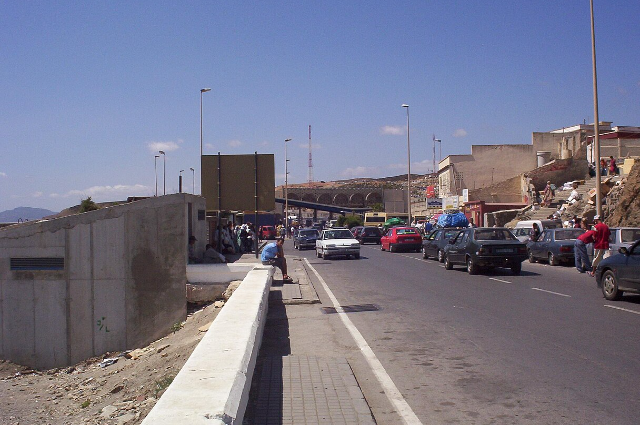
With thousands of immigrants crossing over from Morocco to Ceuta, an enclave of Spain in North Africa experiencing one of its largest immigration waves in history, the first thing that came to mind was images of overcrowded beaches, tired swimmers, security forces, and people sleeping wherever they could. But once the border was closed and most immigrants had started to return to Morocco, a new question appeared – what happens to these immigrants once they are returned?
The matter is quite complex, as the immigrants are in different situations and circumstances. Firstly, some adults returned of their own accord, having discovered that it was unlikely for them to stay in Ceuta. Secondly, some immigrants are being returned through the negotiations between Spain and Morocco. And thirdly, some immigrants are children – and they cannot be treated in the same way as adults.
Ceuta is a Spanish city-state situated on the northern African shore. Ceuta is surrounded by Moroccan territories, which means that its geographical location renders it one of the most important points along the external borders of Europe. Indeed, once having reached Ceuta, a person will have access to Europe, which is why this small territory became the subject of repeated attacks on the part of the people who wanted to reach Europe.
The numbers related to the last attack are impressive. Spanish officials claimed that about 72,000 people entered Ceuta recently. According to their Moroccan colleagues, the number is much lower, around 40,000 people. The difference in numbers shows how complicated it can be to provide the correct figure amid a growing emergency at the border. What matters is that there were many people, and they overwhelmed local facilities.
For most of the adults, the trip back to Morocco was swift. Indeed, Spain and Morocco were committed to stepping up coordination with regard to the return of individuals who entered Ceuta illegally. According to the statements by Spanish authorities, most of the individuals who crossed the border went back to Morocco since some were forced to do so because the conditions in Ceuta differed significantly from their expectations.
This scenario illustrates the fact that illegal migration involves one reaching Europe without having a chance of staying there. This is because once a person enters the country, he/she still face several procedures such as identification, deportation and others. For those who entered thinking that they would be able to live in a completely new environment right away, the process may end up with them being taken back to where they came from.
For some, it might entail going home to family. For others, it may imply going back into a jobless and financially precarious situation or to the very circumstances which caused them to embark on such a journey.
This is particularly true when people have paid money for help in making the trip. In the case of failure, the migrants become not only financially insecure but also physically tired. As a result, they become unsure of what actions to take. They may decide to cross once again or return home forever.
The hardest cases of all are those involving minors.
In the context of the crisis, many children managed to cross into Ceuta alone, without their parents or other legal guardians. Spain has special obligations towards children who cross alone without any of their relatives being present. Thus, these people cannot be regarded as just another illegal immigrant who needs to be deported on the bus.
There were approximately 1,100 unaccompanied minors who remained in Ceuta by August 6. According to Morocco, it was ready to cooperate with Spain in the identification and repatriation of its citizens, but the repatriation process would require certain procedures as well as taking into account the needs of children.
This brings up a problem for Spanish authorities. There is little space and fewer resources in Ceuta; however, they have a legal duty to protect the children who are already in their territorial jurisdiction. Thus, the issue is not whether a child is Moroccan, but whether returning this child will be safe and how this can be arranged.
Ceuta's reception centres were put under serious strain. Even without the latest influx of minors, this area faced the problem of accommodating unaccompanied migrant children. The Spanish authorities have developed a program for the transportation of some minors to other regions of the country. By February, the Spanish authorities announced the transportation of more than 1,000 unaccompanied minors from Ceuta, the Canary Islands and Melilla to other parts of Spain.
The current crisis thus created another burden on a pre-existing issue.
There is, however, the human toll that cannot be measured by figures. The passage to Ceuta can include swimming across the open waters with improvised flotation equipment or moving within the crowded border regions. In the July rush, there were fatalities from drowning and crowd issues. One such fatality was that of Faten Ben Omar El Azizi, a young Moroccan football player, who became the human face of the statistics. She drowned while trying to reach Ceuta even after obtaining the Spanish visa on the same day.
Her case shows how migration is not always easily understood through the simple binary of stay or go. Individuals may be reacting to the effects of unemployment or lack of opportunities, or even the expectations that come from the European environment. At times, social media may even lead people into false illusions regarding how difficult it is to cross into European territory.
However, the return of migrants also has its implications for Morocco. Moroccan government has raised security measures in the vicinity of Ceuta and Melilla following calls for mass migration via social media sites. Reports published on August 13 indicate that Moroccan security is on alert regarding new attempts to cross into Europe starting August 15.
What it means is that this crisis has not necessarily ended merely because there is now peace on the border. The security forces are still vigilant, and the government is attempting to avoid future mass exoduses.
But even the broader European perspective is crucial to consider here. Ceuta is geographically African but politically Spanish, which makes it unique in its geographical position where Africa and Europe meet. Consequently, any significant migration into the enclave is a European migration question. France has already been practising temporary border control within its borders with Spain due to many issues regarding security and migration; yet, such measures cannot be interpreted as caused by Ceuta's crisis alone.
The ultimate destination for those migrants who are sent back to Morocco depends entirely on who they are and how they managed to enter Ceuta. Some migrants go back voluntarily or through agreements on their voluntary return; some are minors who require more complicated measures to be considered in the process. Some of them return to their communities; some encounter similar problems as before.
This is the reason why the story of Ceuta does not end with the border fence.
While the striking scenes of mass migration will soon vanish from TV screens once the streets become empty, the effects linger on. Families might be looking for their relatives who went missing, children will be expecting decisions on their fate, and governments on both sides will be preparing for another potential wave of migrants.
The problem, then, lies not in the effort of stopping the migrants from coming into Spain. It is in answering why people choose to undertake such risky journeys and creating a system which could help people in need without undermining control at borders.
Ceuta once more showed that a small border crossing may become an international issue rather quickly. For those who have been sent back to Morocco, though, it became a crisis on a personal level. The act of crossing the border may take just a couple of hours, but its effects might prove to be long-lasting indeed.
References:
- https://www.reuters.com
- https://www.reuters.com
- https://www.reuters.com
- https://apnews.com
- https://mptmd.gob.es
- https://home-affairs.ec.europa.eu