
There is a particular kind of ache that comes from standing in a temple queue in Khandwa’s summer heat; three, sometimes four hours, shuffling forward a few inches at a time, children fussing, grandparents leaning on canes, everyone’s eyes fixed on the sanctum they can’t yet see. At the Omkareshwar Jyotirlinga temple, one of the twelve places in India where Shiva is said to reside in his most formless, most sacred aspect. That queue has been a rite of passage for devotees for generations.
This year someone found a way to shorten it. Not with money. With blood.
It started, as these things often do, with a problem nobody wanted to talk about out loud: the hospitals were running low. District Magistrate Rishav Gupta had watched demand for blood creep upward in Khandwa, particularly among emergency patients, while the usual Donation camps brought barely a trickle– 15 to 20 units a day, nowhere near enough.
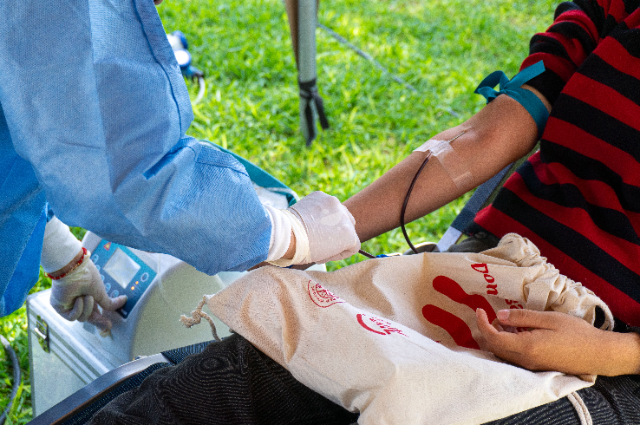
So in February, his office tried something almost cheeky in its simplicity. Set up a small blood collection unit, just 5 beds, a stone’s throw from the temple. Tell devotees: give twenty minutes of your morning, and skip the four-hour line entirely. Bring your whole family in with you.
It shouldn’t have worked as well as it did.
Picture it: a pilgrim who has travelled hours to reach Omkareshwar, prepared to wait out the afternoon in the sun, is instead offered a choice at the gate: twenty minutes, a blood pressure cuff, a needle and then a certificate, a cup of tea, a plate of prasad, a photograph of the deity to carry home. And most precious of all, immediate entry. No queue. No four-hour wait. Just faith, freely given, exchanged for blood, freely given.
Devotees didn’t just accept the trade. They embraced it. Daily collections at the district hospital rocketed from 15-20 units to nearly 200. The numbers even stunned the officials who suggested the scheme.
Dr O P Jugtawat, the district’s chief medical officer, put it plainly: the shortage that had been quietly worrying the hospital staff for months was easing. Blood drawn from a devotee’s arm outside a Shiva temple was, within days, saving a stranger's life in a hospital bed in a neighbouring district. Even the rarest blood groups that hospitals struggle to stock started showing up in healthy supply.
A VIP darshan pass at Omkareshwar normally costs Rs 300. Under this scheme, it costs nothing but a pint of blood.
None of this was engineered by a hospital PR team or health ministry campaign. It emerged from a district officer noticing the devotion; when given somewhere useful to go, it doesn’t need to be forced. It just needs an outlet.
Word has reached Bhopal. The state government is now weighing whether to extend the Khandwa model to more shrines, including Mahakaleshwar temple, another of the state’s Jyotirlingas, and possibly to set up blood bank counters in ordinary places like banks, government offices and anywhere people already gather.
It wouldn’t be the first temple to try this. At Trimala, the TTD-run Ashwini Hospital already offers a free Special Entry Darshan ticket to blood donors, cutting their wait to an hour or two. But Khandwa’s numbers are a tenfold surge in daily collections, a real dent in a genuine hospital shortage and have given the idea fresh weight and a fresh audience across Madhya Pradesh.
For now, though, the story is still a local one: a queue outside a Shiva temple that, on any given morning, is a little shorter than it used to be, because somewhere nearby, five beds are quietly filling up with the kind of gift that outlasts any darshan.
References:
- https://www.deccanchronicle.com
- https://www.india.com
- https://www.siasat.com
- https://www.youthkiawaaz.com
- https://inshorts.com