
It was just paint.
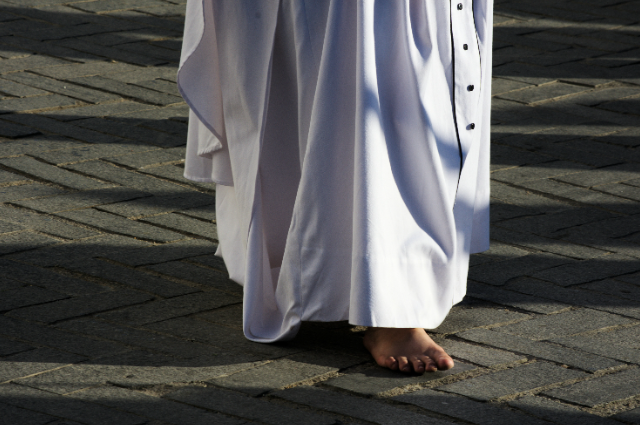
A thin white strip, running through Sumer Nagar Co-operative Housing Society in Borivali West, Mumbai, a quiet, residential neighbourhood in the city’s north-western suburbs, home to a sizable Jain community. No signs of announcements, no discussions; just a quiet action taken by the residents for the Jain monks passing by the neighbourhood barefoot every day. The whole story was to provide these monks some relief in the scorching heat of Mumbai by painting a white strip on the ground for them to walk on because white reflects heat and keeps the surface a few degrees cooler.
The practice of painting a white path for Jain monks isn’t something new. It is a form of community hospitality with roots going back decades, observed in Jain-majority neighbourhoods across Gujarat, Rajasthan, and Maharashtra. Jain monks and nuns, called sadhus and sadhvis, follow a rigorous code of conduct called Mahavrata, the five great vows. One of them is Aparigraha, non-possession, which means they own almost nothing. Another is Ahimsa, non-violence, which extends to their mode of travel; they walk everywhere, barefoot, to avoid harming any living creature that might be crushed beneath a shoe sole.
This makes the ground they walk on a genuine practical concern. Dark asphalt absorbs heat and can reach high temperatures in Indian summers, which is pretty painful and harmful for unprotected feet. White or light coloured surfaces, by contrast, reflect sunlight rather than absorbing it, keeping the ground cooler.
In Jain communities, painting these white strips is considered an act of seva– selfless service. Many societies in areas with Jain populations maintain these strips during the warmer months as a matter of quiet tradition. They aren’t demands. They are impositions. They are the community equivalent of leaving a glass of water on the doorstep.
A local YouTuber, identified in reports as Omprakash Giri, who runs a Hindi language channel with a following built on social commentary and local issues, came across this scene and didn’t ask any questions. He filmed it, called it “Jind Jihaad”, and posted it online. Giri also implied that the Jain community was engaged in a coordinated effort to impose itself on shared public space.
The video spread quickly like wildfire, comments flooded in, outrage built, and within days, a single strip of white paint became evidence of something sinister in the eyes of thousands of strangers on the internet. Other creators picked up the story. Screenshots circulated. The society’s name was shared widely.
The police knocked on the YouTuber’s door, acting on complaints filed against him for spreading communally sensitive content. Threats started coming his way, also. The society, most likely exhausted by the whole controversy, repainted the strip– and just like that it was over: the outrage, the viral moment, the collective fury, all bygone within a week.
I want to be fair here, because fairness is exactly what this story was denied from the beginning.
We live in an era where the gap between “I don't understand this” and "this is an attack” has become dangerously thin. The white strip was never explained publicly. A housing society making changes to shared spaces without consulting the residents wasn’t ideal at all. A simple notice could’ve prevented the whole situation. Transparency isn't a burden; it is a basic courtesy. That part is worth acknowledging.
But here is where my fairness ends: The leap from unexplained to Jain Jihad was not a genuine mistake. It was a choice. A calculated choice made by someone who knew what that phrase would do to an audience. An act of community hospitality was framed as religious misconduct. It is manufactured panic, dressed up as concern.
What bothers me isn’t the YouTuber; it’s how quickly thousands of people accepted the framing without having any second thoughts as to why there is a white strip on the ground in the first place. The answer was never hidden. It was never complicated. It was just one question away.
The monks were never involved in the controversy at all. They walk. They don’t own phones; they probably never knew any of this happened. What is absurd about the whole situation is that thousands of people were fighting over it online, yet the ones for whom this all was done were completely unaware, walking through the city.
Social media doesn’t create outrage out of nothing. But it does give outrage a stage, a microphone, and a vast audience. The YouTuber likely wasn’t wicked; he was doing what the platform excites: find something that looks suspicious, frame it dramatically, and post it before anyone offers proper context. Leaving the rest up to the algorithm.
The aftermath was quite too. No dramatic apology, no public debate, no lasting change. Just a repainted strip and a story that stopped getting views. Which, in my opinion, is the most honest ending possible. It is a reminder that something that looks like a huge debate on the internet, in the real world, is just a line on the ground.
Next time you see something you don’t understand, maybe the first move isn’t to film it.
Maybe it’s just to ask.
References: