
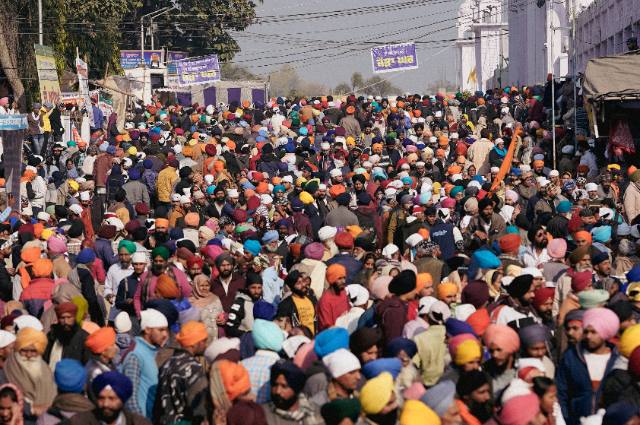
Hundreds of farmers from Punjab, Haryana and several states began marching towards Delhi on July 21 to attend a Kisan Maha Panchayat organised by the Desh Bachao Morcha. The protest was held against the proposed India-US trade deal, which the farmers believe could seriously affect Indian agriculture and the livelihoods of farmers and rural workers. However, the march was halted before the farmers could reach Delhi. The Haryana police sealed the Shambhu border with barricades, cement blocks and heavy police deployment. The bridge over the Ghaggar river was also fenced off to stop the convoy from entering Haryana. Similar reports of farmers being stopped came from Jyotisar in Kurukshetra, while the Haryana police issued a traffic advisory and diverted vehicles travelling between Punjab and Delhi to avoid congestion.
The Kisan Maha Panchayat was organised at Kisan Ghat in Delhi and brought together farmers’ organisations from Punjab, Haryana, Uttar Pradesh, Uttarakhand, Rajasthan, Telangana, Tamil Nadu, Kerala, and other states. Unlike previous farmers’ protests, where tractors were used for travelling, most protesters travelled by buses and private vehicles. The farmers started their journey from Gurdwara Sri Fatehgarh Sahib in Punjab after more than a thousand farmers and protesters spent the previous night at the Gurdwara’s Sarai. A large group of protesters left early in the morning around 5 a.m., travelling through Madhopur near Sirhind on the GT road before reaching Shambhu border, where they were halted.
This incident reminded many of the February 2024 “Delhi Chalo” protest, when farmers demanding a legal guarantee for the minimum support price (MSP) were also prevented from entering Delhi from the same border. Before the march, Bhartiya Kisan Union Chief Gurnam Singh Chaduni was detained by the Haryana police. Farmer leader Sarwan Singh Pandher criticised the Haryana government; he said that the farmers had no intention of disruptions or breaking the barricades or clashing with the police. According to him, they just wanted to peacefully protest and wanted a meaningful conversation with the government. He demanded the release of Chaduni and other detained farmers. Pandher also demanded accountability from the Chief Minister Nayab Singh Saini of Haryana regarding the actions taken against the farmers and assurances given to the Punjab farmers beforehand. The main reason for the protest is the uncertainty of farmers’ livelihood and their fear that the proposed India-US trade deal will allow cheaper American agricultural products to enter the Indian market. They believe this could lower the prices of their Indian crops, which will reduce farmers’ incomes, and make it difficult for local farmers to compete. Farmer leaders also believe that the government may have less freedom to impose protective tariffs on imported farm products in the future.
According to farmer organisations, this deal will not only affect agriculture but also dairy, poultry, livestock, digital trade, e-commerce, government procurement, intellectual property rights, industry and services. They are worried that farmers growing apples, rice, sugar, soyabean and maize could face lower prices and unstable incomes. They also fear that cheaper American dairy and poultry products could hurt Indian producers. Farmer groups said that the deal could weaken the rural economy by directly affecting agricultural labourers, livestock producers, small traders and micro-industries. According to the farmers, their major concern is the lack of transparency by the government. Farmers’ group said that the government has not made the complete details of the trade deal public. Without seeing the full details, they believe it is difficult to trust the claims that farmers’ interests are fully protected. They are demanding that the government withdraw the proposed trade deal completely and protect the interests of farmers and rural communities.
However, the government has strongly rejected these concerns. The interim India-US trade framework, announced on February 6, 2026, reduced the reciprocal US tariff on Indian goods from 25 percent to 18 percent, after briefly reaching 50 perper centring negper centns. In return, India agreed to allow greater imports of certain American products and gradually reduce its purchases of Russian oil. The deal also provides zero-duty access for several Indian agricultural exports to the US market, including spices, tea, coffee, cashew nuts, chestnuts, avocados, bananas, mangoes, kiwis and papayas. Negotiations for a broader trade agreement are continuing, with both countries discussing safeguards for different sectors. Union Commerce and Industry Minister Piyush Goyal has repeatedly presented the agreement as “fair, equitable and balanced”. He said sensitive agricultural and dairy products such as maize, wheat, rice, sugar, soyabean, poultry, milk cheese, fuel ethanol, tobacco, certain vegetables, and meat have been kept outside tariff concessions. He also said the agreement would give India a better access to the US market, valued at 30 trillion, while protecting Indian farmers. Agriculture and Farmers Welfare Minister Shivraj Singh Chauhan has also defended the agreement. He said Prime Minister Narendra Modi had made it clear that farmers’ interests are “non-negotiable”. Chauhan said the government would not allow any harm towards the domestic farmers in exchange of foreign products. He also claimed that India would not allow genetically modified products such as meat, dairy, grains, oilseeds, fruits, vegetables, spices and processed foods. He dismissed claims such as “India would become a dumping ground for American products”.
Despite the government’s assurances, farmers’ organisations remain distressed. They have declared that they will continue raising their voices and concerns until the complete text of the trade agreement is made public and a proper conversation takes place with the government. The farmers’ protest took place right after the “Chalo Sansad” march by the CJP (Cockroach Janta Party) in Delhi, raising concerns about how public dissent is being managed in this country. While maintaining law and order is the government’s responsibility, so is engaging with citizens who have genuine concerns over policies that could affect their lives. Preventing protesters from reaching their destination and detaining their leaders will not help to control the situation, and it does not help in solving the issues being raised. In a democracy, dialogue, transparency and accountability are the foundational pillars.
References:
- https://www.downtoearth.org.in
- https://www.indiatoday.in
- https://www.financialexpress.com
- https://www.outlookindia.com