
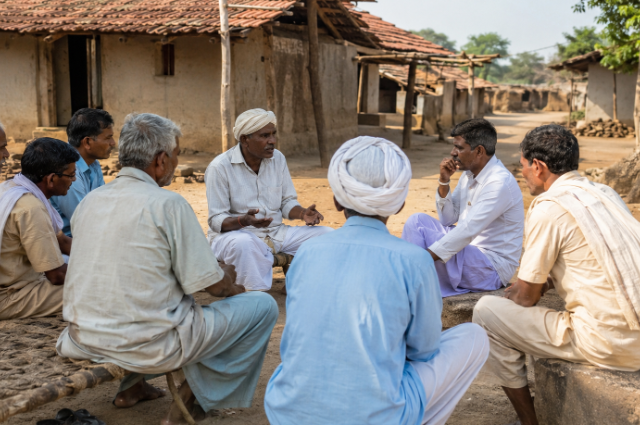
Have you ever wondered why people in different villages speak the same language in slightly different ways? People in the first village and the second may speak almost the same language, but not exactly in the same way. They may pronounce certain words differently, use different expressions, or arrange sentences in slightly different ways. Travel farther, and the differences become easier to notice. Eventually, you may reach a place where the language sounds unfamiliar, even though it was born from the same linguistic root. This is how dialects are created. A dialect is a variety of language that has its own pronunciation, vocabulary and sometimes grammar. It is different from an accent, which mainly refers to the way words are pronounced. Two people can have different accents but use almost the same vocabulary and grammar. Dialects go further because they can change the words people choose and the way they form sentences. One of the most important reasons dialects develop is simple: language is always changing. It is not constant. A new expression appears, a pronunciation shifts, or an old word slowly takes on a new meaning. One small change may not seem important, but after many generations, several changes can build up.
Imagine three villages connected by a weekly market. People from Village A regularly meet people from Village B, so they quickly pick up each other’s expressions. Village B, however, has very little contact with Village C because a large forest separates them. Over time, a new way of pronouncing a common word may spread from A to B but never reach C. A few generations later, all three villages may still understand one another, but their speech will no longer sound the same. This gradual pattern is called a dialect continuum. In simple terms, it is a chain of related speech varieties. People living next to each other can usually understand one another, while people living at the distant ends of the chain may struggle to communicate. There is no sudden line where one dialect ends and another begins; the differences grow little by little. Geography often helps create this gradual change. Mountains, rivers, forests and oceans can make regular communication difficult. When people live apart and have limited contact, their speech can develop in its own direction. But geography alone does not decide how language changes. A river can separate two communities, but it can also connect them if people regularly cross it for trade. A mountain may isolate a village, while a well-used road may bring several mountain communities together. What matters is simply not how far apart communities are situated, but how often they interact.
Language also changes when different groups come into contact. Traders, migrants, workers, and travellers often bring words and expressions from their own languages. Communities may borrow these words and make them part of their everyday speech. Over time, this mixing can create a distinct local variety. For example, imagine a small town where a large group of workers from another region settles over several decades. The local children grow up hearing two languages at home, school, and in the marketplace. They may start mixing words from both. Their speech could eventually develop expressions that are familiar in the town but unusual to people elsewhere. Thus, migration does not simply move dialects from one place to another. It can also create new forms of speech.
History plays an important role as well. Wars, migration, colonisation, and the movement of populations can bring different speech communities together or push them apart. When several dialects meet in a new place, they may gradually influence one another. Some features survive, some disappear, and others become part of a new variety. Social identity also plays an important role. People do not speak only to exchange information, but their way of speaking becomes their identity and shows where they belong. A person may use standard language at school or in an office but may switch to local dialect at home. A particular word or pronunciation can immediately indicate, “I am from here”. This is why dialects are closely connected to community pride. Local speech can also reflect the life of a community. A fishing community may have detailed words for different winds, tides, and types of boats. A farming community may have expressions connected to soil, rainfall, and harvests. These words develop because they are useful to the people who live there. In a way, every dialect holds a record of the community’s environment and experiences.
However, dialects can also face pressure. Standardised education, migration, television, and social media expose people to widely accepted forms of language. Younger generations may stop using certain local words or change their pronunciation to fit in. Sometimes people may face discrimination because of the way they speak. A dialect may be unfairly labelled as uneducated or inferior, even though it has its own history and origin. At the same time, technology can help protect local speech. People now record traditional songs, create videos in regional dialects, and share local expressions online. The story of dialects is the mirror to the story of people. Communities shape language through the places they live in, the people they meet, the work they do, and the identities they build. A dialect is simply not a “different way of speaking”. It is evidence of history, migration and belonging.
REFERENCES
- “Linguists' Definition: mutual intelligibility” https://ccat.sas.upenn.edu
- “Mutual intelligibility” https://en.wikipedia.org
- “Language Dialects Across the World: The Hidden Ties Between Speech and Culture” https://www.remitly.com
- “Why Do Dialects Develop? 5 Key Factors” https://aboutlinguistics.com
- “Dialect continuum” https://en.wikipedia.org