
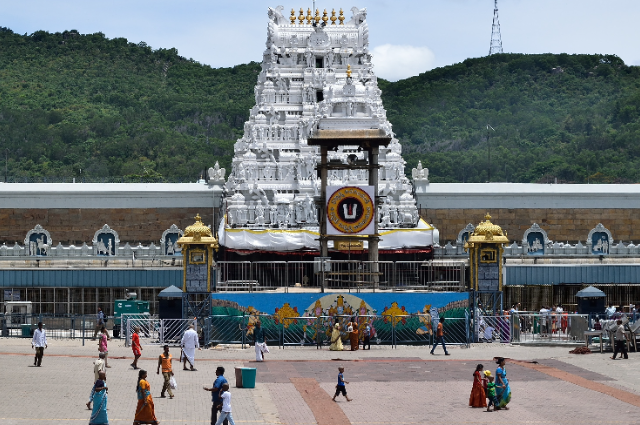
Every single day, an endless sea of humanity winds its way up the sacred, mist-shrouded hills of Tirumala. These are not merely tourists; they are devotees, many of whom have saved for months or even years just to catch a fleeting, few-second glimpse of the deity at the Sri Venkateswara Temple. Along with their profound faith, they bring their hard-earned money. They drop crumpled banknotes, gold ornaments, and lifetime savings into the temple’s hundi (donation box), trusting completely that their offerings will serve a divine purpose.
Managed by the powerful Tirumala Tirupati Devasthanams (TTD), this institution stands globally as one of the absolute wealthiest religious organizations in existence. Its annual revenue effortlessly scales into thousands of crores, generated through a relentless influx of voluntary donations, accommodation fees, and the sale of the iconic prasadam. Yet, beneath the golden canopy of the temple and the immense financial prosperity, a deeply unsettling human question has begun to echo through the hearts of the public: Where does this money actually go?
This inquiry is not born out of casual curiosity or scorn toward faith. Rather, it is a demanding cry for basic transparency from the very ordinary citizens whose devotion fuels this entire empire.
The Contrast of Wealth and the Vanishing Audit Trail
To understand the sheer scale of the TTD is to look at a sprawling mini-state. It doesn’t just manage altars; it runs vast networks of universities, world-class hospitals, free food distribution centers, and massive administrative offices. On paper, the budget maps out beautiful altruistic goals. But when you pull back the curtain on the actual day-to-day financial pipeline, a starkly different reality emerges— one characterized by a troubling lack of public oversight.
Unlike public corporations or state welfare departments, the billions flowing through India’s wealthiest temples often operate within a vacuum of true public accountability. The real tragedy of this system is that the actual donors, the millions of everyday people standing in suffocating lines for hours, have absolutely no institutional right to audit where their money goes. They give blindly, and the system absorbs it silently.
This systemic opacity has paved the way for deeply concerning scandals, heavily echoing the anxieties surrounding the broader landscape of religious fund mismanagement. When vast sums of unmonitored cash move through an institution, the temptation for exploitation becomes inevitable. The real moral crisis arises when the money meant for the divine appears to be diverted into the pockets of the corrupt.
Whispers in the Counting Room: Deleted Footage and Fast Wealth
Nowhere is this crisis of faith more apparent than in the recent, heavily scrutinized irregularities within the Parakamani—the highly secured inner sanctum where temple donations are opened, sorted, and officially recorded. The Parakamani is meant to be a fortress of integrity. Instead, it became the epicenter of a massive fraud investigation that forced the intervention of the Andhra Pradesh High Court, the Crime Investigation Department (CID), and the Anti-Corruption Bureau (ACB).
The ground-level details of the investigation read like a corporate thriller. Whistleblowers who attempted to point out systemic gaps and flag suspicious activities found themselves abruptly sidelined, silenced, or outright fired from their positions. Simultaneously, crucial pieces of security evidence—specifically, vital hours of CCTV footage capturing the counting tables, mysteriously vanished or were permanently deleted from the recording servers.
But what truly shocked the public consciousness was the sheer human greed unmasked by investigators. The probe zeroed in on specific lower-tier employees who were drawing modest, basic salaries of just ₹18,000 per month. Yet, a financial audit of their personal lives revealed that these exact same individuals had somehow accumulated sprawling, luxury properties worth multiple crores. How does a clerk surviving on an ₹18,000 wage suddenly become a multi-crore real estate tycoon? The answer seemed to lie hidden within the unmonitored, uncounted piles of the temple hundi. While the devotees sacrificed their livelihoods to give to the deity, an internal ring of actors was allegedly helping themselves to the blessings.
Adulterated Faith: The Laddu Prasadam Contamination
The rot, however, did not stop at the cash box. It bled directly into the most sacred ritual of the Tirupati experience: the distribution of the legendary laddu prasadam. For a devotee, the laddu is not food; it is a physical manifestation of divine grace. Families carry it back to their villages like a precious relic.
Yet, a judicially overseen Special Investigation Team (SIT) uncovered a deeply cynical procurement scam. Investigations revealed that for years, corrupt administrative actors had manipulated the supply chain, allowing heavily adulterated, substandard ghee to be used in the preparation of these sacred sweets. Quality control protocols were bypassed, and vendor contracts were handed out through highly compromised procurement processes.
To the public, this wasn't just a financial crime or an act of administrative bribery; it was a profound spiritual violation. The idea that corrupt officials would intentionally compromise the purity of an offering to skim profits off a ghee contract shattered the trust of millions. It highlighted a terrifying truth: without strict independent oversight, nothing—not even the sacred food offered to a deity—is safe from corporate and bureaucratic greed.
The Structural Path Forward: Restoring Sanctity Through Reform
As these overlapping scandals continue to unravel—from the adulterated laddus to suspicious gold plating contracts and multi-crore asset inflation, the defense from political circles has been predictable. Rival factions have aggressively weaponized the controversies, turning a deep structural crisis of governance into a chaotic political circus of mutual accusations and strategic cover-ups.
But the solution does not lie in political mudslinging. It lies in radical, unyielding institutional reform. If modern technology can be used to manage millions of visitors, it must also be used to hold the administration accountable. TTD must transition toward a future of absolute transparency:
- Public Portals: Transitioning to independent, third-party financial audits published transparently online for public viewing.
- Whistleblower Integrity: Enforcing strict, legally protected whistleblower channels to ensure employees can report internal theft without fearing immediate termination.
- Tamper-Proof Tech: Deploying tamper-proof, cloud-backed digital tracking for every single rupee and ounce of gold that crosses the temple thresholds.
Ultimately, the escalating public outcry surrounding Tirupati’s wealth forces us to look at a profound spiritual truth. The same divine presence that resides within the grand, golden walls of India’s richest temple exists equally within the quietest, smallest roadside shrines. God does not demand grand financial empires; humanity creates them. Therefore, when ordinary citizens step forward to ask hard questions about financial accountability, they are not attacking religion. They are desperately trying to protect it. It is time for those in power to provide a clear, honest answer to the millions who give so selflessly, and finally determine exactly whose pockets are truly getting blessed.
References:
- NDTV. “Andhra Pradesh High Court Directs Anti-Corruption Action in Tirupati Donation Theft Case.”
- The Indian Express. “SIT Probe into Tirupati Laddu Procurement and Quality Control Issues.”
- The Times of India. Reports on TTD financial administration and donation management.
- Economic Times. “TTD to Strengthen Quality Monitoring and Testing Systems.”
- Official Tirumala Tirupati Devasthanams (TTD) Annual Reports and Financial Disclosures.