
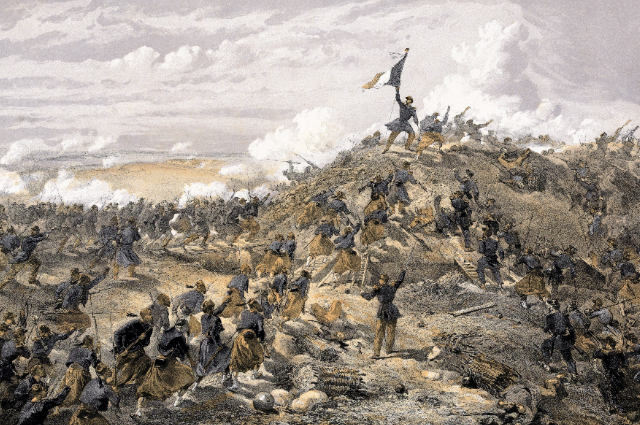
In February 1854, an Irish-born reporter known for his fondness for brandy and cigars boarded a ship bound for the East. John Delane, editor of The Times, sent William Howard Russel to accompany British troops that were being gathered for war against Russia. This episode was expected to be brief, and it was expected that he would be home in London by Easter. Instead, Russell remained at the front for nearly two years, and in that time, he did something the history of journalism remembered: he managed to make the British public aware of what war looks like, and in doing so, he helped bring down their government.
A War Sold as Glory
The Crimean War began in 1853 over a matter of religious and imperial tensions between Russia and the Ottoman Empire, with Britain and France entering an alliance with the Ottoman side the following year. At home, the conflict was framed by officials and much of the press as something noble and prestigious, basically a check on the Russian Plans. Russell arrived in Crimea with the army in September 1854 and began sending stories that put the camera lens to an entirely different angle.
He was present for the Battle of Balaclava, where he described the stand of the Highland regiments, the British infantry units, in a phrase that got the most prominence among his works; he wrote: a “thin red streak topped with a line of steel.” But the heroism he documented coexisted along the catastrophic mismanagement which was essential to open the eyes of the public regarding the real war. As the siege of Sevastopol, another campaign of the Crimean War, dragged through the winter of 1854 and 1855, Russell reported that British soldiers were not just dying at the hands of the army but from cold, hunger, and disease, while basic supplies for survival remained inaccessible to them.
Reporting What Officials Would Not
What set Russell apart from earlier correspondents was his willingness and courage to criticize the army’s own leadership in print. He wrote of soldiers without boots, tents, or adequate medical care, despite Britain’s wealth and industrial capacity. He directly attacked the incompetence of the general staff, and his criticism of the British commander, Lord Raglan, adversely affected Raglan’s standing both in the field and back home in Britain. One frequently cited line from his reporting was the comparison of the condition of British troops to that of London’s poorest beggars, and this brought attention to the matter of how Britain was exploiting its own people for its political gains.
Russell’s reports travelled home primarily by two mediums, one by ship and, second increasingly, by telegraph, a new technology that compressed the gap between the battlefield and the breakfast table. For the first time, the British public was reading near-real-time accounts of suffering and failure rather than filtered official reports. Newspaper circulation for The Times spiked sharply, and Russell’s dispatches were reprinted across Britain, Ireland, and as far away as the United States.
Czar Nicholas I of Russia is reported to have remarked that Russia had no need of spies because it had The Times, since therein Russel provided a considerable amount of sensitive information regarding the war. Lord Raglan, for his part, reportedly urged his officers not to speak with Russell at all.
Toppling The Government
The political consequences emerged in no time. Public outrage over Russell’s accounts of the army’s suffering during the siege led directly into a parliamentary crisis. In January 1855, the government of Prime Minister Lord Aberdeen fell, a collapse historians long linked to the political damage inflicted by the unsanitized coverage coming out of Crimea. While later historians say that Aberdeen’s government faced other pressures as well, there was little doubt that Russell’s reporting had become a serious liability for the ministry, and the connection between his dispatches and the change in government became a point of memory for how the war was remembered.
The fallout extended beyond Westminster. Public anger over the conditions Russell described helped weaken practical reform. A group of British financiers and engineers built the Grand Crimean Central Railway to improve the movement of supplies to the soldiers, a direct reaction to the logistical failures his reporting had put before the naked eye of the general public.
Inspiring Florence Nightingale
Perhaps Russell’s most long-lasting legacy lies in medicine rather than journalism. His descriptions of the state of military hospitals, where wounded and sick soldiers often received worse care than the conditions of battle itself, managed to reach a woman in London named Florence Nightingale. She later credited that it was his reporting that brought her into wartime nursing. Nightingale’s subsequent work organizing care for British soldiers in Constantinople became one of the most noticeable humanitarian achievements of the Victorian era. This was fueled by Russel. Russell also wrote admiringly of Mary Seacole, a nurse of Jamaican and Scottish heritage who cared for soldiers in Crimea, helping bring her contributions to public attention as well.
A New Kind of Journalism
Russell was not, strictly speaking, the first war correspondent; other reporters had covered earlier conflicts such as the Napoleonic Wars. But his work was the first of his kind, and he was the first whose dispatches were consistently built on firsthand observation among ordinary soldiers rather than secondary sources such as officers’ accounts or official dispatches. He mixed with the lower ranks, ate their food, and listened to their complaints, and he wrote what he found rather than what authorities wanted printed. He camouflaged himself within the people, and then he narrated their accounts unfiltered.
References:
- Dictionary of Irish Biography. “Russell, Sir William Howard.” Royal Irish Academy. https://www.dib.ie
- Maynooth University. “How Irishman William Howard Russell Invented Modern War Reporting.” Spotlight on Research. https://www.maynoothuniversity.ie
- Murphy, David. “How William Howard Russell Invented Modern War Reporting.” RTÉ Brainstorm, 21 August 2024. https://www.rte.ie
- News UK Archives. “Getting the News Back: Crimea War 1854–55.” Medium, 2 December 2022. https://medium.com
- Research at Kent, University of Kent. “William Howard Russell (1820–1907) — Picturing the News.” https://research.kent.ac.uk
- The Royal Parks. “William Howard Russell (1820–1907).” Brompton Cemetery, Famous Graves and Burials. https://www.royalparks.org.uk
- Wikipedia contributors. “William Howard Russell.” Wikipedia, The Free Encyclopedia. https://en.wikipedia.org