
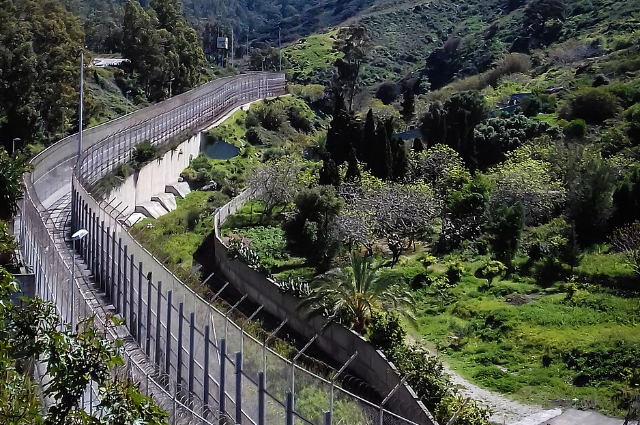
They were a controlled frontier for a couple of hours, but more like a city in a rush of tide. In the final days of July, thousands of people flowed towards the Spanish enclave on land and sea from Morocco. Others tried to cross on foot. Others went in the water and attempted to swim around the border. The scale was tremendous. Later, Spanish officials estimated the crossing numbers at around 72,000, but the numbers have varied as the events have been reviewed. Most of those who returned to Morocco soon after, but Ceuta was caught off guard with the number of people who stayed behind.
Ceuta is a small bit of Spain on the north coast of Africa. That's what is at the root of a lot of the tension. It is a Spanish territory but with only land borders to Morocco. The distance between the two sides is small compared to the long journeys migrants are normally used to travelling to get to Europe.
This is not a safe crossing. The huge crossing of land was preceded by the first signs of crisis. On July 29, Ceuta's police and security forces reported that over 1,500 adults and minors had already arrived in the Spanish enclave by boat over the past few days. Hundreds were trying to cross the Moroccan waters by swimming in the relatively favourable summer weather.
After that, the numbers bounced up. The situation was one in which Spanish and Moroccan authorities were suddenly faced with a movement that exceeded anything they had ever seen before as an irregular flow. The consequences were deadly. Reuters reported 57 deaths by July 31st, and as more bodies were identified, the death toll became much higher. Casualty figures have been subject to variable changes from one report to another, as rescue operations and investigations are still ongoing.
There is one other number that really helps to understand the crisis. Spain's security department had already documented a significant increase in arrivals of people by land in Ceuta before the mass crossing. 2,826 individuals had entered Ceuta irregularly between January 1 and July 15, representing an increase of around 150 per cent compared to the previous year. At the same time, irregular arrivals across Spain as a whole were actually down by almost 25 per cent. That is, Spain did not have a simultaneous growth in all parts of the country. Ceuta was becoming a hot spot in itself.
The toughest period of the tale came once the border had been closed. Many of the people who went in came back to Morocco. But there were still thousands, such as the unaccompanied children who couldn't be treated like adults. Ceuta was requesting transfers of approximately 1,100 unaccompanied minors to mainland Spain, due to overcrowding, Reuters reported. It was reported that some children were sleeping in warehouses and outside.
That has introduced a problem which the fence is not able to solve. Another crossing can be prevented by a border. It can not provide beds, healthcare, social workers, or long-term housing overnight. This is made even more evident due to the small size of Ceuta. Charities and locals have been providing food and basic help, and the authorities are going through the legal proceedings related to the minors.
For some migrants, the reasons for coming are economic. Others aim for employment and/or the mainland of Europe. Each of them is in a different situation and, as with any person in the crowd, it would be inaccurate to assume that everyone had the same story. But an even more puzzling issue has emerged with the mass migration itself: why so many people at nearly the same time?
For years, both Spain and Morocco have been working together in an effort to tackle migration, especially at the two European enclaves in North Africa: Ceuta and Melilla. But that co-operation has helped to lower some crossings, but it has never taken away the pressure. The current influx, then, has brought back an old fear on the European continent: migration patterns can shift rapidly.
There might also be a role for social media in the dissemination of information on this opportunity to cross. The crowd was unusually large, as people were learning about the movement via the Internet, according to the reports. That does not automatically make it clear who had organised the movement and for what reason it occurred at that specific time. Rumours have been swirling around about deliberate coordination, but these are not facts that have been confirmed by authorities.
The impact did not end on the Spanish-Moroccan border.Following the surge, the French government has tightened its security at the border with Spain. French Interior Minister Laurent Nuñez said there had been further investigations and a rapid-response border force had been deployed. The decision was an indication of a general European reaction. Governments in other parts of the Schengen zone were concerned about the potential for further migration.
Italy took it a step further and imposed temporary restrictions on travellers from Spain. Later, Spain would retaliate with restrictions on flights and ships from Italy. The disagreement has escalated from a crisis in a small North African enclave to a disagreement between European governments over who is responsible for migration and how far free movement of people goes.
However, there is an important aspect that can fall through the cracks in the political debate. The migrants who made their way to Ceuta were not granted free roam of the rest of mainland Europe. The status of Ceuta and the border arrangements in the enclave make it more difficult to enter or exit the Schengen area than it would be to cross an ordinary European internal border. But it hasn't prevented the political response.
Ceuta has been the scene of migration crises in the past. During May of 2021, approximately 6,000 people entered the enclave in one day, many of them being minors. It left Spain dazed and stunned and was one of the most visible migration movements in recent Spanish history. The number of reports makes the new episode special.
Moreover, it comes at a challenging period for Europe. The EU is already attempting to put in place new migration policies, reinforce external borders and determine a way to share responsibility when specific countries are receiving especially high numbers of migrants. The European Commission has urged increased coordination with non-EU countries, and increased systems for monitoring sudden shifts in migration patterns.
Those debates are not hypothetical for Ceuta. They mean overcrowded reception facilities. They signify the children awaiting a resolution on where they will reside. They mean weary rescue workers and border guards . And for the migrants themselves, they mean uncertainty after taking a dangerous route in the hope of finding something better.
The water between Morocco and Ceuta is narrow. The political distance created by this crisis is much wider. France's reinforced checks, Italy's response and Spain's countermeasures show how quickly a local border emergency can become a European dispute. The immediate crossing may have slowed, but the question that produced it remains: how should Europe manage migration when pressure arrives suddenly, in numbers that even a small border city cannot absorb? Ceuta has provided no easy answer. It has simply made the question impossible to ignore.
References:
- Reuters: Spain's Ceuta seeks transfer of unaccompanied migrant minors
- Reuters: Spain says migrants are returning from Ceuta
- Spain's Department of National Security: Irregular migration figures
- European Commission: Schengen and EU border management
- The Guardian: Conditions facing migrants in Ceuta
- Associated Press: Migrants swimming from Morocco to Ceuta