
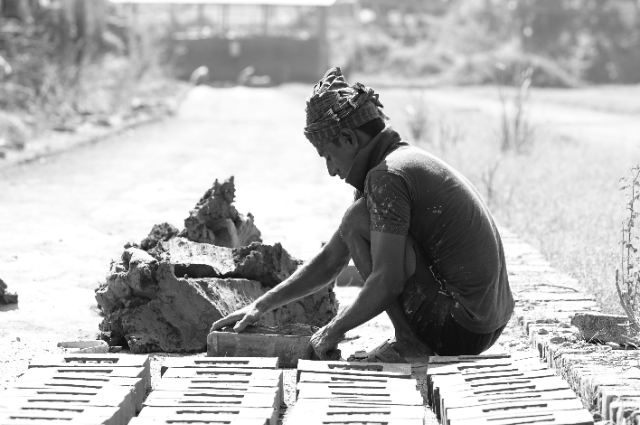
A construction worker might have done less work at the end of a very hot day. The farmer may have spent less time in the field. The delivery rider may have required more breaks between deliveries. Such scenarios are seldom seen in debates on economic growth but do show the problem that's growing increasingly difficult to ignore: climate change is altering the circumstances in which people make a living.
Heatwaves are frequently referred to as environmental emergencies. The news media is highlighting extreme heat, the electricity crisis, and strain on hospitals. Fewer studies have been conducted on the working lives of people exposed to heat over the course of several hours. For them, extreme weather is not a matter of occasional inconvenience. It can impact how much they are able to work, how much they make and whether they are able to go back to work the following day safely.
The figures are significant. A 2026 Lancet Countdown report estimated that by 2025, the impacts of extreme heat cost the world 573 billion potential working hours. The related loss of potential income amounted to some US$1.07 trillion (0.91 per cent of global GDP). The estimated losses in agriculture were the highest of the losses. These numbers are not an indication that all affected workers lost income directly, but they reflect the value of work lost by people who were less likely to be able to work due to heat exposure.
It would be important to take note of the distribution of this burden. A home-based worker might be able to make some changes to their work schedule when it gets hot. A person working in a construction environment has much less control of his working environment. The street vendors cannot simply take their trade into the house, and a farmer's labourer cannot always delay the labour. They may need to be there and earn income even in bad weather conditions.
A new study from May 2026 in Scientific Reports illuminates this issue. A sample of 320 construction and welding workers has been surveyed in Bangladesh to gain insight into how the workers perceived the heat in the workplace and what they did to cope with it. Over 80 per cent felt they were at risk from heat. It also showed that 87.5 per cent of the respondents spent more than five hours outside during the hot season and 48.1 per cent of workers worked for more than eight hours during the hot season.
The most telling finding is one of them. Despite knowledge of the risks of heat exposure to worker health, awareness did not always lead to safer employment practices. Others had difficulty adjusting to reduce their rate of work or to schedule work around cooler hours. That is to say, information about a risk does not necessarily translate into freedom to avoid it. There may be a need to take a break, but a worker feels compelled to work through because of deadlines, pay, workplace expectations, etc.
It is here that the question enters the realm of working conditions. While it's great to encourage people to drink more water, that's only a part of the solution if there's no shady rest area at work. Shorten the hours if they can, but if they can't, then it's not much good. Protection must be incorporated into the setup of the work, not left to individual choice.
The report of the research of the International Labour Organisation (ILO), published on 29 October 2026, completes the picture. It has undertaken research on the impact of heat stress on work, productivity and economic activity in Ethiopia, Ghana, Lebanon, Maldives, Senegal and Sri Lanka. While the labour markets and working conditions are different in all of these countries, the research does highlight a general concern: labour markets and the businesses and economies around them are affected by rising temperatures.
Employers see the repercussions as practical. Building projects can be delayed, farm yields may be reduced, and businesses may have to cover extra expenses to ensure staff safety and the continued running of the business. However, adapting the workplace is usually seen as a cost which may be deferred. When heat-related illness and interrupted schedules and productivity start to impact daily operations, that calculation can start to cost.
No single setup is ideal for all occupations. Proper ventilation and temperature management are required in a factory. Construction sites must have available potable water, work schedules that take into account hazardous heat, and shaded rest areas. Agricultural employers may have to modify working hours and offer consistent opportunities for recovery. Some workplaces may require cooling equipment to be used. The key is that the safeguards are suitable for the realities of work.
The topic of income must also be considered. But if a worker is instructed to stop work during hazardous conditions without compensation for the loss of wages, it's a hard call to make. Safety and productivity are no longer the only options. It's now a decision between health and household costs. Policies that fail to recognise this truth can appear to be successful on the surface, but do little to support workers.
Pakistan is one of the countries with a significant challenge. Many people rely on jobs in the informal and non-agricultural sectors, which may offer different levels of access to formal safeguards and working conditions. So heat policies must go beyond the big office and registered companies. Small businesses, agricultural workplaces, construction sites and daily-wage workers should also be included. Otherwise, individuals most vulnerable to increases in temperature could continue to be outside of temperature protection systems intended to support them.
Heat warning rates are not the only criterion to evaluate the response to extreme heat; they should also be assessed during the winter months. It should also be assessed in terms of workers' rights to rest and recuperate without sacrificing their livelihoods, whether employers offer a safe environment, and whether governments implement substantive measures for a safe workplace. Temperature records tell us how much the world is getting hotter. Workers' experience gives us some idea of the costs of that change.
Many changes will be necessary if the world is to be warmer. It will make employers think again about how to schedule their work, governments toughen up their labour laws, and businesses understand that a safe workplace is an economically stable one. Those who are doing the actual work should not bear the burden of a changing climate per se, just because their work can't be done indoors.
References:
- The Lancet Countdown (2026). Loss of Earnings from Heat-Related Labour Capacity Reduction.
- Tamim et al. (2026), Scientific Reports. Occupational Heat Risk Perceptions and Behavioural Adaptation Strategies Among Construction and Welding Workers in Bangladesh.
- International Labour Organisation (29 October 2026). New ILO Studies Reveal Growing Impact of Heat Stress on Jobs and Productivity in Six Countries.