
There is a queue outside almost every major temple in India that tells you something uncomfortable about the country. It is not just a queue for God. It is a queue sorted by money, connections, and caste, a vertical hierarchy dressed in devotional clothing. Ministers walk in from the side entrance. Celebrities post Instagram reels from the inner sanctum. The retired schoolteacher from Ujjain, the domestic worker who saved for six months to make the trip to Khandwa, the family of four who took the overnight bus- they wait. Sometimes for three hours or sometimes for more, and then, in a few polite seconds of managed movement past a deity they can barely see, it is over.
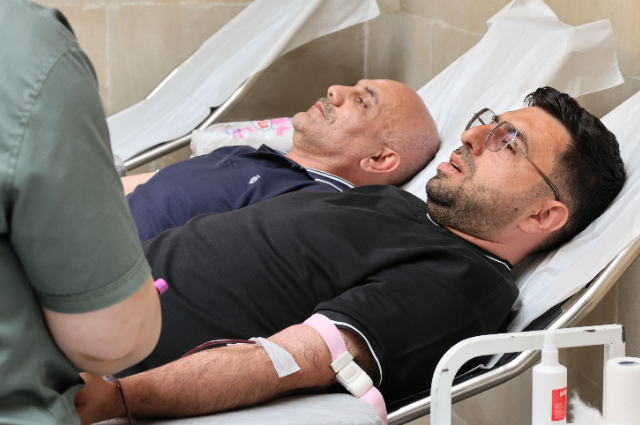
This is why what the Khandwa district administration has done at the Omkareshwar Jyotirlinga temple deserves to be treated as more than a feel-good headline. Under a new campaign, devotees who donate blood(a process that takes about 20 minutes are exempted from the standard three-to-four-hour queues and granted direct VIP entry. The logic is elegantly simple: instead of money or political access, what grants you priority here is something biological, democratic, and of genuine civic value. The pilot project was implemented in February and has led to a rise in blood donations in the district hospital in Khandwa from 15–20 units to 200 units per day. That is not a marginal improvement. That is a public health intervention disguised as a pilgrimage incentive.
The numbers are striking. By June 14, 497 units of blood had been collected, compared with 168 units collected during the programme’s initial phase. The donations surged particularly during the Hindu month of Adhik Maas. A five-bed blood collection facility has been set up near the temple complex, and donors receive refreshments, a certificate, Baba’s Prasad, and a photograph of Lord Omkareshwar. The certificate grants the donor and their family immediate VIP entry, sparing elderly relatives and children the inconvenience of long queues. State officials are now examining whether similar programmes could be rolled out at other major temples across Madhya Pradesh.
To understand why this matters, one must first understand how badly India needs blood and how poorly the current system serves that need. As of 2022, the annual shortage of blood in India was estimated at one million units. Over 80 per cent of primary healthcare centres lack blood storage facilities, and the sector remains largely unorganised and fragmented, with no real-time centralised data on blood availability between hospitals. While the national collection figures improved significantly, India collected 14.6 million units in 2024–25, exceeding national demand. The same period saw research mapping vast blood deserts across northern India, where timely transfusion remains practically impossible for millions of people. Madhya Pradesh, crucially, is among the eight Empowered Action Group states identified as having the worst access gaps. Only about 26 per cent of residents in these states reside within 30 minutes of a blood bank.
In this geography, pilgrimage gatherings become uniquely strategic moments. Lakhs of people, many of them adults in the 18–60 age bracket, many of them healthy enough to have undertaken physically demanding travel, converge at a single point. Their visit is already embedded in a framework of sacrifice, seva, and giving. Religious organisations, educational institutions, and community groups have historically been among the most responsive to voluntary blood donation drives in India. What Khandwa has done is simply formalise this tendency and attach it to the one thing every pilgrim desperately wants: unobstructed access to the divine.
The ethics of incentivised blood donation deserve scrutiny, but they hold up better here than one might expect. The WHO’s standard objection to incentivised donation that financial rewards attract donors who lie about their health status does not apply cleanly in this case. The reward on offer is not money. It is a queue bypass at a temple, redeemable only if you are already there on a pilgrimage. The self-selection effect is powerful: someone who has travelled to Omkareshwar, who has walked to a blood camp, who has passed the eligibility criteria of being 18–60 and weighing at least 45 kilograms, is unlikely to be the high-risk donor that coercive incentive systems attract. This is closer to community persuasion than commercial inducement.
The comparison to the existing VIP darshan system across India makes the Omkareshwar model look even better. At the Tirumala Tirupati Devasthanams, the number of VIP break darshans surged from 2,000 in 2014 to between 5,000 and 6,000 at peak, with recommendation letters flowing from politicians, bureaucrats, and celebrities across Andhra Pradesh and Telangana. At ₹500 per ticket, certain devotees could not only have a quick darshan but could also stay longer in front of the sanctum sanctorum, unlike regular pilgrims who get a couple of seconds. A PIL filed in the Supreme Court of India earlier this year challenged this preferential system on constitutional grounds, arguing that discriminatory access at religious sites violates the spirit of equality. Chief Justice Sanjiv Khanna acknowledged that such preferential treatment should not occur but held that the court could not issue directions under Article 32 on the matter. The system, in other words, is constitutionally awkward but legally protected.
This is precisely why the Omkareshwar model is politically and symbolically clever. It does not eliminate the category of VIP darshan; it redefines what earns it. The entitlement is no longer transmitted by a minister’s letter, a ₹500 ticket, or a Bollywood actor’s publicist. It is earned in twenty minutes, from your own vein, for the benefit of a stranger in a district hospital who may be haemorrhaging after a road accident or delivering a baby in a high-risk pregnancy. The transaction is still transactional, but it is one that the state can defend in public, before courts, and before God.
There are critiques to be made, and they should be made honestly. The scheme works partly because the religious calendar in this case, Adhik Ma, creates a captive, motivated crowd. Outside peak seasons, or at temples with smaller footfall, the model may not generate the same volumes. There is also the question of who benefits: devotees with underlying health conditions, pregnant women, or those on certain medications are ineligible to donate, and they remain locked out of the VIP entry even though their inability is medical, not motivational. A parallel pathway for such devotees,ees perhaps involving other forms of social contribution, would make the scheme more inclusive and less accidentally discriminatory against the chronically ill, the elderly, or the immunocompromised.
There is also a longer institutional question. India’s blood system remains vulnerable to seasonal and regional fluctuations, with most donations being reactive rather than regular. National drives attract new donors, especially students, but repeat donation rates remain low. The Omkareshwar scheme addresses the volume problem in a specific geography during a specific pilgrimage window. It does not, by itself, solve the deeper behavioural challenge of building a culture of year-round, voluntary, repeat donation. For that, the state needs concurrent investment in donor registries, follow-up systems, and the kind of sustained community outreach that turns a first-time temple donor into someone who returns to the blood bank in six months.
But these are arguments for expansion and refinement, not against the scheme itself. If Madhya Pradesh scales this initiative to other Jyotirlingas, to Mahakaleshwar in Ujjain, to the Amarkantak shrines, to the dense pilgrimage circuits of Chitrakoot,t the cumulative effect on rural blood availability in one of India’s most underserved states could be significant. The Sant Nirankari Mandal in Delhi collected 1,321 units in a single blood donation camp during a spiritual congregation. The Indian Red Cross has long noted that religious gatherings are among the most productive environments for blood collection drives. The difference with Omkareshwar is that the state administration has embedded the incentive into the temple’s own access infrastructure rather than treating it as a peripheral camp outside the gates.
What the Khandwa district administration has stumbled upon, or more likely deliberately engineered, is a convergence that Indian public health has long failed to achieve: the meeting of faith and civic infrastructure at the same point of motivation. The devotee who donates blood is not donating it for the state. They are donating it for God, for merit, for the 20 minutes that earn them the sanctum. The state simply intercepts that devotion and redirects it toward a plasma bag that will reach a patient in Khandwa district hospital before the devotee’s bus reaches home.
That is not cynicism. That is governance,e and in a country where public health campaigns have for decades struggled against apathy, superstition, logistical inaccessibility, and the sheer noise of competing urgencies, using the architecture of faith to move blood from willing bodies to critical patients is not manipulation. It is, quietly and without fanfare, one of the smarter things a district administration has done in recent memory.
References:
- India.com — Is Omkareshwar Temple providing ‘VIP darshan’ in exchange for blood donation? https://www.india.com
- Deccan Chronicle — MP Mulls Offering VIP Darshan to Devotees for Voluntary Blood Donation https://www.deccanchronicle.com
- My Pune Pulse — Can Devotees Get ‘VIP Darshan’ at Omkareshwar Temple by Donating Blood? https://www.mypunepulse.com
- Wikipedia — Blood donation in India https://en.wikipedia.org/wiki/Blood_donation_in_India
- ORF Online — Securing India’s Lifeblood For A Reliable National Blood Supply https://www.orfonline.org
- PLOS One / PMC — The clinical demand and supply of blood in India: A national-level estimation study https://pmc.ncbi.nlm.nih.gov/articles/PMC8986005/
- BMJ Global Health / PMC — Defining blood deserts and access to blood products for 660 million people https://www.ncbi.nlm.nih.gov/pmc/articles/PMC11499795/
- The Federal — Tirumala temple board abolishes ‘VIP darshan’ at Tirupati shrine https://thefederal.com
- NativePlanet — Tirumala Temple’s VIP Break Darshan Policy Faces Increasing Backlash https://www.nativeplanet.com
- LawChakra — VIP Darshans at Temples: CJI Sanjiv Khanna Refuses to Hear PIL https://lawchakra.in
- WHO India — India strengthens blood safety for universal access https://www.who.int
- Indian Red Cross Society — Blood Services Programme https://www.indianredcross.org/ircs/program/bloodbank/