
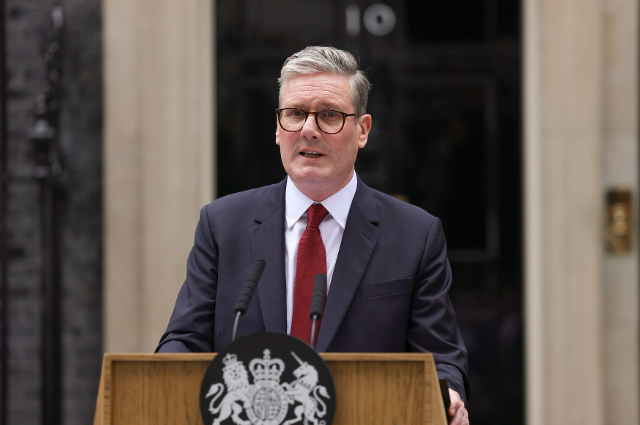
On the morning of June 22, 2026, Keir Starmer walked out of 10 Downing Street, stood before the same lectern that has seen five prime ministerial exits in the past seven years, and announced that he was stepping down. It was a quiet, almost procedural ending to what had begun less than two years earlier as one of the most emphatic mandates in modern British political history, a landslide victory in July 2024 that handed Labour a majority not seen since the Blair years. Starmer's fall is not merely a story about one man's political misjudgement. It is a case study in how hyper-local anger, magnified through the mechanics of Britain's council election system, can travel upward with startling speed and dislodge a national government that still, on paper, commanded a working majority in Parliament.
The local elections that started the unravelling
The proximate cause was not a general election defeat but a local one. On May 7, 2026, England went to the polls for over five thousand council seats across 136 local authorities. The results were, by any measure, catastrophic for Labour. Reform UK, Nigel Farage's populist right-wing party, won 1,453 council seats, an increase of 1,451 on its previous tally and took control of 14 councils outright. Labour, by contrast, lost 1,496 seats and control of 38 councils, including boroughs it had held for decades, such as Newham, under continuous Labour rule since 1971. Psephologists Colin Rallings and Michael Thrasher calculated that Labour lost 59 per cent of the seats it was defending that night, and that its projected national vote share had fallen to just 15 percent, its lowest in a forty-year series of local election data and a nineteen-point collapse from the 34 percent it had recorded in the 2024 general election. Political analyst John Curtice described the results as "bleak" for Labour, noting they confirmed the fragmentation of British politics rather than a simple swing from one major party to another.
What made the results especially damaging was not just their scale but their symbolism. Reform's gains came disproportionately in the old industrial metropolitan boroughs, the very seats that once formed Labour's electoral bedrock in the north of England and the Midlands. Nearly 800 of Reform's new councillors came directly at Labour's expense, giving the party outright majorities on eight metropolitan councils. For a governing party less than a year removed from a landslide, the message from its own traditional base was unambiguous: something had broken.
The chain of events between May and June illustrates how quickly intra-party pressure can compound. Within a week of the local election results, Health Secretary Wes Streeting resigned from cabinet on May 14, and more than a hundred Labour MPs were reported to have either called for Starmer's resignation or refused to publicly back him, according to tallies compiled by LabourList. A fragile truce followed, with over 150 MPs signing a unity statement urging colleagues to focus on rebuilding public trust rather than infighting. But the peace did not hold. In June, Defence Secretary John Healey's abrupt resignation, followed swiftly by that of Armed Forces minister Al Carns over a dispute concerning defence investment plans, reignited the crisis at the worst possible moment.
The decisive manoeuvre came from Andy Burnham, the Mayor of Greater Manchester, who had built a national profile as a plain-spoken northern Labour figure often positioned to Starmer's left. Because Burnham held no seat in the House of Commons, sitting Makerfield MP Josh Simons resigned on May 14 specifically to create a vacancy,y the first time since the 1965 Leyton by-election that a by-election had been engineered to open a parliamentary seat for someone not yet in Parliament. Burnham won the June 18 contest with a majority exceeding 9,200 votes, comfortably beating expectations. His arrival in the Commons effectively completed the mechanism by which he could challenge Starmer directly, and within four days, Starmer had resigned.
In his resignation statement, Starmer was notably restrained, avoiding blame or bitterness. "The question my party is asking now is whether I am best placed to lead us into the next general election," he said outside Downing Street. "I have heard the answer of my parliamentary party to that question, and I accept that answer with good grace." It was a telling formulation: Starmer did not concede that voters had rejected Labour's programme, but that his own parliamentary colleagues had lost confidence in him as a messenger. That distinction matters. Britain's parliamentary system allows a prime minister to be removed by internal party mechanics without a general election, a fact Starmer himself had once criticised when the Conservatives cycled through Liz Truss and Rishi Sunak without consulting voters. Kemi Badenoch, the Conservative opposition leader, seized on precisely this irony, accusing Labour of leaving the country ungoverned for weeks while Burnham "wants a summer holiday."
Starmer will remain in office in a caretaker capacity until Labour selects a new leader, with nominations opening on July 9 and a contest, if one materialises, expected to conclude before Parliament's summer recess. Burnham is the overwhelming favourite; Streeting, once seen as his most credible rival, has already endorsed him, saying there is "a place" for his own ideas "under his leadership." Barring a late challenge, Britain looks set to have its seventh prime minister in a decade, a pace of turnover that even seasoned observers of Westminster describe as extraordinary for a parliamentary democracy not currently facing war or economic catastrophe.
For observers in India, where local body elections are often dismissed as parochial affairs disconnected from national politics, the British case offers a useful corrective. Local elections are frequently the first place where economic discontent, a sense of institutional drift, or anger over specific local failures, housing, immigration pressure, or the cost of living, finds an outlet before it reaches national polling. Reform UK's rise was not built in Westminster; it was built ward by ward, council by council, in exactly the kind of contests that national commentators often ignore. Starmer's landslide of 2024 always rested on a coalition assembled more out of exhaustion with fourteen years of Conservative rule than enthusiasm for Labour itself, and that coalition proved to have remarkably shallow roots. His resignation is a reminder that a parliamentary majority, however large, is not the same thing as a mandate that renews itself automatically; it must be maintained, ward by ward, or it can collapse just as quickly as it was won.
References:
- CNN, Keir Starmer resignation, UK to get sixth PM in seven years (June 22, 2026): https://www.cnn.com
- Al Jazeera, Why has Keir Starmer resigned as UK prime minister, and who will take over?: https://www.aljazeera.com
- ABC News, UK Prime Minister Keir Starmer announces resignation with 'good grace': https://abcnews.com
- Wikipedia, 2026 Labour Party leadership crisis: https://en.wikipedia.org
- Wikipedia, 2026 United Kingdom local elections: https://en.wikipedia.org
- Local Government Chronicle, Rallings & Thrasher: How Labour fell to historic defeat: https://www.lgcplus.com