
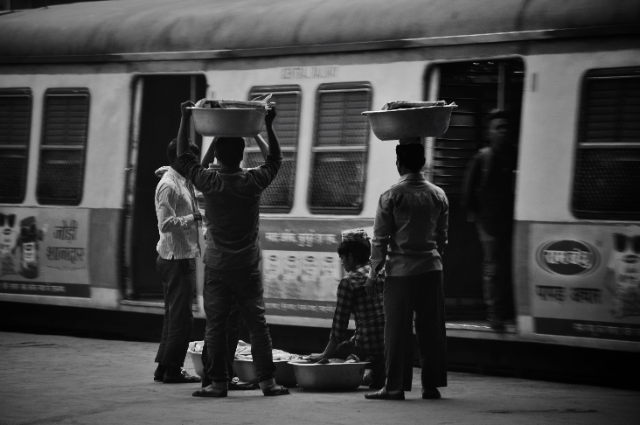
There is a particular cruelty to the way Mayank Lohar died. Not the stabbing itself, though that was brutal enough: a blade driven into the abdomen of a 22-year-old salesman somewhere in the dark, rain-lashed stretch of track between Andheri and Borivali. The cruelty lies in the banality of what triggered it. A door. Whether it should be open or shut on a monsoon night. That is the entire, absurd provocation that ended a young man’s life on the first-class compartment of Train No. 90663, the Churchgate–Nallasopara fast local, somewhere past 10 pm on a Tuesday that also happened to mark the arrival of monsoon in Mumbai this year.
According to the Government Railway Police, Lohar, a resident of Virar who worked as a salesman in Andheri and was simply trying to get home, asked a fellow passenger to close the coach door as rain lashed in. The other man, later identified by police as Sachin Ramesh Suvarna, 30, did not take kindly to the request. What followed was an argument, then a knife, then a body slumped in a compartment racing through the suburbs at speed, and an accused who leapt off onto Platform No. 6 at Borivali before the train had even fully halted, vanishing into the crowd that swallows everything in this city. He was traced and arrested hours later at Kurla, after police scanned footage from nearly 400 CCTV cameras across the network; a manhunt as extensive as the crime was sudden.
Borivali GRP has registered a murder case. Railway authorities say they are cooperating fully. These are the procedural facts, and they will, in time, run their course through India’s notoriously slow judicial machinery. But procedure is not what should occupy us here. What should is the question of why, in a city that prides itself on the resilience and discipline of its commuting millions, an argument over a train door, surely the most mundane friction point imaginable, has become a plausible enough precondition for murder.
This is not an isolated aberration. It is, distressingly, the second such stabbing on the Western Railway suburban network this year alone. In February, Alok Singh, a 32-year-old lecturer at a college in Vile Parle, was allegedly stabbed during an altercation while trying to disembark at Malad station. The accused in that case, Omkar Shinde, was arrested soon after. Two stabbings in six months, both born of nothing more than the friction of bodies and tempers packed too close together for too long. The pattern is not coincidence. It is structural, and Mumbai’s suburban railway is the structure.
To understand why a closed door can become a murder weapon’s pretext, one has to understand what a Mumbai local actually is at rush hour, or even at 10 pm on a rainy weeknight. The network carries roughly eight million passengers a day across some 400 kilometres of track, making it the busiest commuter rail system on the planet. It is also, by a wide margin, one of the deadliest. The Bombay High Court itself flagged this in scathing terms last year, noting that 2024 alone saw 3,588 commuters killed on Mumbai’s suburban network, an average of nearly ten deaths every single day, most from falls, electrocution, and people being struck while crossing tracks born of sheer overcrowding. Over the two decades between 2004 and 2024, close to 66,500 lives were lost on this “lifeline,” a euphemism that has long curdled into something closer to a sentence.
Against that backdrop, a man being knifed over a train door stops looking like an anomaly and starts looking like an inevitability. When a system routinely operates at three, four, sometimes five times its rated capacity, when commuters dangle off footboards because there is simply no room inside, when a five-minute discomfort from rainwater splashing through an open door becomes an unbearable indignity at the end of a twelve-hour workday,y tempers are not a personality flaw; they are a designed outcome. The Railways have promised redesigned coaches with vestibule access, meant to roll out by early 2026, allowing passengers to move between compartments and balance overcrowding. For commuters like Lohar, that promise arrived too late by months.
None of this is an argument for absolving Suvarna, who, if the GRP’s case holds, escalated a verbal spat into a killing with a knife he was apparently carrying onto a public train in the first place itself a quietly terrifying detail that deserves more scrutiny than it has received. Carrying a blade onto a commuter train is not impulse; it suggests either habit or a low threshold for anticipated confrontation, both of which point to a wider, uncomfortable normalisation of being armed in transit. That the Railway Protection Force and GRP, despite checkpoints and CCTV networks numbering in the hundreds at a single station alone, did not intercept a weapon before it boarded a train is its own quiet indictment.
What ought to follow this case, beyond the inevitable arrest, chargesheet, and the news cycle’s brief outrage, is an honest reckoning with the conditions that keep producing these flashpoints. Mumbai’s commuters have absorbed, for two decades, a level of daily physical risk that would be considered an emergency anywhere else in the world. Falling to death from a footboard, being struck while crossing tracks, drowning in flooded subways during the monsoon these have all, over time, been filed away as the ordinary cost of getting to work in this city. A stabbing over a shut door is simply the latest, starkest expression of a system that has trained its users to treat each other as obstacles rather than fellow travellers, because there is rarely room, literal or otherwise, to be anything else.
Lohar’s family will want justice, and they should get it, swiftly and through the courts. But justice in the narrow sense a conviction, a sentence will not stop the next argument over the next door on the next rain-soaked evening. That requires acknowledging what Mumbai’s suburban rail has quietly become: not just a transit system but a pressure chamber, one that periodically, and now with grim regularity, produces violence as a release valve. Until that changes, the city will keep mourning young men like Mayank Lohar, and keep calling it news rather than what it really is: a symptom.
References:
- Free Press Journal, “Mumbai Local Murder Case: Accused Arrested For Stabbing 22-Year-Old Salesman To Death On Moving Churchgate-Nalasopara Train” — freepressjournal. in
- Telangana Today, “22-year-old passenger stabbed to death on Mumbai local train after argument during heavy rain” — telanganatoday.com
- NewsX, “Mumbai Local Train Horror: 22-Year-Old Allegedly Stabbed to Death on First-Class Coach After Dispute Over Closing Door” — newsx.com
- The Tribune, “Mumbai horror: 22-year-old stabbed to death on local train after fight over keeping doors open during rain” — tribuneindia.com
- Think Global Health, “Why Mumbai’s Overcrowded Trains Prove Fatal” — thinkglobalhealth.org