
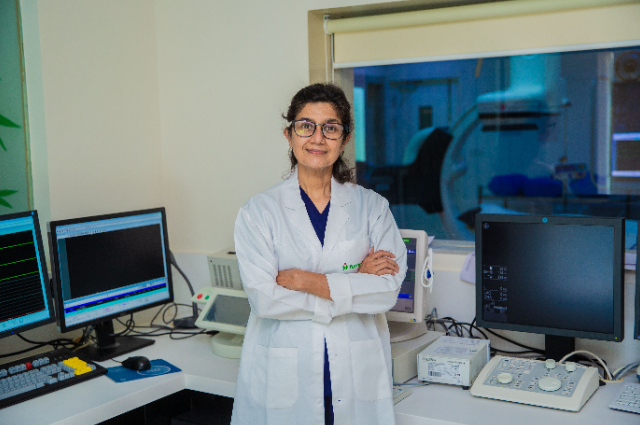
Bengaluru: In a country where career trajectories are largely expected to follow a single, unbroken line, the story of Janhavi Ajit Rao reads like a quiet act of rebellion. At an age when most professionals are consolidating decades of expertise, Rao chose to dismantle hers entirely, walking away from a successful 18-year run as a software engineer and entrepreneur to begin, quite literally, at the bottom of a medical school classroom.
Rao was born and raised in Aurangabad, Maharashtra, before her academic path took her to the United States. She completed a Bachelor of Science in Electrical Engineering from the University of California, San Diego, followed by a Master of Science in Electrical Engineering from the University of California, Santa Barbara. What followed was a career that, on paper, needed no reinvention. She spent close to two decades in the information technology sector, working as a software engineer in both the United States and India, and built a career marked by professional stability and a well-established path forward.
In 2002, she relocated to Bengaluru with her husband, who is also an engineer. It was here that her professional identity took its next turn, not towards medicine yet, but towards entrepreneurship. She went on to found her own company, serving as Director at Spectranta Systems from 2009 to 2015, a Bengaluru-based defence electronics startup she established after a career at Wipro. By most conventional measures, Rao had already built the kind of career many spend a lifetime chasing.
It was a personal health crisis, not a professional one, that quietly set the next chapter in motion. Rao was diagnosed with rheumatoid arthritis, an autoimmune disease, in 2003. The diagnosis placed her, for the first time, on the receiving end of medical care rather than at a comfortable distance from it. During her treatment, she witnessed how doctors changed patients’ lives, and that experience inspired her to leave engineering behind and dedicate herself to medicine. It was not an epiphany that translated into immediate action. The seed, as it often does, took a decade to germinate into an actual decision.
That decision arrived in 2013, when Rao was 40 years old. She enrolled for MBBS at M.S. Ramaiah Medical College in Bengaluru, walking back into a classroom after nearly two decades away from formal study. The adjustment was neither symbolic nor easy. She found herself relearning anatomy, physiology and medicine alongside students who were almost half her age, a transition that demanded long hours of study, practical training and examinations, all while starting an entirely new career from scratch.
There is a particular kind of discomfort in being the oldest person in a room built for the young, and medical school in India is not designed with accommodation for career-changers in mind. Returning to academic life after nearly 18 years in another profession required discipline and a willingness to start from the very beginning, and medical education, demanding for students of any age, asked even more of someone re-entering it later in life. Rao’s response to that pressure was not dramatic reinvention of self but sustained, unglamorous consistency. She stepped back into student life with determination, focusing entirely on her medical education despite the challenges of restarting so late.
The MBBS degree, when it finally came, was the product of eight years of sustained effort. After completing her medical studies and clinical training, Rao earned her MBBS degree following approximately eight years of work. For context, a standard MBBS programme in India runs closer to five and a half years, including internship. That Rao’s path stretched longer speaks less to any deficiency and more to the reality of navigating a rigorous professional course as an adult with a life, and likely a household, to manage alongside her studies.
Qualifying as a doctor was not the endpoint. Rao returned to the United States to continue building her medical career, choosing the demanding route of postgraduate specialisation over settling for a general practice licence. She completed her residency in Internal Medicine at Riverside University Health System, training there from July 2021 to June 2024. She has since moved into a formal clinical role. She is currently serving as a Primary Care Physician at the U.S. Department of Veterans Affairs in San Diego, California, a position she has held since September 2024. At 47, she is simultaneously pursuing her MD while continuing her work as a primary care physician in the United States.
Rao’s story surfaced in the public eye almost by accident, carried not by a press release or an institutional profile but by a single social media post. The account was first shared on X, summarising her path from software engineer to MBBS student to practising physician, with a note pointing readers to her professional profile for verification. The post, and Rao’s story with it, went viral, with many online praising her courage and holding her up as proof that it is never too late to begin a new chapter.
What makes the story resonate beyond the algorithm-driven churn of viral content is the specific texture of the trade-off Rao made. She did not pivot from one adjacent technical field to another, the kind of lateral move that software engineers occasionally make into product management or academia. She chose a path that required starting over entirely, giving up an established position in one field to rebuild, from the ground up, an entirely different one centred on healthcare and patient care. Engineering and medicine share little beyond a demand for rigour. One trains a person to build systems; the other asks them to sit with human fragility, arthritis flare-ups and all, daily.
There is also a quieter thread running through Rao’s story that is easy to miss amid the “age is just a number” framing that has dominated its retelling online. Her decision was rooted in illness, in the particular vulnerability of being a patient with a chronic autoimmune condition, and in what that vulnerability revealed to her about the value of the care she was receiving. That is a different kind of motivation from ambition or restlessness. It suggests a decision made not to prove something to herself or to others, but because a specific, lived experience changed what she understood a meaningful working life to look like.
For a country whose medical education system is often criticised for being narrowly gatekept by age, marks secured straight out of school, and rigid entrance-exam cutoffs, Rao’s trajectory, however exceptional, is a reminder that professionals exist outside that funnel. Her second career was not built on a shortcut. It was built on eight years of examinations and clinical rotations undertaken well past the age at which most of her peers had already completed theirs, and on a residency completed in a foreign healthcare system afterwards. Whatever else her story has become online, in bracketed captions insisting that “age is just a number,” what it actually documents is far less catchy and far more instructive: that sustained, structured perseverance, however late it begins, can still arrive at expertise.
References:
- https://news24online.com
- https://hunterfly.in
- https://newsable.asianetnews.com
- https://x.com/VikasAlwys/status/2073036367979041040
- https://www.oneindia.com