
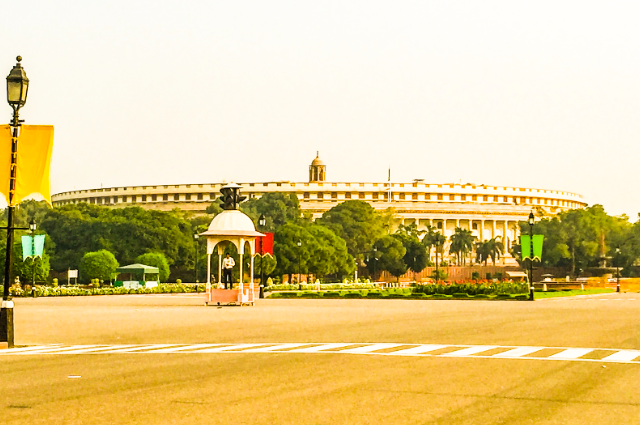
The winter session of the 18th Lok Sabha had been adjourned forty minutes before the first shot was fired. Both the Rajya Sabha and Lok Sabha had been adjourned roughly forty minutes before the incident, yet more than a hundred people, including major politicians and government officials, were still inside the Parliament building. Among them, as later confirmed, were Home Minister L.K. Advani and Foreign Minister Jaswant Singh. The building was not empty. It was merely quieter than usual.
It was into this quiet that a white Ambassador drove, bearing a red beacon light and two stickers, one reading "Parliament," the other "Home Ministry." The car bore the license plate number DL 3C J 1527 and drove toward Gate No. 1 from Vijay Chowk. On any other morning, that combination of markings would have been sufficient. Sufficient, that is, for anyone who was not watching the car the way Constable Kamlesh Kumari Yadav was watching
She noticed it was moving too fast. The protocol required VVIP vehicles to slow down as they entered the compound. This one did not. As the Ambassador crossed the gate, instead of slowing down as protocol demanded, it suddenly accelerated. Kamlesh Kumari noticed the unusual behaviour immediately. She was unarmed, carrying nothing except a walkie-talkie. The reason for that last detail is one the country has not examined nearly enough: at the time, despite the CRPF having women's battalions, female constables deployed at Parliament were not issued weapons.
She ran back to her post, sealed the gate, raised the alarm on her wireless set, and alerted every colleague within range. This single act triggered an immediate security response. Parliament's heavy wooden doors were shut. Internal gates were sealed and then the terrorists, their cover broken and their vehicle blocked, opened fire. Kamlesh Kumari absorbed eleven bullets. She became, as every subsequent account would confirm, the first victim of the Parliament attacks in 2001. Tfipost The Better India She was thirty-two years old.
The Attack and Its Arithmetic
On December 13, 2001, terrorists from Lashkar-e-Taiba and Jaish-e-Mohammed attacked the Indian Parliament, resulting in ten deaths and multiple injuries. The five men in the Ambassador, carrying a heavy cache of assault rifles, grenades, a grenade launcher, handmade bombs, spare ammunition, and a large bomb made of ammonium nitrate, had come to kill as many elected representatives as they could reach.
In an intense exchange of fire between the CRPF and the militants which lasted approximately thirty minutes, all five militants were eliminated. What that condensed sentence does not say is how close the outcome came to being something else entirely. It was Constable Sukhwinder Singh, alerted by Kumari's actions, who perceived one of the terrorists was wearing a suicide bomb and shot him. The bomb exploded, killing the terrorist and saving the lives of many others. Constable Santosh Kumar gunned down three of the five terrorists. The coordination that morning was the product not of a formal plan but of one woman's alarm, transmitted through a walkie-talkie, rippling outward in the seconds that remained.
The official death toll of nine killed, comprising six Delhi Police personnel, two Parliament Security Service personnel, and a gardener, does not quite capture the alternative. Over one hundred elected representatives, ministers, and staff were inside the complex. Home Minister Advani was in the building. The attackers' explicit goal, as per intercepted communications and group ideologies, was to provoke war by striking the political heart of India. They came within one gate of achieving it.
Constable Kamlesh Kumari joined the CRPF in 1994 and was first posted with the elite 104 Rapid Action Force in Allahabad. Soon after, she was posted at the 88 Mahila (Women's) Battalion on 12 July 2001. Kumari became part of Bravo Company, the group tasked with securing Parliament when in session.
The 88 Mahila Battalion was, and remains, one of the CRPF's all-female units. The force currently operates six Mahila Battalions across its 246 battalions, a number that reflects both how far the institution has come and how small that share still is. In 2001, when Kamlesh Kumari was posted to Parliament duty, women constables performed frisking and checking of female visitors’ roles considered appropriate, and therefore also roles in which they were not thought to require arms. That policy decision, made far above her pay grade, is the structural fact that sits beneath every account of that morning: she ran toward five men carrying AK-47 rifles and grenade launchers with a walkie-talkie in her hand because the institution had not thought to give her anything else.
She was from Sikanderpur, Kannauj, in Uttar Pradesh. She and her family had been living in Vikaspuri, Delhi. She is survived by her husband Avdhesh Yadav and two daughters, Jyoti and Shweta.
The Award and Its Aftermath
As of 2026, there have been 87 recipients of the Ashoka Chakra, of which 68 have been posthumous. Only two women have ever been awarded the honour: flight attendant Neerja Bhanot in 1987, and police constable Kamlesh Kumari in 2001. Neerja Bhanot, who died shielding passengers during the hijacking of Pan Am Flight 73 in Karachi, was the first; she remained the youngest recipient of the award until 2003. Kamlesh Kumari became the second and, specifically, the first woman police officer from India's central armed police forces to receive the honour, following Neerja Bhanot's 1987 award for civilian actions during a hijacking.
The award was presented on Republic Day, 2002. Constable Kamlesh Kumari was posthumously awarded the nation's highest peacetime gallantry award, the Ashoka Chakra, by the President of India, K.R. Narayanan, in honour of her bravery and courage. Prime Minister A.B. Vajpayee also paid tribute to her.
The aftermath did not stay ceremonial. Mohammad Afzal, determined to have played a key role as a conspirator in the attack, was convicted and sentenced to death by the Supreme Court of India. His family had camped in New Delhi with the hope of conveying a mercy petition to then President Dr A.P.J. Abdul Kalam. In response, Kamlesh's surviving family publicly declared that they would return the Ashoka Chakra if the President were to accept the petition. The families of eight security officials honoured for their bravery during the attacks, including Kamlesh's, returned their gallantry medals on 13 December 2006, in protest at the delay in execution. Afzal Guru was eventually hanged in February 2013, more than eleven years after the attack.
That her family returned the medal is not a minor biographical footnote. It is evidence that what she died for did not recede for them into abstraction. The Ashoka Chakra is a wheel of Ashoka, the same motif at the centre of India's national flag. For a family from Kannauj, Uttar Pradesh, to hand it back to the government and demand that the state act on its own verdicts was an act of civic pressure that rarely comes from a household still in grief.
What the Structural Record Shows
The 2001 Parliament attack produced immediate security reviews, and the CRPF was formally designated India's primary internal security force in its aftermath. In 2001, following a recommendation by a Group of Ministers, the CRPF was designated as the primary internal security force in the country. The question of whether women paramilitary personnel should be armed at sensitive postings was less loudly addressed, though it is a question that December 13 put on the table in the starkest possible terms.
The policy of deploying unarmed women constables at Parliament was not a lapse in the conventional sense. It was a consequence of institutional assumptions about what female personnel were for and where their duties ended. Those assumptions cost Kamlesh Kumari her life. They are also, in their way, what made her action remarkable: she fulfilled a duty her institution had not fully imagined for her, using only the resources it had seen fit to provide.
The CRPF's own website, under its milestones of bravery, describes December 13, 2001, in these terms: "A Mahila Constable displayed extraordinary courage and presence of mind, making the ultimate sacrifice in the line of duty." Passive construction is unintentional but accurate. She made the sacrifice. The line of duty was, in part, a line that her institution had drawn around her, and she crossed it.
The Smaller Truth
Twenty-four years on, the 2001 Parliament attack is most often recalled through its legal and diplomatic consequences: the trial of Afzal Guru, Operation Parakram, and the near war with Pakistan. These are not small matters. But they are also consequences of things that happened because of what was, in its origins, a security breach stopped by one unarmed woman at an iron gate.
The five terrorists came equipped for mass slaughter inside a building where India's democratic government convened. They were stopped at the perimeter. Kamlesh Kumari's actions were instrumental in limiting the attack outside the building, indirectly protecting the Home Minister and Foreign Minister, among others. The distinction between what happened- nine dead, all five attackers killed, no elected representative harmed- and what was intended is the measure of what she did.
She had no weapons. She had a walkie-talkie, seven years of service, and whatever combination of training, instinct, and nerve it takes to run toward a car full of armed men and close a gate behind you. The Ashoka Chakra citation spoke of valour and self-sacrifice. Both are accurate. What is also accurate is simpler: she did her job. She did it completely. She did it under conditions her institution had not prepared her for, with equipment her institution had not thought to give her.
Iron Gate No. 1 was held. That is the whole record.
References
- Wikipedia — Kamlesh Kumari Yadav: https://en.wikipedia.org
- The Better India — Story of Kamlesh Kumari, 1st Policewoman to receive Ashok Chakra: https://thebetterindia.com
- India TV News — With no weapons, just a walkie-talkie in hand: https://www.indiatvnews.com
- TFI Post — Parliament Attack Anniversary: Remembering CRPF Braveheart Kamlesh Kumari: https://tfipost.com
- Wikipedia — 2001 Indian Parliament Attack: https://en.wikipedia.org
- Wikipedia — Ashoka Chakra (Military Decoration): https://en.wikipedia.org
- Wikipedia — Neerja Bhanot: https://en.wikipedia.org
- CRPF Official — Milestones of Bravery: https://crpf.gov.in
- CRPF Official — About CRPF: https://crpf.gov.in
- The Better India — 2001 Parliament Attack: The CRPF Braveheart Who Stopped 3 Terrorists: https://thebetterindia.com
- Medium / Incredible India — The Story of a Brave Heart and Ashoka Chakra Awardee: https://medium.com