
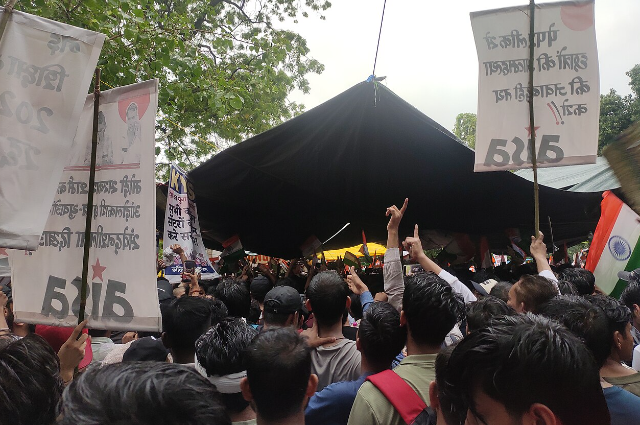
On the evening of 25th July 2026, Dharmendra Pradhan posted a two-page resignation letter on X. He did not apologise for the NEET-UG paper leak or the CBSE marking irregularities that had driven weeks of protest since the Cockroach Janata Party’s sit-in began at Jantar Mantar on 20th June, 2026. His resignation letter stated that he was stepping down so that students’ anger would not be “exploited by anti-national forces”. Nevertheless, the resignation marked a step towards accountability and within hours celebrations broke out at Jantar Mantar, with CJP founder Abhijeet Dipke raising his fist in the air, “We have done it.”
For over a month, students had marched despite baton charges and tear gas firings, while a 59-year-old education reformist went on a 26-day hunger strike on their behalf. The resignation was, therefore, read as evidence that a government had answered to street pressure, to the forces of democracy. Opposition parties called it a win for student power and the Irish Times reported that the government had “conceded all their demands”. This reading, however, was slightly premature.
A closer look at the Union Minister of Education reveals that Pradhan was not replaced. His portfolio was. Succeeding Pradhan as the Union Minister of Education is Pralhad Venkatesh Joshi, who also holds the position of the Union Minister of Consumer Affairs, Food and Public Distribution as well as the Union Minister of New and Renewable Energy. The resignation was followed by the announcement of a six-member task force chaired by Nandan Nilekani, one of the chief architects of Aadhaar, alongside a former ISRO chairman and a former Intelligence Bureau director, to recommend how to make examinations “leak-proof”. Both moves are visible, immediate and reversible.
While Dharmendra Pradhan’s resignation marked accountability, the reshuffling of the cabinet limits the resignation to just that – a symbol of accountability rather than the first step in a series of actions designed to ensure that the future of an entire generation is never up for juggling again. While the formation of a task force is required indicates an effort to reform the education system; the government announced no timeline binding it.
The one concession with real teeth, a law, has moved further than a promise. The Public Examinations Amendment Bill cleared Cabinet on 24th July, 2026, the day before the resignation, and passed the Lok Sabha on 29th July 2026 after a nine-hour, repeatedly adjourned debate. While it is not yet a law, it is genuine legislative progress, catalysed by the protest. It is waiting on the assent of the Rajya Sabha and the President, and it answers for the next leak. With respect to this leak, which claimed the lives of 11 students by suicide,e the CJP demanded compensation of 1 crore rupees per family. The government has agreed to provide a “suitable” compensation, in the words of Union Minister J. P. Nadda. However, it has not been defined by a number.
The clearest evidence that the resignation bought time rather than resolution emerged on 27th July 2026 when CJP spokesperson, flanked by Rajya Sabha MP Kapil Sibal, accused the government of stalling on its 25th July commitment to withdraw FIRs against protesters, alleging that students were still being arrested and volunteers monitored and harassed. They threatened to resume the agitation within 24 hours unless a written commitment was provided. A partial climbdown followed on 28th July at 1:00 AM. Government representatives shared withdrawal notifications for two states: Bihar and Assam, promising the rest “by tomorrow”. By 30th July, the Delhi government had clarified that the amnesty would exclude protesters with prior criminal records or anyone linked to the violence during the 20th July march on Parliament. This clarification arrived against the backdrop of Delhi Police’s identification of more than 2,800 protesters with “criminal backgrounds” and registering 13 FIR’s from that day alone. The sequencing of these events reveals the cost of each concession to the government.
Another party in this dynamic between the state, the CJP, the protesters and the police is Sonam Wangchuk, who did not wait until the complete resolution of this interchange, ending his 26-day hunger strike on the night of 23rd July, 2026, a day before Pradhan resigned, after Union ministers J. P. Nadda and Jitender Singh met him at Medanta Hospital. He had set three conditions in writing: government acknowledgement of compensation, a parliamentary discussion of accountability that would include Pradhan’s position and an unequivocal assurance against punitive action against protesters. However, he chose to end his fast on a verbal hospital room assurance. “I did not think I personally needed to secure the minister’s resignation,” he replied to critics who called his exit premature. The harder protection (for the protesters) which he had perhaps hoped would survive without him fasting for it has been tested in the last weeks.
The FIR withdrawals remain partial, issued state-by-state on the government’s own clock. The compensation remains unquantified. If the resignation was the country’s win, it is worth asking what this victory actually means for the future of the education system and therefore, the future of our country.
References:
- India’s ‘cockroach’ movement ousts education minister: NPR
- TIMELINE | From ‘cockroach’ remark to Pradhan’s resignation: How the CJP protest shook the Centre - The Tribune
- The Irish Times view on India’s protests: a turning point for Modi – The Irish Times
- Outlook Explains: From Radhakrishnan To Nilekani, Why India Is Revisiting NEET Reforms | Outlook India
- Tech titan Nandan Nilekani picked by PM Modi to fix national public examination system - BusinessToday
- What is the Anti Paper Leak Bill 2026, provisions and Law in India
- Lok Sabha passes anti-paper Leak Bill after 9-hour debate
- NEET Paper Leak: CJP Demands ₹1 Crore Compensation for Families of Suicide Victims | Outlook India
- Cockroach Janta Party warns of fresh protest if FIRs against students are not withdrawn - The Tribune
- No legal action against CJP protesters except those with criminal records: Delhi govt
- Wangchuk Denies Deal with Centre, Says Ended Fast Fearing Crackdown
- 2026 Delhi Jantar Mantar protests - Wikipedia