
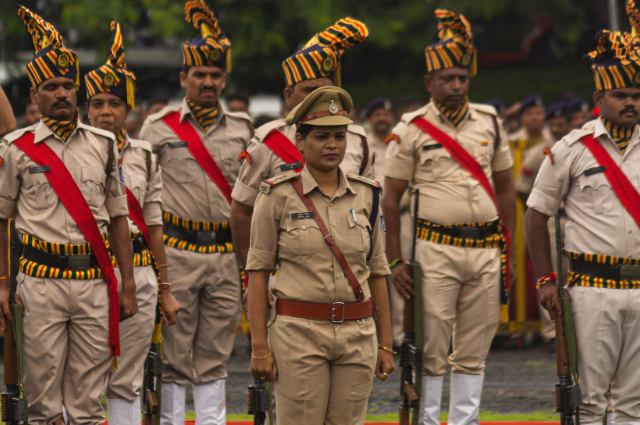
Eighteen non-bailable arrest warrants were issued against the sitting Chief Minister of Madhya Pradesh, Uma Bharti, between 2002 and 2004 in relation to the Idgah Maidan riot case. Seventeen of them went unexecuted. The eighteenth one was executed by twenty-nine-year-old Superintendent of Police (SP), Roopa Moudgil, two months into her first posting in Dharwad district.
On 25th August 2004, Uma Bharti resigned and made her appearance in a small courtroom in Hubli, Karnataka, to surrender. This was Roopa Moudgil’s first assignment as SP. Over the next two decades, she was transferred over forty times, faced a corruption complaint, a defamation suit, and a whistleblowing episode. It followed her very first act of boldness in the line of duty: arresting a sitting CM when her predecessors had left the warrants lying. However, her bold journey, even by the standards within civil services, did not begin with her first posting in Dharwad.
Her route into the police service was itself a choice against convenience. Roopa scored All India rank 43 in the 2000 UPSC examination. The score secured her a seat at the Indian Administrative Service (IAS) table. She chose IPS, and she traces her decision back to 1990, when, as a ninth-grade NCC cadet from Devangere, she represented Karnataka at a Republic Day camp in Delhi and heard Kiran Bedi address the cadets. That address imprinted on Moudgil’s young mind, and it survived fourteen years and pushed her to become the first woman IPS officer of Karnataka.
As Deputy Commissioner of Police, City Armed Reserve, in Bengaluru, she withdrew 216 unauthorised police orderlies accumulated by 81 politicians as personal staff, along with departmental SUV’s attached to a former CM’s cavalcade. The private convenience of politicians on public funding was stopped, and the resources were returned to the public departments. In 2013, she became the first woman officer in India to head a Cyber Crime division.
In July 2017, as Deputy Inspector General of Prisons, Roopa visited Bengaluru’s Parappana Agrahara Central Prison and found the AIDMK General Secretary being accorded special privileges which included a private kitchen, a corridor of five cells reserved for her exclusive use, relaxed visiting hours, and a rumoured payment of two crore rupees to jail officials to arrange it. Moudgil filed a report naming the Director General of Prisons. The news reached the press, and the government ordered a probe, which confirmed her findings in full, two years later. However, Moudgil was transferred to the traffic department. She had been the DIG of Prisons for seventeen working days.
The number is critical, and Moudgil has repeated it herself in interviews since. It captures the cost of performing one’s duty when it clashes with political authority. This pattern of transfers following an act which checks political authority and wrongdoing is not exclusive to Moudgil’s career in the Civil Service. A 2012 study by the economists Lakshmi Iyer and Anandi Mani tracing the career histories of IAS officers between 1980 and 2004 found that Indian bureaucrats face close to an even chance of transfer in any given year. Since constitutional service protections make it difficult to fire a civil servant in India, this frequency of reassignment points to the lever of control exercised by politicians over bureaucratic officers who will not fall in line. Civil servants are thus reassigned into posts of diminishing consequence. The study offers a completely new perspective on Moudgil’s over forty transfers.
However, Moudgil’s trajectory of reassignment is further complicated by claims against her and her methods of operation. In early 2023, a long-running public dispute with fellow officer Rohini Sindhuri escalated when Moudgil posted private photographs of Sindhuri on social media alongside a list of corruption allegations. Years earlier, during the Sasikala case, retired officers had commented on her emerging pattern of adopting alternative routes around institutional processes by taking a grievance to the press rather than the chain of command.
In 2025, a junior officer, DIG Vartika Katiyar, accused Modgil of directing two subordinates to plant files inside her office and photograph them, a complaint that ended with Modgil’s reassignment to the Karnataka Silk Marketing Board.
While none of this undoes the warrant executed in Hubli, or the report filed on Parappana Agrahara, it does impact the broader narrative on her career as a whole. It affects how her story is told and how her work is perceived. Her reputation rests on exposing the exploitation of power: rules bypassed, influence used for personal advantage, escaping accountability in the seat of power. Therefore, when she is herself accused of using the very same measures, even in the line of duty, it raises questions about the cost of performing one’s duty as well as whether the means justify the end. Whether these allegations are the consequence of three decades spent fighting power of the highest order or a question of the measures she had adopted to perform her duty is beyond the scope of this article.
References:
- Meet the whistle-blower cop of Karnataka -Governance Now
- The Weekend Leader - Story of supercop Roopa Moudgil, IPS officer of Karnataka cadre
- Karnataka IPS row: Roopa Moudgil is now Silk Marketing Board Ltd MD
- Roopa IPS vs Rohini IAS: Allegations fly thick & fast between Karnataka officers
- content