
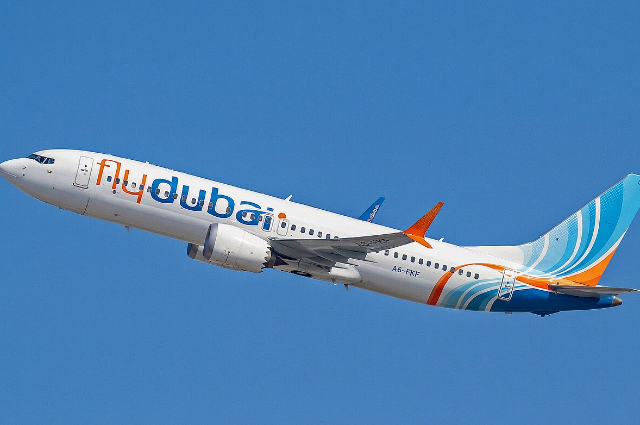
Post 9/11, aircraft were modified to enable cockpit crew to lock the cockpit from inside. While this move towards greater security of air travel was considered controversial, the near-catastrophe of the Flydubai flight FZ1073 proves a strong case in point against the security provided by this measure. The incident appears as the perfect illustration of terrorism as a multi-headed snake which can never be completely beaten, but only repeatedly thwarted and defeated.
On 30th September, 2026, Flydubai flight FZ1073 took off from Dubai to Tel Aviv. Two hours into the flight, the co-pilot, an Omani national, attacked the pilot, Cpt. Smit Machchhar, an Indian national, with a crash axe. According to passenger witnesses, a tussle ensued which drew the attention of an Israeli mother who was leading her daughter to the washroom. She hailed the attention of the cabin crew. Meanwhile, the pilot managed to unlock the cockpit, enabling three male passengers to barge in and prevent the attacker from destroying the instruments and control tools. However, the aircraft was descending, losing altitude. One of them held the attacker in a chokehold and dragged him out of the cockpit. Another attended to the injured captain, and one of them, a plumber, managed to regain control of the aircraft, which had dropped 17,000 ft within minutes. It is unclear who raised the distress signals, but within minutes of the descent the transponder began squawking the general distress signal 7700. The aircraft steadied at roughly 15,000 ft. This was followed by the second signal, 7500 for unlawful interference. Finally, a reserve crew travelling in the flight took control of the cockpit and landed the aircraft safely in Tabuk, in northwestern Saudi Arabia.
Cpt. Machchhar received praise and appreciation from Israeli Prime Minister Benjamin Netanyahu as well as Indian Prime Minister Narendra Modi. American President Donald Trump credited the Israeli plumber for taking control of the aircraft. Captain Machchhar was airlifted to Abu Dhabi and, according to reports from the Indian Embassy, is recovering well. The investigation, led by United Arab Emirates is underway. However, Colin Clarke of The Soufan Centre said to The Guardian that “The odds that a pilot would decide to commit suicide and just happen to be flying a plane full of Israelis are pretty low”.
While discrepancies in the minute details of the sequence of events await resolution in official investigation reports, the incident illustrates a collective rescue response.
Two unclear details stand out as focal points in the incident. The first is the assignment of an Omani first officer to the flight. The second concerns how the cockpit door was opened, eventually leading to the rescue.
The attacker, Hamam al-Hammami, a 29-year-old Omani citizen and according to the UAE’s Attorney General, the investigation confirmed that he attempted a terrorist act. While his nationality drew attention over the last few days owing to the absence of any diplomatic ties between Oman and Israel, unnamed sources stated that Oman had earlier banned Hammami from flying over concerns about his radical views. This raises concerns over information exchange and due process in pilot screening, processes which are critical not only for sensitive routes but under ordinary circumstances, too.
While the Israel-UAE agreement did not require pilots to come from countries maintaining ties with Israel, it is unclear whether a separate security arrangement did contain such stipulations. On the other hand, according to Transport Minister Miri Regev, Flydubai violated the aviation agreement by assigning the Omani co-pilot to the sensitive route.
Considering the degree of risk in air travel, being a pilot is not professionally adjacent to being a lawyer or a chartered accountant. It requires greater integrity and strength of character against radicalism and a strong moral compass. Being a pilot is no longer limited to aviation training but one requiring other values which make the crew worthy of holding lives in their hands, literally. This discourse on nationality-based-screening is further complicated by what happened on Germanwings flight 9525. In 2015, A German, flying for a German airline, locked the captain out of the cockpit and flew the Airbus into the Alps, killing 150 people. This was not an act of terror, but the underlying fact remains the same: that the lives of all aboard an aircraft rest solely and completely in the hands of the cockpit crew.
The second focal point in the incident was the rescue, which would not have been possible without access to the cockpit. It is disputed whether the injured captain opened the door from inside or if the crew outside opened the door using the access code. In any case, the fact remains that it was access through that door that saved lives. It highlights the criticality of procedures that keep a check on the pilots because extremist views and psychiatric illnesses can be kept from employers. This is where the design of the door and the engineering behind it becomes heroic.
It’s difficult to wrap one’s head around the fact that the safety feature of a door could lead to questions of morality, and yet, I wonder if the engineers designing cockpits feel the burden of designing and constructing the difference between life and death.
References:
- Israeli officials to question co-pilot of flydubai flight, source says | Reuters
- Suicide by plane or terrorism? Speculation over motive in flight 1073 attack | Flydubai plane incident | The Guardian
- What we know about stabbing on Flydubai flight to Israel
- FlyDubai Attacker Was Banned From Flying by Oman | What’s News for Oct. 2 - WSJ
- https://www.aljazeera.com
- https://www.ynetnews.com/article/byjyjso5mx
- https://www.adn.com