
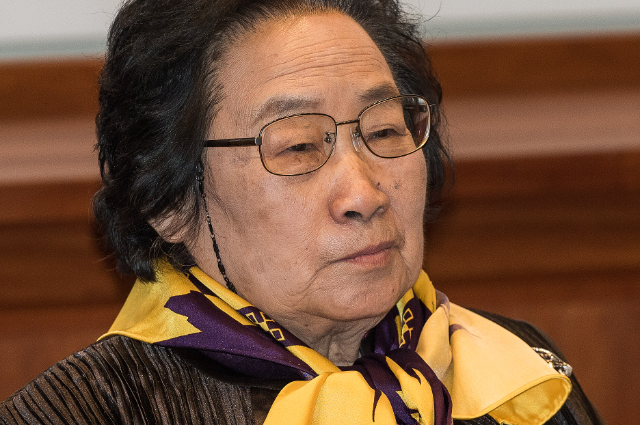
In 1972, Tu Youyou and two colleagues checked into a Beijing hospital, not as patients, but as subjects. While China underwent the Cultural Revolution under Chairman Mao Zedong and the Vietnam War neared its end (1975), a secret scientific research mission was underway in China. However, since there were no facilities for a formal drug trial in Cultural Revolution China, Tu Youyou and her colleagues tested their extract of sweet wormwood on themselves. It was successful, and weeks later, the same extract cured twenty-one malaria patients in Hainan.
Today, the discovery of artemisinin, the antimalarial drug, ug is credited to Tu Youyou. This collapse of three names into one did not happen over time or on account of academic hierarchy. Tu Youyou’s accreditation is the consequence of two distinct cultures of research colliding.
On 23rd May, 1967, a secret national meeting was held in Beijing, marking the commencement of Project 523 to fight malaria in northern Vietnam and southern China. From 1967 until its official termination in 1981, over 500 researchers from across 60 institutes came together to find a cure for a major cause of death concern for soldiers during the Vietnam War (1955-1975). In 1979, the report's findings were published under the collective name: The Qinghaosu Anti-Malarial Coordinating Research Group. It contained no individual authors. The research found that, when used with other therapies, artemisinin (qinghaosu) can reduce mortality from malaria by one-fifth, saving more than 100,000 lives each year. A milestone in medicine and no individual name to credit it to.
However, in 2015, the Nobel Committee recognised Tu Youyou as the discoverer of artemisinin, awarding her the (shared) 2015 Nobel Prize in Physiology or Medicine. Tu Youyou’s recognition emerged in 2011 when two researchers at the US National Institutes of Health, Louis Miller and Su Xinzhuan, began digging through the archives of Project 523 to locate the discoverer. Miller’s motivation to search for the discoverer stemmed from his fascination with how quinine’s origins among Peruvian healers were nearly lost to history and his concern that the story of artemisinin might be lost, too. In September 2011, Miller and Su published a paper in Cell concluding that primary credit for artemisinin belonged to Tu. This was followed by recognition from the Lasker Foundation. Four years later, Tu Youyou became the first mainland Chinese scientist to win a Nobel Prize in the scientific category.
While the accreditation of the cure for malaria is now specific, it highlights the difference between the Western lone-genius narrative and China’s collectivist approach to research. One of the most critical questions within this debate and highlighted by this accreditation is that of recognition. The Nobel Prize caps recognition at three names. It is designed to commend identifiably individualistic discovery and endeavour. On the other hand, there is the collectivist research, which is structured differently. In 2006, the former Deputy Director of the project, Zhang Jianfan,g explained that the success of artemisinin was a “collective honour” for everyone involved, comparing the discovery to a relay race where “every runner” is important and no one can accomplish the goal solely. Approaching the Nobel recognition through the same analogy implies that one of the relay runners has been awarded over others. It highlights the predicament of applying an individualistic metric of recognition on a collectivistic apparatus.
Project 523 did not hide the names of the researchers. It was organised differently. Historians at Peking University argue that Tu’s group and Project 523 operated differently from Western research protocols. Western research is headed by a Principal Investigator (PI). In Western tradition, the PI originates a hypothesis, writes a proposal, competes for funding and owns the resulting intellectual credit. The system is designed around an individual. Within Project 523, Tu functioned as a Principal Director, carrying out a project assigned to her by the state, overseeing execution. The project did not begin with a research question but with a state meeting in 1967, which set up regional 523 offices to coordinate affiliated institutions under military supervision, and divided the work into four assigned coordination groups. Historian Jia-Chen Fu has described Project 523 as an exercise in ideological self-reliance as much as pharmacology, showcasing how state-directed science could surpass individual scientific effort. Project 523 was collectivist in its structure and design.
Tu Youyou was recruited in 1969 to lead a traditional-medicine research group. In 1972, her team isolated the pure, effective compound and named it qinghaosu (artemisinin), after low-temperature extraction finally worked and the Hainan human trials succeeded.
However, Tu’s testing of artemisinin on herself first contests the collectivist narrative. Western research historiography has documented numerous instances of self-experimentation, and it is seen as heroic.
This tension between the two traditions of research has also been acknowledged by scientists in the West. Martin Rees, British cosmologist and physicist and former President of the Royal Society (the world’s oldest scientific society), has pointed out the challenge for the Nobel committees owing to the increasingly collaborative nature of scientific research, noting cases where it's not obvious that those they’ve singled out from the team are the dominant figures. In an interview with CNN, he pointed out other similar instances, such as the 2017 Nobel Prize in Physics as well as the project of mapping the human genome (completed in 2022 and involving hundreds of people), which carried the same tension.
The Nobel Prize is one of the most prestigious awards in the world. The growth of collaborative research poses a strong challenge to the statute of the Nobel Foundation, which fulfils the will of Alfred Nobel (which states that the prize can only be awarded to a maximum of three people). It can either include a new and separate process of recognition for collaborative research or reframe its recognition as within the individualistic research tradition. This is not to say that the challenge only lies in taking a decision. If the Nobel Foundation were to refrain from the realm of collaborative research, it would not be the first instance. As per the statute of the Nobel Foundation, it focuses on three scientific disciplines, excluding mathematics, computer science, earth and climate science and oceanography. Even within the fields of chemistry, physics, nd medicine and physiology, five out of 114 sub-disciplines account for more than half of the Nobel Prizes awarded (1995-2017).
While Lu Bai, a professor at Tsinghua University’s School of Medicine, said that Tu Youyou played a pivotal role in Project 523 by taking the most important decisions, Tu’s colleagues who self- tested with her remain unnamed in both the Chinese and English language sources that credit them. They could have requested privacy or may wish to remain within the collectivist apparatus within which the research was conducted. However, a brief explanation for this anonymity would have offered greater depth to either tradition in the particular instance of Project 523.
References:
- China’s Nobel Prize winner Tu Youyou faces criticism for malaria research.
- Discovering an Antimalarial Drug in Mao’s China
- https://www.science.org
- Culture and Unmerited Authorship Credit: Who Wants It and Why? - PMC
- Artemisinin therapy for malaria - Lasker Foundation