
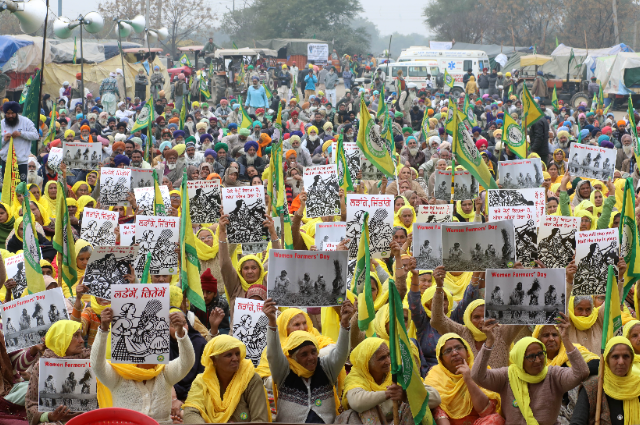
If a nation’s capital is considered a reflection of the nation at large, the protests in New Delhi reveal the chasm between the central government and the people.
On July 20th, 2026, the Delhi police fired tear gas and swung batons at thousands of students marching towards Parliament. The following day (21st July, 2026), the Delhi police stopped farmers marching towards Kisan Ghat. The two marches carried two completely unrelated national grievances concerning two critical communities of the nation. The students were marching against an educational ministry accused of institutional apathy towards a deeply flawed examination system. The other was against the India-US Free Trade Agreement (FTA) based on its interim framework.
In early February 2026, New Delhi released the interim framework of the India-US Free Trade Agreement, revealing plans to lower tariffs, reconfigure energy ties and deepen economic cooperation in an endeavour to realign global supply chains. The framework also suggested that India pushed back against opening its agricultural market. Negotiations followed the entire first half of the year while the US imposed a 10% 150-day temporary tariff which expired on 24th July, 2026. Without a signed deal, it left room for Washington to impose a new (and possibly higher) tariff regime from 25th July, 2026. On 22nd July, 2026, multiple media outlets reported that Washington was conducting trade investigations under Section 301, covering unfair trade practices and the use of forced labour. The statute allowed it to impose tariffs and retaliatory measures. Alongside this, reports claimed that the negotiations stood at the last 1%. The inclusion of agricultural produce in the framework, the government’s looming window of possibly higher and non-negotiated tariffs, the reports on the deal’s approaching closure and the lack of public discourse about the agreement, together drew the farmers to the streets.
The umbrella body of various farmer unions across different states, the Desh Bachao Morcha (DBM; formed 2nd July, 2026) demanded that negotiations under the Free Trade Agreement be cancelled, all documents be made public and agreements be discussed in Parliament. The Samyukta Kisan Morcha (SKM, formed in November 2020, also comprising different farmer unions) sent an open letter to President Droupadi Murmu opposing the FTA.
The farmers' protest adds to the prevailing unrest in Delhi owing to the Cockroach Janata Party (CJP) led student protest demanding accountability for the education ministry’s failure to conduct exams successfully. If a country’s capital mirrors the country it governs, Delhi in July 2026 reflected a government which was strained on two critical aspects – education and farming; the disappointment and anguish of the country’s backbone and its future with the central government. That’s not to say that either of these issues is not grave enough to deserve attention on their own. But in parallel, the demonstrations reveal the chasm between the central government and the people.
Not every policy of the government is agreed upon by the populace. However, when a policy or decision goes against the interests of the people or when their grievance has been met with indifference, a protest is a people’s last resort to gain the government’s attention. It is disruptive not only for the country at large but also for the individuals involved, the individuals who make up the protest. It’s not limited to a single day of demonstration organised on a weekend, making it convenient for people to show up. It is inconvenient for even those who are there. Farmers have to leave their fields during sowing season (a cost measured in income), and students are doing their assignments while demonstrating their solidarity with the cause. And yet they are there because they recognise the gravity of the issues and the threat of their causal potential. Not demanding accountability for the mishandled education and academic system will perpetuate ineptitude and carelessness on the part of those in power, which will have a direct bearing on the futures of entire generations. Not demanding that trade documents be made public is a direct threat to the livelihood of 48% of the country’s population dependent on agriculture. Dairy farming is a common practice among small farmers in Punjab to supplement their income. Reducing tariffs on US imports of dairy will flood Indian markets with cheaper dairy products. Domestic produce that cannot compete with cheap US products will be taken off the shelves, causing a drop in the income of small farmers.
It is difficult to trace this pattern without noticing its historical echo. The British colonisation of India began, in significant part, as Britain’s search for new markets for its goods. British goods flooded the Indian market precisely because British colonisation provided British goods and manufacturers access to Indian markets, undercutting Indian producers on their own soil. Lowering tariffs for US produce to enter the Indian market at lower prices reads as neo-colonialism, facilitated through the Free Trade Agreement rather than outright colonisation. The demand for the FTA documents to be made public not only upholds transparency between the central government and people, it also reveals the power dynamic between the two parties involved and whether the agreement was indeed negotiated or imposed.
The Dairy question also sits uneasily against the Make in India campaign. Built on the premise that domestic production, not imported substitutes, should meet the country’s needs, the central government has spent over a decade advocating it. India is the world’s largest milk producer, accounting for a quarter of global output. Policy Circle notes that while sensitive commodities such as liquid milk, skimmed milk powder, and bulk products must be excluded from tariffs, premium and processed dairy (mozzarella, cheddar, gouda, probiotic yoghurt, protein shakes, and whey isolates) could be opened selectively. In FY23, cheese and yoghurt grew 18-22% in volume against 8-10% for milk. However, it is precisely in the clarification of these nuances that transparency is required.
Two protests over two completely unrelated issues converged in the capital in the same week. It evidences a strain along more than one fault line. Whether this strain resolves through negotiation, disclosure and reform, or through the kind of prolonged confrontation Delhi has now witnessed twice in a single month will reveal a great deal about the strength of the world’s largest constitution and how far its reigning government can demand trust without earning it.
References
- Reuters – Explainer: Why are farm goods holding up the US-India trade deal?
- Explainer: Why are farm goods holding up the India-U.S. trade deal? | Reuters
- The Hindu – Farmers stage motorcycle rally to protest against proposed India-US trade deal
- Farmers stage motorcycle rally to protest against proposed India-U.S. trade deal - The Hindu
- Down To Earth - Farmers protest against India-US trade talks as convoys stopped near Delhi
- Farmers protest against India-US trade talks as convoys stopped near Delhi
- Al Jazeera – Police attack Cockroach activists as thousands march on Indian Parliament https://www.aljazeera.com
- The Tribune – What’s fuelling opposition to India-US trade deal
- Explainer: What’s fuelling opposition to India-US trade deal - The Tribune
- Business Standard – India-US trade deal: Timeline of negotiations, tariffs and turning points India-US trade deal: Timeline of negotiations, tariffs and turning points | Economy & Policy News - Business Standard
- The Hindu – As temporary tariffs expire, US imposes 10% ‘forced labour’ tariffs on India
- As temporary tariffs expire, U.S. imposes 10% ‘forced labour’ tariffs on India - The Hindu
- Reuters – US-India trade deal could be signed in 3-4 months, US official says
- US-India trade deal could be signed in 3-4 months, US official says | Reuters
- The Economic Times – India engaged with US for negotiating trade pact, govt tells Rajya Sabha
- US-India bilateral trade agreement: India engaged with US for negotiating trade pact, govt tells Rajya Sabha - The Economic Times
- Policy Circle – Dairy industry continues to block India’s trade deals https://www.policycircle.org