
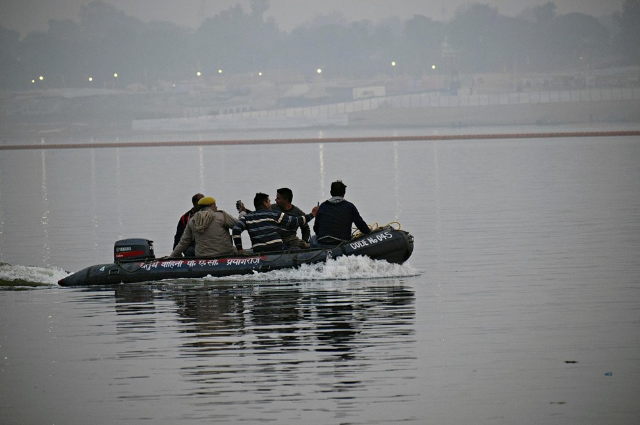
Image by Rajesh Balouria from Pixabay
On 5th August, 2026, R Rajesh, a trained flood rescuer, was laid to rest with full state honours in Thiruvananthapuram. He was neither a part of the Fire and Rescue Personnel nor the National Disaster Response Force or its state counterpart. 36-year-old Rajesh was a swimming and rappelling instructor and the president of the Adventure and Disaster Management Club in Kalliyoor, Thiruvananthapuram.
On 2nd August, 2026, 36-year-old Rajesh answered a call along with two other volunteers, Shibin and Jithin, to rescue a 61-year-old man, Benny, on the islet of Meenthulli. Benny had gone to check on his coffee plantation when he heard about the landslide in the forest across the district border. Within hours, the Kariyankode River was at his waist. By the time Rajesh and his companions reached him, Benny was holding on to a coconut tree. The volunteers threw Benny a rope. As he tied the rope around the tree, his finger caught in the knot. Rajesh swam over and freed Benny. He then gave Benny his own life jacket, and they began their return, Rajesh holding on to the safety rope of the life jacket. But Rajesh did not make it back to the bank. Somewhere during the crossing, he lost his grip on the rope, and the strong current swept him away. Following a search by rescue personnel, Rajesh’s body was discovered on 4th August, 2026, near Meenthulli bridge.
The 1st August flood in Kannur’s Cherupuzha was also not his first operation. He had been a part of rescue operations during the 2018 Kerala floods and the 2024 Wayanad landslides. As part of a local volunteer network responding to calls alongside the Fire and Rescue Personnel and the Disaster Response Force, he received no monetary compensation for his rescues, while undertaking the same risk as insured rescue personnel. It is a mark of recognition of this asymmetry between what his efforts yielded and the risk he undertook (and sacrifice made) that the state of Kerala awarded him full state honours, the Chief Minister offered his condolences to his grieving family in person, and the government announced that it would complete the unfinished house he had left behind.
Rajesh acted alongside a formal rescue team but outside its structure of protection. The National Disaster Management Authority’s Aapda Mitra scheme exists to bring volunteers like Rajesh within its state’s structure. Its own stated mandate is to train, equip and insure one lakh able-bodied volunteers across the country’s most disabled-bodied districts. However, in Kerala, the scheme runs thin. While the scheme began in the district of Kottayam with 200 volunteers, there is no evidence suggesting that Rajesh was volunteering as a member of this volunteer community. He entered the water based on his own training and outside the state’s insurance rolls.
This is not particular to Kerala or civilian volunteers alone. Even where the state’s own trained, uniformed responders go in, the current does not distinguish. On 21st August, in Madhya Pradesh’s Bhind district, a State Disaster Emergency Response Force team wearing life jackets capsized while trying to reach a man swept away in an attempt to save his cousin. The river tore the jackets off two of the personnel, and both went missing. This incident evidences how no measure of institutional backing can guarantee safety in this task. It highlights the stark reality of what it means to enter the river, whether as a volunteer or as assigned personnel.
Nevertheless, the value of volunteers like Rajesh lies precisely in their exclusion from formal protection because it highlights their decision to undertake their risk without any obligation or compensation. Their perspective of this role differs, and it is precisely owing to this perspective that their effort and, in this particular case, sacrifice, is valued.
What the state offered Rajesh’s family is, therefore, gratitude, not protection. Gratitude is also always granted after the fact and to families visible enough and losses public enough. Rajesh had an older brother who died in an accident two years ago. His parents have lost both their sons, their daughter now being their only surviving child. Their loss is unfathomable, and it shifts our perspective of the story. Rajesh was not only aware of the risk he was undertaking, but also of the grief of losing a loved one and yet he deemed this cause worthy of risking his life. There is no compensation for this innate humanistic approach to life where one values their life only as much as they can give to others.
Kerala’s disaster machinery depends on people like Rajesh showing up before it can. Aapda Mitra’s own founding premise is that community is the first responder, arriving before the Fire and Rescue, before NDRF. However, this immediacy is a function of local knowledge and personal initiative, and it cannot be replicated in a chain of command. Institutional processes may be bound by formality. This is where a trade-off would be required if informal and volunteer rescue operations were to be brought within institutional protection, which will always fall short of guaranteeing a rescuer’s return and never be compensation enough when disasters claim sacrifices. However, that is not why they are set up. These systems of protection are markers of the state’s and, by extension, the citizen’s recognition of what hangs in the balance each time a rescuer answers a call.
References:
- Kerala accords state honours to Rajesh who died during rescue operation, vows to complete unfinished house | Kerala news in English | Onmanorama
- ‘Rajesh to be laid to rest with state honours, financial aid for shops destroyed in rain fury’ - KERALA - GENERAL | Kerala Kaumudi Online
- Body of Rajesh, who lost his life during rescue operations, brought home; CM pays tributes - KERALA - GENERAL | Kerala Kaumudi Online
- https://www.khaleejtimes.com
- https://ndmindia.mha.gov.in/ndmi/programs
- https://sdma.kerala.gov.in/aapda-mitra/
- Farmer trying to save his cow drowns; two SDERF jawans go missing during rescue operation in MP's Bhind district.