
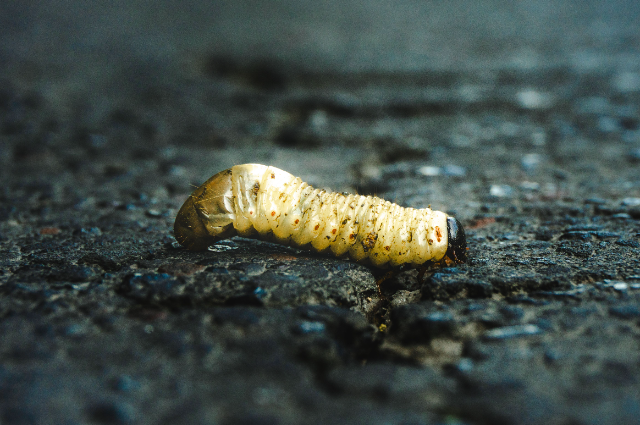
A female screwworm fly mates once in her life. If her mate is sterile, her eggs never hatch. However, the eggs are always laid on a wound or a mucous-membrane opening, such as a tick bite or an umbilical stump of a calf; and when they hatch, the larvae burrow into the skin, widening the wound as they feed. In 1935, screwworms killed 180,000 head of livestock in nearly half of Texas’s counties in a single year. Ranchers checked their herds by hand twice a week as no other alternative was available to them.
However, in 1966 the USA declared itself screwworm-free through strategic eradication following the work of entomologists Edward Knipling and Raymond Bushland, who spent the 1930’s learning how to farm the fly in a lab. In the 1950’s they learnt how to sterilise it with radiation, and tested the idea of releasing sterile males among the females on Sanibel Island in 1950, followed by Curacao in 1954. In both places,s the fly was wiped out within months.
The US eradication line was pushed south, decade by decade through Mexico and Central America, until in 2006, a permanent barrier was established at its narrowest natural chokepoint: thDariénin Gap (roadless jungle between Panama and Colombia). A joint US-Panama commission, COPEG, ran a factory there capable of producing 100 million sterile flies a week. By APHIS’s own account, the barrier saved the US cattle industry an estimated $2.3 billion a year, becoming one of the most successful, visible achievements in the history of pest control.
However, in 2021, the barrier stopped holding. Warmer and wetter conditions expand the range in which the fly and breed and survives. Researchers have pointed out a documented northward creep in viable habitat. Panama’s case count went from an average of 25 a year to over 6,500 in 2023. This spike tracks with another trend. Between 2021 and 2024, more than 1.2 million migrants crossed the same jungle corridor the sterile flies were dropped over, peaking at 520,000 crossings in 2023 when the barrier broke. The migration crossings opened and offered more pathways to the fly and infested hosts than the surveillance designed for a ‘desolate’ jungle could keep up with. US officials believe that the surge in human movement disrupted the surveillance and release operations. Alongside this contributing factor have been others, such as budget cuts and reduced surveillance funding, Covid-era relaxation of monitoring and surveillance, illegal and unregulated cattle-trafficking, and the loss of expertise.
By late 2024, the fly had reached every Central American country and southern Mexico. In June 2026, it reached Texas, a calf in Zavala County, the first domestic case since 1966. This was followed by other cases across the state, within days. In August 2025, the CDC confirmed the first travel-linked human case in the US in decades, a Maryland resident treated after returning from Central America. While HHS and USDA named El Salvador as the point of travel, at least one wire report, citing several sources, named Guatemala. The discrepancy in public reporting indicates the thin information trail.
The US cattle industry is facing an immense challenge and horror. The US cattle herd is at its smallest since 1951, thinned by years of drought and the country’s closed border to Mexican cattle imports since 2025, over screwworm,m which removed over a million head a year from US feedlots. The retail prices, es standing at record highs, have kept climbing. The Dallas Fed has warned that a genuine Texas outbreak could shrink the herd further, keeping consumer prices elevated for years, rather than months, since cattle cannot be bred back into the supply chain within a season’s notice. APHIS’s response has been to build more capacity. A new sterile-fly plant is under construction in Texas, and another is being converted from a fruit-fly facility in Metapa, Mexico. Both will be operational in 2027. In the meantime, all that the US cattle industry has is the Darrien barrier, which has already been breached.
The Screwworm recurrence highlights the fragility of the processes and mechanisms protecting human and animal lives from natural threats. Its eradication was never constrained to the past, but depended completely on continued maintenance and monitoring. The new facilities in Texas and Metapa will work, but their success depends on continued funding and monitoring.
References:
- congress.gov/crs_external_products/IN/HTML/IN12558.html
- New World Screwworm: Rise, Fall and Resurgence
- How history is guiding a U.S. attempt to beat screwworm again
- Ranchers herd it all as fewer cattle pressure beef prices; screwworm lurks - Dallasfed.org
- How a favoured Migrant Route Became Invasive Species Superhighway to US - Newsweek
- New World Screwworm Outbreak | New World Screwworm | CDC
- Current Status of New World Screwworm | Screwworm.gov