
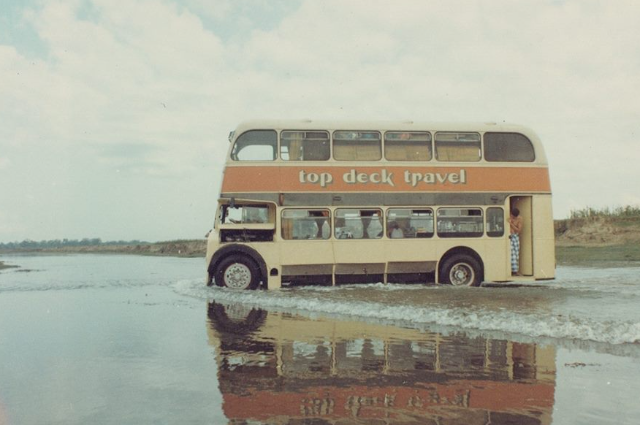
On 15th April, 1957, a bus called the ‘Indiaman’ pulled out of London’s Victoria Coach Station, carrying twenty passengers, a ferry ticket to Belgium, and a route map that ended 20,000 kilometres and fifty days later, in Calcutta (now Kolkata). A one-way ticket cost less than the ticket from Paris to Rome. For nineteen years, the bus crossed West Germany, Austria, Yugoslavia, Turkey, Iran, Afghanistan, and Pakistan, entirely by road.
The Indiaman’s inaugural run was driven by Oswald “Paddy” Garrow-Fisher and covered by the New York Times. It was a novel journey to report on: cliffside passes near Mount Ararat, planks laid under the wheels to cross soft desert sand in Iran, a return leg diverted around a closed Pakistan-Iran border during the 1957-58 influenza pandemic. The Indiaman was the first of what would later become more than thirty operators running the London-Calcutta route through the fifties, sixties and seventies. The most famous of these buses was Albert, a ddouble-deckerbought and rebuilt by a British traveller after an accident retired its predecessor, fitted with sleeping berths, a dining area and an upper deck observation lounge. Albert alone completed 15 round trips between London and Calcutta (and several more to Sydney), crossing over 150 borders. Fares across the different operators ran roughly between 85 pounds and 150 pounds, a fraction of a flight expense, in exchange for two months of a passenger’s life in exchange.
This route became the overland corridor for thousands of young Western travellers through the sixties and seventies to reach Kathmandu, Kabul and Goa, later known as the Hippie Trail. In 1972, Tony and Maureen Wheeler undertook a journey on a similar route, ending up in Sydney with next to nothing and wrote Across Asia on the Cheap, the pamphlet that became the first Lonely Planet guide. The overland route birthed a genre of travel writing, a mode of budget tourism, and a shared vocabulary of border towns and chai stops that outlived the journey itself.
In the 1970s, the Hippie Trail was at its cultural peak, but by 1976 the London-Calcutta bus service had stopped running. Instability building through the second half of the seventies, culminating in the Iranian Revolution of 1979, followed by the Soviet invasion of Afghanistan, closed the route’s corridor of borders.
However, the bus continued operating elsewhere. Albert changed hands several times over the following three decades until Andy Stewart, the traveller who had rebuilt and named it, tracked it down in Brighton in 2001 and bought it back in 2009. He restored it along with a group of friends and, in 2012, drove it overland out of the UK once more, a one-off private trip rather than a revived commercial service. The bus is reportedly still in circulation today, making appearances at classic vehicle shows. The corridor was closed. The journey was in the past. The bus, however, remained.
Mobility is often viewed as a function of engineering: better roads, faster vehicles, efficient logistics. However, the London-Calcutta bus proves that connectivity and mobility are not only a consequence of technical achievement but a political question, deliberated by states whose territory a route must cross, and it can be revoked by the same states without any change to the underlying structure of the other variables.
Fifty years later, the corridor remains closed. In 2021, the Gurugram-based travel company Adventures Overland announced a modern revival,l ‘Bus toLondon ’’, inspired by the Hippie Trail. Covering 20,000 kilometres, seventy days, and eighteen countries, the service runs between Delhi and London. However, it is yet to commence this journey. The first attempt was postponed by the pandemic. When travel resumed post-pandemic, the land borders with Myanmar and China were not open for crossing. The company has since rerouted parts of its journey through Istanbul and the Balkans instead. Nearly seventy years since the Indiaman first left Victoria Coach Station, the roads are unquestionably better, the vehicles safer, but the journey remains unrunnable for the same reason it was stopped in the first place.
Borders are political, and this political nature and identity highlight another reality of the journey. The often-repeated claim that Albert crossed 150 borders and “was always welcomed wherever we went” describes the experience of travellers holding British and other Western passports at a moment when their government’s standing made that welcome inevitable. The same borders did not extend the same hospitality to others, those journeying out of Iran, Afghanistan or Pakistan and into Europe, in that decade or since. The corridor’s openness was not symmetric. It raises the question of whether the Hippie Trail demonstrated the ease of movement itself or the ease of movement for a particular kind of traveller. In other words, even the freedom a route offers can be a privilege wearing the costume of an infrastructural achievement.
The Indiaman’s map still exists, and so does the reason this route can no longer be taken.
References:
- London–Calcutta bus service - Wikipedia
- India–United Kingdom bus routes - Wikipedia
- The Remarkable Journey Of The World's Longest Bus Route
- All Aboard the Giant Hippie Bus from London to Calcutta
- London to Calcutta by Bus - East India Story
- https://www.amusingplanet.com
- The Hippie Trail: An interactive history of the road trip that inspired Lonely Planet
- Literary Hub » How Lonely Planet Founders Tony and Maureen Wheeler Revolutionised the Way We Travel
- New bus trip will take you from Delhi to London | CNN
- Epic Bus Journey-Bus to London with Adventures Overland