
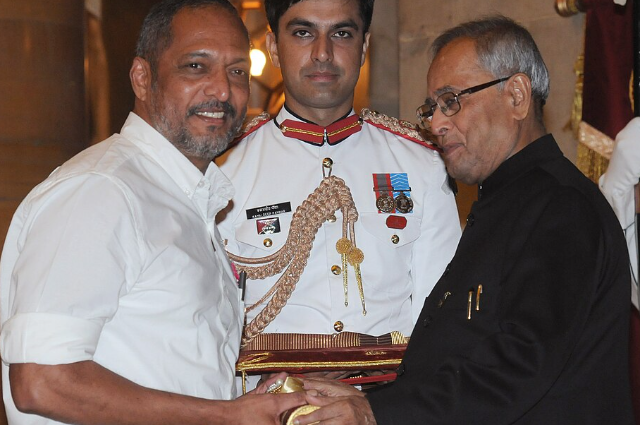
In the early hours of the morning on 8th October, 2026, Nana Patekar sent a message to a friend that he was not feeling well. By 4:30 am, an emergency team arrived and found him unresponsive at his Goa home. They began a cardiac massage and shifted him to Manipal Hospital, where doctors continued CPR for roughly 45 minutes. At 5:20 am, he was declared dead. He was 75.
Within hours, the Maharashtra government announced a state funeral. Chief Minister Devendra Fadnavis described him as being as large-hearted off-screen as he was formidable on it.
Vishwanath Patekar was born in Murud-Janjira on 1st January, 1951. Through Marathi theatre, he found his way into the film industry, making his debut in 1978 in Gaman. His breakthrough was Parinda (1989), wherein he played gangster Anna Seth, which earned him a National Film Award for Best Supporting Actor and a Filmfare Award. For Krantiveer (1994), he won the National Award for Best Actor and Best Supporting Actor for a second time for Agni Sakshi (1996). One of his most prominent roles was Uday Shetty, a gangster, albeit a comic character in Welcome (2007), which introduced him to a younger audience. He also won the Filmfare Marathi for Best Actor for Natsamrat (2016). In 2013, he was awarded the Padma Shri.
Off screen, in September 2015, he co-founded Naam Foundation with fellow Marathi actor Makarand Anaspure, in response to the agrarian crisis and farmer suicides in drought-hit Maharashtra. It began as financial assistance to families of farmers who had died by suicide and expanded into water conservation, livelihoods, education and healthcare. On the day of his passing, Fadnavis credited him with supporting farmers and the state’s own Jalyukt Shivar water campaign.
However, his record also carried shadows. In 2018, actress Tanushree Dutta alleged that Patekar had behaved inappropriately with her during the filming of the song for Horn Ok Pleassss (2008). Patekar denied the allegation, and in June 2019, the police filed a B-summary report, closing the case on account of lack of evidence. Dutta filed a protest petition opposing it; however, on 7th March 2025, a Mumbai magistrate refused to take cognisance. The alleged offences carried a limitation of three years, whereas the complaint was filed a decade after the incident. In addition, neither the prosecution nor the informant applied for the delay to be condoned. The magistrate stated that condoning such a delay without sufficient cause would go against equity.
The order does not imply that the allegation was true. It does not imply that it was false either. It implies the limitation of the court in assessing it. The ceiling of time refers to the procedural limitation. This is a corner of Patekar’s life which can never be uncovered. The allegation exists just as. The limitations of law cannot erase the questions which hang even after his passing.
Writing on mourning rites in The Elementary Forms of Religious Life (1912), French sociologist Émile Durkheim argued that mourning is not the spontaneous overflow of private feeling but a duty laid down by the group. In other words, a funeral is a society describing itself. It decides who is to be mourned, how loudly, and what their legacy is. A state funeral describes these at the largest scale. It also implies recognition by the state of the individual’s contribution to society.
State’s honour public contribution and the Padma Shri of 2013, predates the allegations by five years. While the allegation exists, withholding the ceremony on account of an untested, unproven claim would in itself be a verdict of a different nature. It would hint at having arrived at a conclusion that the law itself did not. Similarly, awarding full state honours is also a verdict of a different kind.
This duality of a state-honoured funeral and lingering allegation exposes a gap between the two systems of law and honours. It reveals the significance of when law has to leave questions unanswered due to limitations. The law can do that. Honour cannot. The retraction of an honour is a statement in itself. For honour, there are no grey areas.
If a funeral is a society’s portrait of itself, this portrait leans heavily towards the well-lit pages of Patekar’s record. It is also an incomplete portrait because honours carry no room for shadows. It also highlights the difference between public recognition and a personal grievance. State honours are a form of public recognition. Dutta’s complaint is a personal grievance.
Nana Patekar’s death closes a career that ran nearly five decades from the Marathi stage to the National Awards, alongside contributions to society and an unanswered question. What remains is a large body of work and an allegation the masses are left to hold simultaneously. Perhaps the honest way to remember him is for what he gave while acknowledging what remains unknown.
References:
- https://www.aninews.in
- https://www.indiatvnews.com
- https://gulfnews.com
- https://www.business-standard.com
- Elementary Forms of the Religious Life (free ebook)