
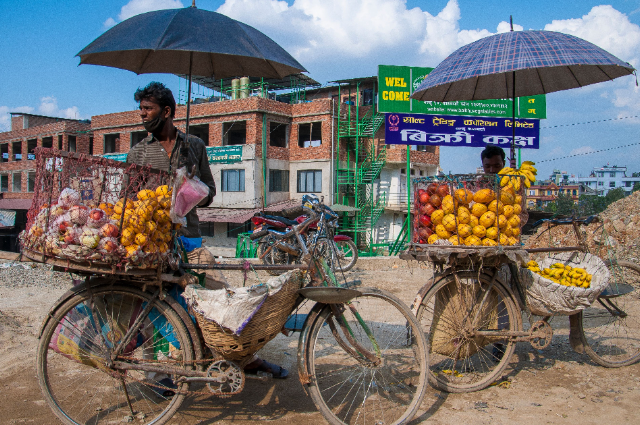
The year was 1978. On a roadside stall near the Mangaluru bus depot, Harekala Hajabba stood by his heap of oranges when a foreign tourist stopped by to inquire about the price of the oranges. But Hajabba did not know English. He had never been to school, having left home young to earn. He knew two languages, Tulu and Kannada, but no English. That exchange was perhaps his first encounter with English and the possibilities and opportunities exclusive to the language.
For the next two decades he continued to sell oranges, carrying that exchange with the foreign tourist. His village, Newpadpu, had never had a school. No child there was given an education.
In 1999 the local Jamaat – the mosque committee in Newpadpu, where Hajabba served as President – started a first-standard class inside the village Madrassa with 28 children. No government department had sanctioned it, running on whatever the local community could spare. When the class ran short of funds and faced closure, Hajabba took personal responsibility for continuing it, funnelling his own earnings into it and spending the next decade petitioning officials, purchasing land and rebuilding the school in stages. In the early 2000’s the school received a proper building,g followed by a recognised High School in 2007-2008 and its first batch of Class 10 students in 2010. Accounts differ on when each piece of land was bought, but they agree on the fact that a community effort, led by an individual, survived because of his spirit.
Article 45 of the Constitution, written into the Directive Principles in 195,0 committed the state to provide free and compulsory education to every child up to the age of fourteen “within a period of 10 years” – by 1960. It was a directive rather than a right; aspirational and unenforceable, dependent on the state’s capacity to provide it. Free education also did not become a fundamental right in India until 20,02 when the 86th Constitutional Amendment inserted Article 21A. By the time this amendment was made, the claim had been running for three years. The law that gave Article 21 enforceable shape, the Right of Children to Free and Compulsory Education Act, was not implemented until 1st April 2010 – the same year Newpadpu’s first class 10 batch sat for its board exams. What the state had just started had been running in the village of Newpadpu, kept alive by Hajabba’s own private income.
While this story carries a sentimental thread, a fundamental fact lies within it: the gap between the needs of a people and the deficient state infrastructure. The school in Newpadpu did not emerge out of the state’s machinery. In fact, it emerged precisely because the state machinery never reached it at all. While this story is deeply inspiring, it is also a record of how long a constitutional obligation can go unmet before anyone with power notices.
In January 2020, the Government of India awarded Hajabba the Padma Shri, India’s fourth-highest civilian honour. Hajabba was honoured for undertaking a role that traditionally belonged to the state. He was honoured for undertaking a responsibility that the state had failed to deliver. This perspective also raises the inverse question of the price paid by the state for its deficiency in providing critical infrastructure over a matter of decades.
Delayed by the 2020 pandemic, Hajabba was awarded the Padma Shri in November 2021, which he received barefoot from President Ram Nath Kovind. Across Karnataka, he is known as Akshara Santha – the saint of the alphabet. When he was asked about the honour, he said it was not his but belonged to the school.
From 28 students, the school expanded to 175, absorbed into the government system as a Zilla Panchayat institution. Hajabba ploughed back every award and honorarium he received into the school, even as he continues to petition for land, staff and a pre-university college – none of it strictly his to secure.
His refusal to accept full credit highlights the contradiction between how the country desires to paint him and how he views himself. The country wanted a hero – a man who had nothing himself, managed to give something so foundational as a school back to his community. The education that he did not have himself, he made available to his village. And yet, the school was never his to begin with. It belonged to a village committee,ttee and this is a critical marker in its story of survival. A community backed by nothing but shared poverty and shared deprivation of education also needed one man’s private earnings, and it did what the state machinery could not. It challenged the often-repeated justification of “budget constraint” from the state machinery.
There is no argument against acknowledging and lauding Hajabba. Education is not an exclusive resource that exists in isolation. Only those who are educated have access to opportunities. Education furthers education. And yet, Hajabba challenged this notion by creating a system and infrastructure that he had no experience with before the law obligated institutions with resources to do so. However, this incredible story also highlights that in the numerous other villages across the country where the state mechanism falls short of providing such critical infrastructure, unless a man like Hajabba comes along, the cost is borne by the community. There is no penalty for the state when an individual has to shoulder its responsibility.
Now, too, the primary perspective drawn from this story centres on Hajabba’s “good deed”. But where is the line between being a good and responsible citizen and shouldering the state’s responsibility?
References:
- Deccan Herald – Humility is central to this orange seller’s school of thought
- Deccan Herald – As Hajabba receives Padma Shri, kids rejoice at his school
- The Print – For Harekala Hajabba, journey from orange cart to Padma Shri began with a foreigner’s question
- The Better India – Orange Seller Saved His Daily Earnings To Build A School That Helped Hundreds of Village Children
- DNA – Meet orange vendor Harekala Hajabba who received Padma Shri for revolutionising rural education
- Press Information Bureau – Padma Awards 2020
- Wikipedia - Right of Children to Free and Compulsory Education