
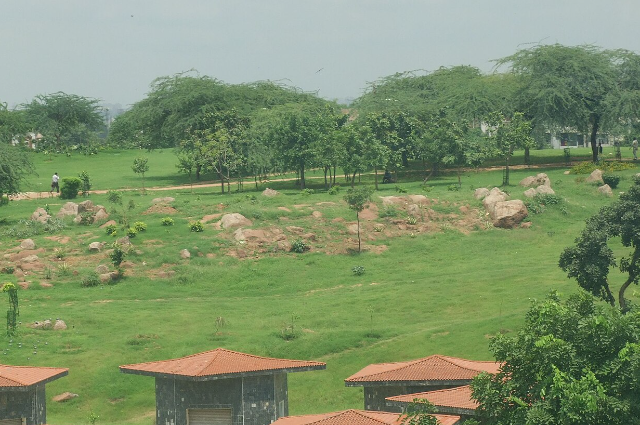
On 21st September, 2026, a seventeen-year-old girl was raped in Delhi’s Aastha Kunj Park. In response, the Delhi Development Authority (DDA) announced that parks with several entrances would admit visitors after sunset only through selected gates. This would enable the guards to better monitor entrances and exits. By 23rd September, 2026, students and alumni of Delhi University began demonstrations demanding stronger measures for women’s safety and greater accountability from authorities. This is a story we’ve heard before, multiple times. While its recurrence indicates that nothing has changed, a closer look at the incidents reveals that it isn’t the same at all.
On her birthday, the seventeen-year-old girl informed her sister where she was going and headed to the Kalkaji temple for darshan with a friend. She planned to visit the ISKCON temple later that evening. Since Aastha Kunj Park lay between the two temples, she and her friend decided to stop by it.
They entered through Gate No. 7 and were approached by three men who claimed to be policemen. According to police reports, the men separated her from her friend and took her to an abandoned stone structure where they raped her. At 8:45 PM, the boy called the police control room after the girl told him of the assault. Following an investigation, the three men were identified and arrested the next day.
The girl was not a student of Delhi University. The demonstrations (by students and alumna) that followed did not imply a delay in the justice system. It demanded greater measures for ensuring the safety of women; measures that did not involve restricting women’s mobility. The DDA’s response also called for more CCTV cameras in and around public parks, floodlights, guards, and night patrols in addition to permitting entrance through only selected entrances. Reports following the incident stated that only one of the park’s seven gates had two guards, that the gates had no CCTV and that the vicinity of Gate No. 3 was poorly lit. In addition, parts of the wall had collapsed. A police officer informed the Times of India that the gates tend to stay open all night because locked gates lead people to leap over walls. The Police also shared that the accused lived and worked near the park, met there often and were therefore familiar with it.
When the men approached the teenagers and separated them, they threatened them with legal action. Genuine police officers have been known to moralise police young couples. In September, a young boy and girl, returning home from coaching on the boy’s two-wheeler vehicle, were stopped by a group of men who weren’t policemen. They harassed the teenagers and groped the girl, which was caught on camera and resulted in police investigations against the men.
In their study ‘Why Loiter?’ Shilpa Phadke, Sameera Khan and Shilpa Ranade observed that a park’s hours, rules and visible security signal morality as much as order, and proposed that what women need to claim public space as citizens is not greater protection but “the right to take risks”. Their case for loitering, being in public without a purpose, implies that women are ordinarily expected to have one. Ironically, there is no such expectation from men. Our step out of the house should have a purpose, while men and boys need not extend such courtesy. They need not explain where they are going and face no harsh repercussions for returning home later than the household curfew.
This incident strongly exemplifies how the onus of combating the threat to women’s safety has been wrongly burdened on women alone. The girl at Aastha Kunj Park had the best possible reason for being there. She was in a public space with a friend, moving between two places; her older sister was informed. The crime happened on a pretext that she had no way of challenging. They separated her from her friend on the pretext of moral policing, which claims to express concerns for the safety of girls who are in the company of a boy. The incident is also alarming on account of this pretext. None of the traditional reasons for assault, which inevitably point the blame on the victim, apply here. By the standards set by society, there should have been no assault. And yet, it did occur, and it occurred on the very pretext of moral policing, which claims to serve in the interest of women. The very thing that society deemed to be in the interest of women was exploited by men.
While this incident appears to share the likeness of countless crimes we have heard of before, it isn’t the same. It highlights the fact that as a society we have been repeatedly wrong in our identification of the issue and providing solutions.
Students of Delhi University have been making this case for over a decade. In 2015, Jamia Millia Islamia announced that women could no longer ask to stay out beyond 8:00 PM. The Delhi Commission for Women asked why such a restriction was necessary, and a student wrote an open letter calling it a violation of her freedom. Women from several colleges gathered to form the ‘Pinjra Tod’ movement. The movement submitted a 45-page report to the Commission asking for an elected sexual harassment committee, safer public transport and better lighting in and around campuses.
Aastha Kunj was one of at least thirteen alleged rape and sexual assault cases reported across Delhi since the start of September, according to The Print. Since they are unsafe, and since their physical safety and life are at risk during ordinary actions like commuting, women have taken measures to protect themselves. Workplaces now have policies and transportation in place for evenings when they require their female staff to stay late. The responsibility has shifted and been distributed between women, municipal authorities, colleagues, and friends. The conditions of this crime have made it impossible to ignore the foundational question. What is the cost of this lack of safety, this repeated and evolving crime, incurred by men? If all women are factoring in the numerous conditions on which their safety depends, as they go through their life every day, what is the cost incurred by every man in the prevention of this crime?
References:
- Delhi University: 'Govt should take responsibility': DU students intensify protests.
- Delhi University: 'Govt should take responsibility': DU students intensify protests.
- No CCTV, Poor Lighting, Few Guards: 'Fake Cops' Rape Case Expose Poor Security Arrangement At Aastha Kunj Park | Outlook India
- Restricted Entry In Delhi Parks After Sunset Post Astha Kunj Gang-Rape | Outlook India
- Supreme Court Takes Suo Motu Cognisance On Delhi NCR Rape Cases
- Pinjra Tod: Delhi girls fight back to reclaim public…
- Why Loiter? Quotes by Shilpa Phadke