
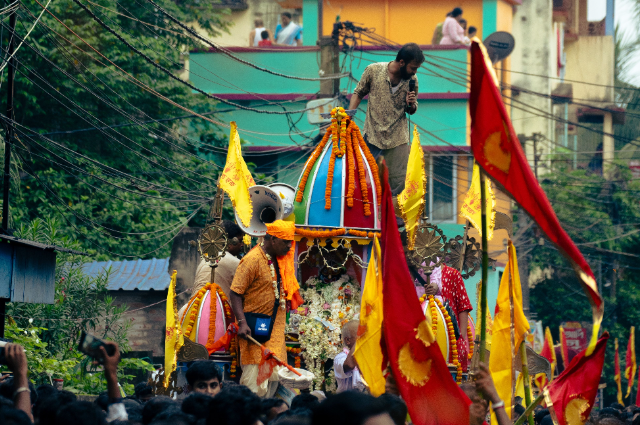
Every year in Orissa, in the month of Ashadha, a king leaves his palace in a silver-plated palanquin, arrives at three wooden chariots on Puri’s Grand Road, and picks up a broom.
This is the titular king of Puri, the Gajapati Maharaja and the chariots belong to Lord Jagannath, his elder brother Balabhadra, and his sister Devi Subhadra. They are rebuilt from scratch every year, without the use of nails or machines, using only sacred wood floated down the Mahanadi and joined by carpentry passed down through generations. Every year, the chariots carry the three divine siblings from Jagannath Temple to the Gundicha Temple (3 km away), their birthplace for nine days. These nine days constitute the oldest and largest chariot festival in the world, the Rath Jatra.
Dating back to the 12th century, the cleaning of the chariots by the titular king is the second phase of the festival. In 2026, the festival commenced on July 16th. Although the festival predates the Jagannath Temple, when the stone temple was commissioned by King Anantavarman Chodaganga Deva, the ritual calendar and the dimensions of the chariots were codified into sacred texts like the Kapila Samhita and the Niladri Mahodaya. The largest, Nandighosa, stands 45 feet tall on 16 wheels. Taladhwaja follows at 44 feet and on 14 wheels. Darapadalana is 43 feet on 12 wheels. The king climbs each chariot, sweeps it with a golden-handled broom before sprinkling sandalwood water as part of the Chhera Pahanra ritual, symbolising the equality of all before the divine. Following this, devotees from across the world pull the chariots to the Gundicha Temple.
The Chhera Pahanra ritual, the king sweeping the chariots of the deities, has survived centuries, relatively unchanged. Sweeping is not an incidental chore. In India, it is one of the socially coded acts of labour, relegated to the bottom of the caste order, beneath the dignity of the privileged. It forms an individual’s identity which does not dissolve with a change of occupation. The king’s act of sweeping is, therefore, not a performance of generic humility. It is a deliberate occupation of labour which has for centuries been deemed as not worthy of respect. Its symbolism of the dissolution of hierarchy is not abstract but precise.
However, neither the ritual nor its symbolism is new. The tradition can be traced back to the 12th century when King Anantavarman Chodaganga Deva declared himself Rauta (servant) of Lord Jagannath, ruling Orissa as his representative rather than a Sovereign in his own right. Since then, kingship in Puri has been structured as stewardship on behalf of the deity, not ownership of the throne. Chhera Pahanra is a reminder and reflection of this arrangement of stewardship. It restates the premise on which the Gajapati’s authority rests. In the name of Lord Jagannath.
The dissolution of hierarchy and differences repeats in another phase of the festival. The Rath Yatra procession, unlike the temple it originates from, does not ask who is pulling the ropes of the chariots. Throughout the nine days, outside the temple which defines who may approach him, caste and religion dissolve in the procession of Lord Jagannath. The chariots pause at the samadhi of Salabega, a 117th-centurypoet and devotee of the God, born to a Muslim father and a Hindu mother, whose verses remain part of Lord Jagannath’s worship.
However, the equality reflected in the most pivotal celebration of Lord Jagannath is a sharp contradiction to the longstanding practice of the institution and infrastructure that serves him. A stone slab at the Lion’s Gate states, in five languages, that only Hindus may enter. Non-Hindus and lower castes cannot seek the deity’s blessings within the temple walls. In 1934, Mahatma Gandhi was not permitted entry into the temple because he was leading an interfaith entourage of Muslims, Christians and Dalits. In 945, Babasaheb Ambedkar was similarly denied entry due to his lower caste. In 1984, Indira Gandhi was denied entry on account of being married to a Parsi. In 2005, the Queen of Thailand was refused entry for being a Buddhist.
While non-Hindus are restricted from entering the temple, devotees from all faiths and castes are welcome to join the procession and pay their respects during the festival. And here, all hierarchy and categorisation dissolve as the Chhera Pahanra ritual symbolises the subjugation of the mortal to the divine. It also highlights the conflicting nature of the temple’s year-long practice and the symbolism of its rituals during the nine days of the festival. A central underlying belief of the most important celebrations of Lord Jagannath does not hold true within his own temple.
This reduces the Chhera Pahanra to a staged performance because true symbolism requires substance from which the symbol is derived. For the symbolism of equality to hold, equality must be practised. The temple does not. It symbolises that the King can sweep the chariot of the deity. But the one who is identified as a sweeper cannot enter the temple. The logic of equality is defied.
This is not a failure of the ritual or a question on the sincerity and faith of the king who kneels to sweep, but rather it reveals the limits of what a ritual can do. The interpretation of the Chhera Pahanra rests with those within the temple. A discourse on why the Chhera Pahanra’s underlying belief is not practised by the temple opens the door to the broader question of interpretation of sacred texts, the need to reinterpret or discard in order to remain culturally relevant and finally, on one’s authority to engage in this discourse.
References:
- Puri Rath Yatra 2026: Titular King performs Chhera Pahanra ritual Puri Rath Yatra 2026: Titular king performs Chhera Pahanra ritual
- Orissa Diary – Rath Yatra 2026: What is Chhera Pahanra? Rath Yatra 2026: What is Chhera Pahanra? The Sacred Ritual Performed by the Puri Gajapati | Odisha Diary, Latest Odisha News, Breaking News Odisha
- Rath Jatra (Government of Orissa) - Rath Jatra, Festival of Chariots at Puri
- Boldsky – Jagannath Rath Yatra Begins Today: The Ancient Chariot Metaphor Every Devotee Should Know Jagannath Rath Yatra Begins Today: The Ancient Chariot Metaphor Every Devotee Should Know - Boldsky.com
- Puri’s Jagannath Temple: Why Non-Hindus and Foreigners Can’t Enter Here Puri’s Jagannath Temple: Why Non-Hindus and Foreigners Can’t Enter Here – Hindu Press International
- Deccan Herald – Will Non-Hindus be denied rendezvous with Lord Jagannath? Will non-Hindus be denied rendezvous with Lord Jagannath?
- Art of Puja – Jagannath Rath Yatra 2026: Date, Significance, Rituals & Complete Festival Guide Rath Yatra 2026: July 16 Date, Rituals & & Significance | Art of Puja
- The India Forum – Faith, Filtered: Jagannath Temple at Puri Faith, Filtered: Jagannath Temple at Puri | The India Forum
- The Wire – When Kumbhipatua Rebels Attacked the Jagannath Temple When Kumbhipatua Rebels Attacked the Jagannath Temple in Puri