
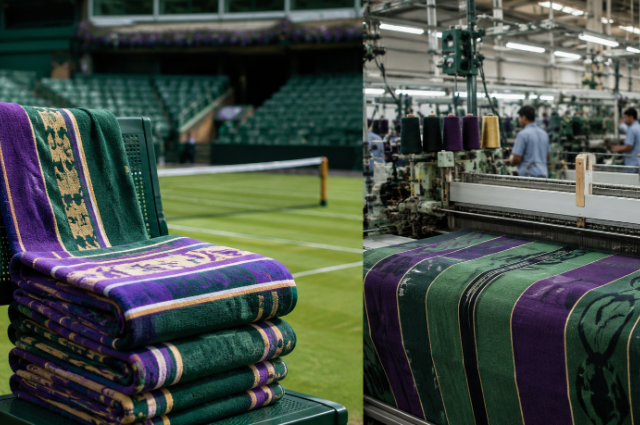
For two weeks every summer, Centre Court shows us a quintessentially British legacy. The all-white dress code, the strawberries and cream, the polite ripple of applause and the Royal Box. Between games, the players reach for their towels, wipe their face, and drape it over their neck as they take a breather. For men, it is green and purple and tennis enthusiasts recognise it. It appears only on the Wimbledon court, and it has a legacy of its own. Fans queue for hours to buy one as a souvenir. Few know that the towel was woven in an industrial town in Gujarat, India.
Wimbledon’s towel supplier, Christy, began in 1850 as a Manchester cotton mill, reportedly weaving one of its earliest pieces of terry towel for the Queen of England. In 1987, it became the tournament's official supplier. For two decades, the towels were designed, woven, dyed and finished in Britain. One British legacy serving another. However, in 2006, Christy was acquired by Welspun Living, an Indian home textiles company, headed by Dipali Goenka. The change was gradual and, on the surface, imperceptible. While the design stayed anchored to Christy’s studio, within the next four years, manufacturing relocated to Welspun Living’s facility in Vapi (Gujarat’s Valsad district). Since 2009-2010, every Wimbledon towel has been woven in India.
Design planning for each year’s towel begins roughly 18 months in advance. Colour palettes have to read clearly under stadium lights and on camera. Men’s towels carry Wimbledon’s signature green, purple and gold. Women’s towels receive a new seasonal palette every year. The 2026 edition was red and white, nicknamed the “strawberry towel” by fans. Each towel takes about seven days to make, using yarn-dyed jacquard weaving wherein coloured yarn is woven onto the fabric rather than being printed onto it, producing a reversible pattern that a pulled thread cannot unravel. Aimed towards sustainability, the towels bear the Oeko-Tex MADE IN GREEN certification and use cotton sourced through the Better Cotton Initiative. Its packaging also incorporates FSC paper and LDPE packaging comprising which includes plastic packaging scrap generated in-house. The towels continue to use HygroCotton, a fibre treatment designed to increase softness and absorbency, trademarked by Christy. The technology remains the same. The brand remains the same. The lineage appears to be the same, although it has changed.
This deserves some thought because it is an inversion of an old status quo. Once upon a time, cotton moved the other way. During the 19th century colonial rule in India, raw cotton was exported to Britain where it was designed, spun, woven, dyed, finished and branded. The value addition occurred in Britain and Indian cotton was marketed back to India and the rest of the world at under a British name (and price). The value of the fibre itself and where it came from was forgotten and replaced by the name that turned the fibre into a finished product. Today, while Christy continues to design the towel in Britain, the weaving and finishing now take place in India. The branding, however, remains British.
Across global supply chains, we find echoes of such arrangements where Western brands take credit for Indian manufacturing. However, this goes beyond such instances. Welspun Living owns Christy. The name, the 1850’s origin story, the royal warrant lineage now belong to Welspun. Its future had been altered by it and will be defined by it. Their futures are now entangled. However, acquisitions do not transfer the psychology of prestige and heritage. The towel is sold and marketed on the strength of ‘Manchester heritage’, not ‘Gujarat craftsmanship’. And I am inclined to argue that this has more to do with luxury marketing than anything else.
Retaining a brand name, particularly a luxury brand name, after acquisition signals and underlines the fact that the uniqueness of the brand will be retained, which ensures that the brand does not lose its loyalists as a result of the acquisition. Losing returning customers would defeat the purpose of acquiring the brand in the first place. If the brand’s value rests in its name, so be it. The name is retained. The technology is retained. All processes and systems which affect the finished product and the consumers are retained. What changes is the name on official documents, but that rarely concerns consumers. This practice also hedges the brand from liabilities falling on the parent company.
In 2016, Target, America’s second largest discount retailer, discovered that 750,000 “Egyptian cotton” sheets supplied by Welspun contained no Egyptian cotton at all. With the US market accounting for nearly 60% of its total revenue and global export accounting for 95% of the company’s revenue, this was a huge liability for Welspun Living. The company took responsibility and accountability, engaging the services of an external auditor to audit their supply and processes. Other retailers such as Walmart and Bed Bath and Beyond announced their own audits. In 2021, following an investigation, Target cut ties with Welspun in 2021. These sheets were sold under the Fieldcrest label, not Christy and throughout the course of this investigation and all its developments, the Wimbledon towels continued to be manufactured in Welspun’s factory in Gujarat.
The liability and damage caused by the Egyptian cotton fiasco raised questions on a company’s word about the quality of its fabric. This liability, damage and the associated questions, however, did not extend to Christy, even though they fell on the parent company itself. The brand of Christy appears insulated from the liability befalling the parent company, which indicates that the acquisition did not completely unify the old brand name of Christy with the new manufacturing relocation (in Gujarat) and parentage (Welspun Living).
Nevertheless, something else had unified. The Wimbledon towel, a quintessentially British legacy, is today woven and housed in India, which once supplied the raw materials for this legacy.
References:
- Gulf News – “Wimbledon’s Iconic Towels have been made in Gujarat, India for 17 years” https://gulfnews.com
- The Print – “Wimbledon’s iconic towels are made in Gujarat” https://theprint.in
- Robb Report – “The Towels of Wimbledon: How The Championship’s Most Loved Keepsake Begins Its Journey In Gujarat” https://www.robbreportindia.com
- Welspun Living – “Exploring the Synergy between Welspun’s Expertise and Wimbledon’s Legacy” https://www.welspunliving.com
- Industry Week – “Scandal Could Be the Unmaking of India’s Bedsheet Industry”
- Scandal Could Be the Unmaking of India's Bedsheet Industry | IndustryWeek
- Quartz India – “Target has dumped one of India’s biggest textile companies because of fake bedsheets”
- Target has dumped one of India’s biggest textile companies because of fake bed sheets
- Reuters – Indian textile maker Welspun’s profit nearly wiped out on US tariff-led slowdown https://www.reuters.com
- Research Journal of Humanities and Social Sciences – “De-Industrialization: The Curse of Colonial Rule” https://rjhssonline.com