
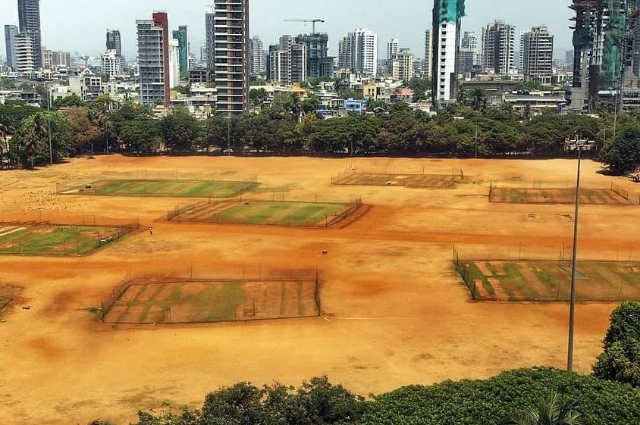
On Monday, 5th October 2026, the Supreme Court of India issued notices to the BJP, the ECI and Chief EC Gyanesh Kumar, demanding answers over concerns about the voter list revision, expecting them “to respond in a clear, transparent manner”. The court order followed protests in Mumbai and Delhi demanding the resignation of the Chief Election Commissioner, Gyanesh Kumar. In Delhi, the police arrested close to 500 people trying to get to Jantar Mantar to participate in the demonstration, including members of the Aam Aadmi Party. In Mumbai, the Cockroach Janata Party had organised the protest in Shivaji Park despite the police’s refusal to grant permission for the protests. Shivaji Park has been a silence zone since 2010.
Young protestors carried placards with memes and film dialogues aimed at Gyanesh Kumar in Shivaji Park on Friday. On Gandhi’s birth anniversary, the stage displayed quotations of non-violence alongside tributes to Ambedkar. Naseeruddin Shah, Shabana Azmi, Vishal Dadlani, and Tushar Gandhi joined the crowd.
This Mumbai police’s refusal rested on a 2013 Bombay High Court order, a state government order and concerns about traffic, noise and hospitals around the park. In 2010, the High Court confined programmes to three days a year. The state and municipal corporation later carved out forty-five days for non-sporting events. The residents raised objections, too, and their grievance was real. On the other hand, the ground is recognised as the stronghold of the Shiv Sena and the Maharashtra Navnirman Sena, both of which backed the protest. Lyricist Javed Akhtar publicly wondered if the same residents objected as strongly to party rallies, too. A 75-year-old man from Thane, Gopalakrishna Subbaiya Pillai, died of a heart attack while approaching Gate No. 6, unable to receive medical attention in time. A citizens’ forum filed a murder case against CJP founder Abhijeet Dipke. The founders, along with 400 to 500 unidentified participants, have been booked for holding the gathering despite the denial.
In Delhi, in 2018, the Supreme Court weighed the right to protest against the interests of the residents on that road and directed the court to design a mechanism for its limited use. The directive was for regulation. On 2nd October, 2026, the police denied permission for protest and suspended internet services near the site. Nevertheless, people gathered and close to 500 people were detained by the police, including AAP leaders and student activists. These were followed by allegations of manhandling of protestors in police custody.
However, a closer look at the protests reveals that these consequences were anticipated. There is a particular category of breach of law which is recognised as legitimate. It is called civil disobedience. It is what Gandhi rallied crowds for, too. These demonstrations did not merely happen to be an act of civil disobedience. The fact that it was held on Gandhi Jayanti and the founder’s slogan “Jail Bharo” (loosely translated to: We’re not afraid of being detained) evidences the intent of civil disobedience. John Rawls defined civil disobedience as a public, non-violent and conscientious breach of law, committed to changing a law or policy, by people willing to accept the legal consequences of their disobedience. Rawls also lays down the conditions for what qualifies as civil disobedience – clear injustice and the exhaustion of ordinary channels.
The Chief Election Commissioner can only be removed on the same grounds as a Supreme Court judge: misbehaviour and incapacity. In light of irregularities revealed by the Indian Express investigation, as well as the fourteen recorded objections of the other two election commissioners against decisions taken by Kumar or processes followed by him and the absence of the Chief Justice of India in the selection panel of the Chief Election Commissioner, the only available channel was public demonstration and civil disobedience. It also answers the question of why the founders, the public and the opposition leaders participated in it despite denial of permission to protest.
With respect to the consequences of this civil disobedience, Delhi and Mumbai diverge. In Mumbai, Sections 189 and 223 of the Bharatiya Nyaya Sanhita and provisions of the Maharashtra Police Act were invoked. Authorities might let minor breaches pass. However, they are also duty-bound to act on breaches committed in their presence. On the other hand, in Delhi, the police acted before the protest, detaining those on their way to the site.
In both cities, the law was upheld by the police. In both cities, the state acted. However, the response of the state agents to the same breach changed with the city. It highlights the fact that state agents also have agency in carrying out their duty and upholding the law. Rawls stated that for the breach of law to be legitimate, it must be conscientious and accompanied by acceptance of the consequences of one’s actions. However, what happens when the consequences for the same breach change with the city and one is harsher than the other? How does that reflect on the state?
Aside from these questions emerges the reality that the protests on 2nd and 3rd October were followed by the Supreme Court’s notice demanding clarification from all institutions and actors involved in the allegation. This measure of demanding transparency (of the workings of the Election Commission, which is itself an oversight body) and a response from the BJP as well as the Election Commission to the allegations was the consequence of civil disobedience. It was the conscientious breach of law which resulted in a formal step to ensure free and fair elections.
References:
- India’s Supreme Court demands answers over changes to voter roll | India | The Guardian
- Hours After Abhijeet Dipke Thanks Police, CJP Organisers & 400-500 Supporters Booked Over Shivaji Park Protest
- Forum Seeks Murder Case Against Dipke Over Protester’s Death
- Youth teaching how to protest peacefully: HC
- Court Lays Down Restrictions on the Right to Protest - Supreme Court Observer
- Civil Disobedience (Stanford Encyclopedia of Philosophy/Summer 2018 Edition)
- 'Gyanu, resign': Memes, slogans colour CJP protest against EC at Shivaji Park – ThePrint – PTIFeed.