
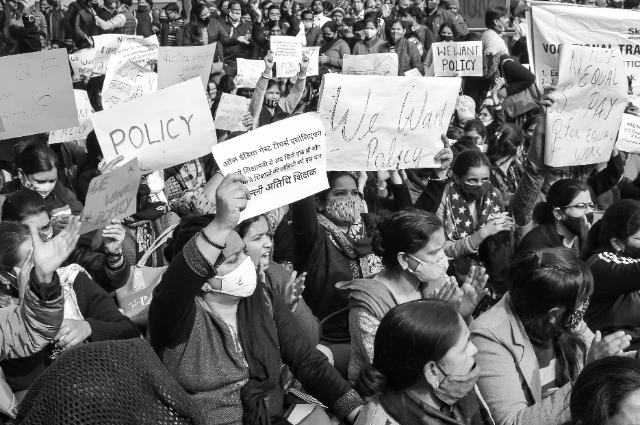
On the afternoon of 2nd October, 2026, on Gandhi Jayanti, thousands gathered at Mumbai’s Shivaji Park to demand the resignation of India’s Chief Election Commissioner, Gyanesh Kumar. Despite the fact that the Mumbai Police had denied permission to the Cockroach Janata Party, the protest commenced at 4:00 PM with an address by Shabana Azmi. The locus of the demonstration and grievance is the execution of the Special Intensive Revision (SIR) of electoral rolls. However, this development is another illustration of how democratic protests and demonstrations are the result of a pattern of grievances and inconsistencies.
An IIT Kanpur civil engineer and an IAS officer (Kerala Cadre, 1988), Kumar was a Joint Secretary in the Home Ministry’s Kashmir Division (2016), where he helped draft the Jammu and Kashmir Reorganisation Bill. This was followed by an administrative role in the establishment of the Ram Janmabhoomi Teerth Kshetra Trust. His last posting before retirement in January 2024 was as Cooperation Secretary under Home Minister Amit Shah. Within two months of his retirement, he became an Election Commissioner, and on 19th February 2025, he became the Chief Election Commissioner.
In 2023, the Supreme Court ordered that the Election Commissioners be appointed by a panel including the Chief Justice of India and the leader of the Opposition, to introduce multi-institutional oversight. However, the Parliament enacted new legislation which replaced the Chief Justice of India with a Union Cabinet Minister nominated by the Prime Minister (the leader of the ruling party). This backdrop assumes great significance in examining the grievance caused by the SIR.
In early 2025, the Election Commission began a phase-wise revision exercise to clean the electoral rolls by removing duplicate entries and names of those who have either migrated or died. In Bihar, the exercise was conducted on the eve of elections. It triggered widespread fears of disenfranchisement and loss of access to welfare. Reportedly, circulars issued in Bihar and West Bengal stipulated that individuals absent from the electoral rolls would be disentitled to welfare benefits. A cluster of write petitions challenged the constitutional validity of the Bihar SIR. On 27th May, 2026, the court upheld the validity of the SIR. It noted that the Election Commission is empowered to conduct SIR under Article 324 of the Constitution, and Section 21 (3) of the Representation of the People Act, 1950, provides for the ECI to conduct it.
However, on 28th July, 2025, RTI activist Anjali Bhardwaj had filed an RTI application asking if it was the ECI that had taken the decision to conduct the SIR. In December 2025, she received a reply from the ECI’s Principal Secretary indicating that the decision was not taken by the Commission. This not only raises serious concerns about the independence of the Election Commission and its ability to ensure free and fair elections, but also indicates that the SIR upheld by the court is not the one being executed.
To complicate matters further, as of 28th September 2026, approximately 13.98 crore names have been deleted from the electoral rolls across all three phases of SIR.
An Indian Express investigation reported that Election Commissioners Sukhbir Singh Sandhu and Vivek Joshi formally objected at least 14 times over the past ten months to decisions taken without their knowledge and raised concerns about the functioning of the Commission to the Cabinet Secretary. While concerns over his selection do not constitute a grievance against Kumar, questions pertaining to the functioning of the EC fall squarely within his authority. In light of these revelations, the two seemingly distinct facets of his selection process (which replaced the CJI with a member of the Cabinet) and his execution of SIR together reveal cracks in the independence of the Commission and its function of overseeing free and fair elections.
In February 2023, before Kumar joined the EC, in Aland, Karnataka, former BJP MLA Subhash Guttedar was found at the centre of fake applications seeking deletion of legitimate voters from the system. An FIR filed against unidentified persons in February 2023 stated that only 24 out of 6,018 deletion applications filed between December 2022 and February 2022 were genuine. The State government formed a Special Investigation Team (SIT) in September 2025 to investigate the racket and found that the targeted voters were Congress sympathisers. However, the investigation could not proceed at a critical point. While the ECI, headed by Kumar, provided the CID investigation with over 5,700 Form 7 applications (filed for deletion) and related documents, IP logos (records showing internet addresses associated with the submissions) and mobile numbers used to create login IDs and passwords on the National Voter Services Portal (NVSP), the ECI did not provide other critical information such as the destination IP address and destination port. These are required to narrow down which particular device or user was responsible for filing the fake applications.
In addition to these cracks, older concerns centred on Kumar have resurfaced. On 4th October 2026, Kerala’s Home Minister, Ramesh Chennithala, ordered a Vigilance inquiry into the 2006 Kerala State Transport Project, a 215 crore World Bank-funded project when Kumar was in the state’s Public Works Department (PWD). A Malaysian engineer working on the project died by suicide that November, naming Kumar in his letter and alleging harassment.
A democracy runs on dual legitimacy, according to Pierre Rosanvallon. Elected governments draw their legitimacy from their votes while unelected bodies draw theirs from their impartiality. Elected governments can also backslide into undemocratic exercise of authority. It is the impartiality of the Election Commission which ensures that the elections conducted are indeed democratic. Therefore, the legitimacy of the elected leaders depends on the impartial function of the Commission. Distrust in the functioning of the Election Commission implies distrust in the legitimacy of one’s leaders.
A Chief Election Commissioner can only be removed as a Supreme Court Judge, for proved misbehaviour or incapacity through Parliament. Demanding resignation is therefore not only a form of expressing grievance but also the only way to repair cracks in this institution because the one neutral member of the selection panel, the Chief Justice, has been removed from the equation. It is the cumulative impact of all these grievances and irregularities that drove the protests in Shivaji Park in Mumbai, demanding the Commissioner’s resignation.
References:
- Keralam government gets legal opinion to proceed against Chief Election Commissioner Gyanesh Kumar in abetment to suicide case - The Hindu
- CJP Protesting Against Gyanesh Kumar: What We Know About CEC At The Centre Of The Poll Panel Dispute? | Outlook India
- Election Commission to Conduct Special Intensive Revision in 12 States, UTs | Akashvani News
- Supreme Court says SIR is legally valid, doesn't violate constitutional provision
- Supreme Court backs Bihar SIR exercise, upholds ECI’s powers to purify electoral rolls - Supreme Court Observer
- Power Without Oversight
- SIR, citizenship and the burden of proof
- Inside the Aland Vote Deletion Scandal and the ECI’s Silence - Frontline