
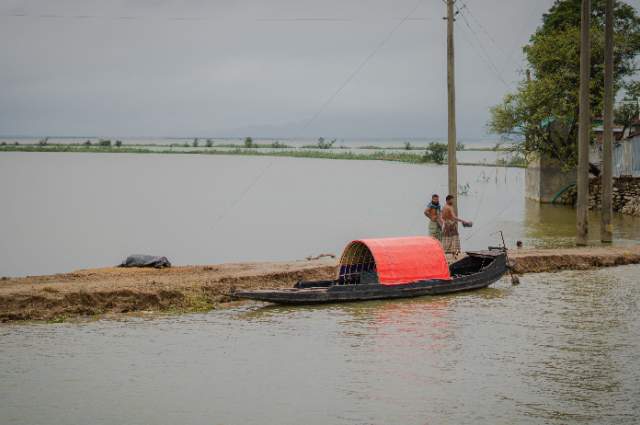
Assam is no stranger to floods. The state has been familiar with and has therefore calibrated the Brahmaputra’s temper. The flooding of Upper Assam in 2026, however, was not caused by the Brahmaputra’s overflow but by its tributaries, Dikhow and Disang, affecting over 3 lakh people across seven districts and claiming 78 lives (as of 5th August, 2026).
What caused the crisis in Assam began as relentless rain in Nagaland in the third week of July. Mon district recorded 137mm in eight to nine hours, classified by the India Meteorological Department (IMD) as intense rainfall, rather than a cloudburst. A cloudburst cannot be absorbed by any terrain. In climate language, this is different from intense rainfall, which can be absorbed by a heavy, forested hillside. The roots and the topsoil slow it down, let it infiltrate and release it gradually. However, a hillside saturated from days of prior rain or degraded from deforestation and mining will have a reduced capacity to absorb intense rainfall. The IMD’s classification, therefore, implies that this was rain that could have been absorbed by the hillside if it had not been saturated. This rainwater thus flowed down into the Dikhow, the Disang and the Janji, three south-bank tributaries that rise in the hills of Nagaland and flow down into the Brahmaputra through Upper Assam. These tributaries rose so fast that they breached their embankments before the Brahmaputra could rise and peak itself. The result was an unprecedented flooding of a part of Assam which never planned for such a crisis (Sivasagar, Charaideo, Golaghat, Jorhat).
Sivasagar and Charaideo are floodplains. However, they are not flood-conditioned in the same way as, say, Dhemaji or Barpet, which budget for Brahmaputra’s annual overreach during monsoon. In areas like Sivasagar and Charaideo, the casualty of the flood compounds because arrangements to deal with it have not been made. Flood-prone areas have raised plinths, stored food for emergencies, and operational evacuation routes. The need for these never arose in areas like Sivasagar and Charaideo.
There is another factor that contributed to the flooding in Upper Assam this monsoon.
On 22nd July, 2026, the North Eastern Electric Power Corporation Limited’s (NEEPCO, a public company under the Ministry of Power) Doyang Hydroelectric Project in Nagaland circulated a warning to Golaghat’s district administration that its reservoir was rising fast and radial gates would soon open. Golaghat’s administration issued its own warning to residents along the Doyang and the Dhansiri to steer away from the river. In the following days, NEEPCO opened the spillway gates in stages. While records show that the release was controlled and communicated, this is not the first time the dam has caused mass casualties in the monsoon.
In 2018, NEEPCO opened the same gates at the same dam with no warnings, according to local accounts, flooding 36 villages, submerging nearly 900 hectares of crop, and pushing Dhansiri’s flood level 31cm above its previous record. However, NEEPCO maintained that both states had been notified. Golaghat’s district administration filed a complaint against the project’s General Manager, and the All Assam Students’ Union threatened agitation until compensation was paid.
The 2026 flooding constitutes the same factors as the 2018 crisis, except for the formal notice issued by the project. However, the casualty figures indicate a gap between a formal issuance and the dissemination of the warning to those whose lives will be most affected by it. The released water from the dam takes eight hours to reach the hamlets of Golaghat. The fact that the crisis repeated itself raises questions about the procedures and timeline of moving information between the public power company, the administration of another district and the residents.
A river basin does not observe state boundaries. A flood-prone state and its neighbours must therefore observe the river. If the project issued its alert and if the district administrations ran their bulletins, there is a third and significant fact where negligence lay, and it rests on the Centre and its ecosystem of state administration and public sector projects to inspect and examine.
The state has raised its ex-gratia to Rs. 9 lakhs per death, waiving the post-mortem requirement to speed disbursal. Meanwhile, the IMD warned of heavy rain through 1st August, 2026, followed by a fresh red alert with more heavy rainfall over Upper Assam. This is a crisis that could have been averted if the state and centre had audited their processes and mechanisms of disseminating urgent information; and if it cannot be averted, the dissemination of this information also rests with the state.
References:
- Outlook Explains | Why Assam Floods Every Year Despite Decades Of Flood-Control Projects | Outlook India
- Assam Floods 2026 Explained: Why the State Faces Devastating Floods Every Year
- Role of Doyang Dam in bringing unprecedented floods in Golaghat – SANDRP
- How the Doyang Hydroelectric Project Flooded Assam and Nagaland – The Wire Science
- Assam floods: Death toll rises to 82; nearly 193,000 people still affected | India News - Business Standard
- Water Release from Doyang Hydel Project Sparks Flood Fears in Assam’s Golaghat District
- Assam CM waives post-mortems for flood victims, orders immediate ex-gratia disbursal - Assam flood victims to receive Rs 15,000 interim relief; ex gratia without post-mortem, announces CM Himanta -