
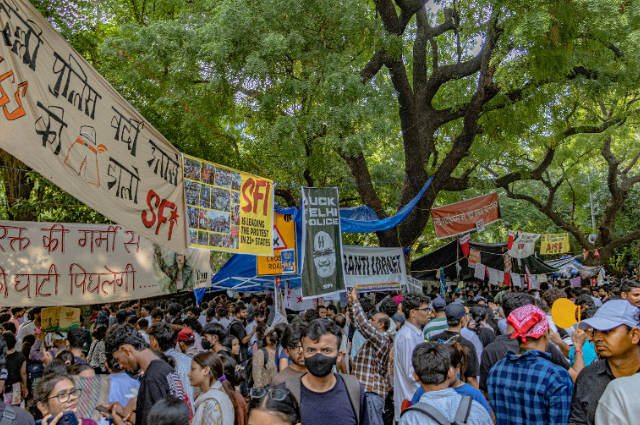
There are moments when a political protest stops being about the people who organised it.
I started thinking about that after a friend of mine returned from a vacation and found herself caught in a situation she had never chosen to be part of.
She had not joined a protest. She had not participated in a confrontation. She had not taken a political position. She simply wanted to come home.
Instead, she found herself caught up in the disruption that followed the violence in Meghalaya. Getting from Assam into Meghalaya was no longer as simple as getting into a vehicle and travelling home. At one point, she had to carry her luggage for kilometres, find a rickshaw, make her way towards Byrnihat and, after several phone calls, eventually find a Meghalaya cab that could take her home.
She had people she could call. She had people who could help her find another way. But I kept thinking about the people who did not.
What happens to the student travelling alone?
What happens to the elderly person who has no one to call? To a family travelling with children? To someone who simply needs to reach Guwahati airport?
What did any of them have to do with the protest?
That question has stayed with me because somewhere between a political agitation in Shillong, the violence that followed, the confrontation with police, and the retaliatory blockades at the Assam-Meghalaya border, ordinary people became part of a conflict they had never chosen.
And that is when I think a protest risks losing something important: its original purpose.
Before the violence, there were demands.
The Khasi Students' Union did not begin its agitation by simply taking to the streets without explanation.
The organisation had put forward a five-point charter of demands and given the Meghalaya government 15 days to respond. The demands included issues concerning indigenous rights, migration, employment, government recruitment and the proposed Shree Cement project in East Jaintia Hills. KSU also raised concerns about recruitment at NEIGRIHMS and demanded implementation of the Meghalaya Residents Safety and Security Act, along with other measures connected to migration and the Inner Line Permit.
On the Shree Cement issue, KSU alleged that the July 31 public hearing for the proposed project had not been conducted fairly and demanded that the proceedings be cancelled and that action be taken against officials it held responsible. Those are allegations made by the organisation, not facts that should simply be assumed to have been established.
The same distinction matters when discussing the other demands.
People can disagree with demands for greater restrictions on migration. They can disagree with proposals for local reservation in employment. They can disagree with the way the Inner Line Permit issue is framed.
But disagreement with a political demand does not make the demand itself irrelevant. These were the issues that formed the background to the agitation.
Then came August 19.
When the rally changed the conversation
After the 15-day ultimatum expired, KSU organised a black-flag motorcycle rally across Shillong. The rally was intended to put pressure on the government over the union's demands. Instead, violence broke out.
Vehicles were damaged. People were reportedly assaulted. Government vehicles were set on fire, and statues of Swami Vivekananda and Netaji Subhas Chandra Bose were reportedly vandalised. Police later said that 31 vehicles had been damaged, while several FIRs were registered.
There is no justification for attacking someone because they happen to be passing by. There is no justification for destroying someone's vehicle because of its registration number.
There is no justification for vandalising public property because you are angry with the government.
And there is certainly no justification for violence against people who had nothing to do with the protest.
I understand the anger that follows when people see videos of someone being attacked or a vehicle being destroyed. I would be angry too.
But this is where I think we lost part of the conversation.
The violence became the story.
The five-point charter became secondary.
The questions about recruitment, migration, environmental concerns and the Shree Cement hearing were pushed into the background.
People stopped asking, What were they protesting about?
They started asking only, What did they do?
That is an important question.
But it is not the only one.
Protest, violence and accountability
Three senior KSU leaders-President Raymond Kharjana, Vice-President Pynkmenlang Sanmiet and General Secretary Reuben Najiar-were arrested following the violence and later remanded to judicial custody. Police said the arrests were connected to offences arising from the rally. KSU leaders, meanwhile, disputed the characterisation of the violence and said that others who joined the rally may have been responsible for acts intended to discredit the organisation.
These competing claims should be allowed to go through the proper legal process. But there is a larger principle here.
A political cause does not excuse violence.
At the same time, condemning violence does not require us to stop asking why the protest began.
We should be able to hold both thoughts in our heads at once.
Those responsible for assaulting people should be held accountable.
Those responsible for damaging vehicles and public property should be held accountable.
Those who organised a large protest should also be willing to answer difficult questions about what happened during it.
And the actions of the police and authorities should also remain open to scrutiny when their operations affect people who were not involved.
One form of wrongdoing does not erase another.
Accountability should not depend on which side we sympathise with.
When the conflict reached people's homes
The situation became even more complicated after police action against KSU members and the unrest that followed.
Authorities reported further incidents involving petrol bombs and attacks on government or police-related properties. At the same time, people living near areas where confrontations occurred were caught in the consequences.
Friends of mine live close to the KSU office in Jaiaw.
When tear gas was used during the confrontation, they experienced burning eyes and difficulty breathing.
They were not protesters.
They had not organised the rally.
They had not attacked anyone.
They were simply living in their own neighbourhood.
That is what concerns me about the way conflicts like this escalate.
At first, the disagreement has identifiable sides.
There is an organisation. There is a government. There are demands. There are negotiations. Then violence enters the picture, and suddenly the number of people affected begins to grow.
People who were not part of the original disagreement become witnesses, victims, bystanders or unwilling participants. The circle becomes wider, and once that happens, the original political question becomes harder to hear.
Then it became Assam versus Meghalaya.
Perhaps the clearest example of this came at the border.
Reports said Assam-registered vehicles were among those targeted during the Shillong violence. In response, transport workers in Assam protested at Jorabat, while Meghalaya-side drivers also blocked Assam-registered vehicles in retaliation. Movement between the two states was disrupted.
And suddenly, a dispute that had begun with KSU and the Meghalaya government had acquired another identity.
It became Assam versus Meghalaya.
That transformation should worry us because a vehicle has a registration number; a person does not. An Assam-registered vehicle became “Assam”. A Meghalaya-registered vehicle became “Meghalaya”, and the person sitting inside the vehicle became secondary. That is where anger becomes dangerous.
When we are angry enough, we stop seeing the individual in front of us and start seeing only the group we believe that person represents.
A passenger, a driver, a vehicle, becomes a symbol. And once people become symbols, it becomes much easier to justify treating them as if they are responsible for something they never did.
That is how collective punishment begins to feel normal.
But the person carrying a suitcase across a border is not responsible for a political dispute simply because of the number plate of the vehicle they were travelling in.
What happened to the original demands?
This is the question I keep returning to.
What happened to the original demands?
The questions about the Shree Cement public hearing are still questions. The questions about migration and employment are still questions.
The questions about recruitment in government departments and at NEIGRIHMS are still questions.
The questions about the Meghalaya Residents Safety and Security Act and the Inner Line Permit are still questions.
Whether we agree with KSU's positions or disagree with them, those political issues did not disappear because the rally became violent.
But the public conversation changed. The violence became louder than the grievances.
The arrests became louder than the demands.
The damaged vehicles became louder than the political questions.
The Assam-Meghalaya confrontation became louder than the issues that had originally brought protesters onto the streets.
And perhaps that is the greatest irony. A protest is supposed to make people listen.
But if violence becomes the dominant story, people may stop listening to what the protesters were actually saying.
We need two conversations, not one.
I think we have made the mistake of treating this entire episode as though there is only one question to answer.
There are at least two.
The first is political.
Were the demands reasonable?
Was the government's response adequate?
Was the Shree Cement public hearing conducted fairly?
How should migration be regulated?
How should local employment opportunities be protected?
How should government recruitment be made more transparent?
What should happen with recruitment at NEIGRIHMS?
These are questions about policy, governance and political representation. They deserve debate.
The second conversation is about accountability.
Who assaulted whom?
Who damaged vehicles?
Who vandalised public property?
Who attacked police personnel?
Was the police response appropriate?
What responsibility did protest organisers have for maintaining discipline? What should happen to people found responsible for violence?
These are questions of law and accountability.
They also deserve answers.
The mistake is allowing one conversation to erase the other.
We can condemn violence without pretending the political grievances never existed. We can examine political grievances without excusing violence.
We can demand accountability from protesters and still demand accountability from authorities. And most importantly, we can refuse to punish people collectively for something they did not do. What does normalcy mean to the person with the suitcase?
The governments of Meghalaya and Assam have had to deal with the consequences of the unrest and the disruption of movement between the states.
But whenever governments speak about restoring “normalcy”, I find myself thinking about that person standing at a blockade with a suitcase.
Normalcy is not a statement issued by a government.
Normalcy is being able to get into a vehicle without worrying about its registration number. It is being able to travel to the airport without wondering whether someone will stop you.
It is knowing that if another person committed a crime, you will not be punished simply because you share a state identity with them.
It is being able to cross a border without becoming part of a political conflict you never chose. That is what ordinary people deserve.
Can we find the conversation we lost?
People have the right to protest when they believe their government is not listening.
But a protest also carries a responsibility.
If violence takes over, the people who are responsible for that violence must answer for it.
And those who organise protests have a responsibility to ask what went wrong when an agitation becomes destructive.
At the same time, the government has a responsibility to engage with legitimate political grievances rather than allowing them to disappear beneath the noise of confrontation.
And all of us have a responsibility not to turn anger into collective punishment. Because once we do that, the conflict keeps expanding.
A political disagreement becomes a confrontation between protesters and police. That confrontation spills into attacks on vehicles.
Those attacks provoke retaliation.
Retaliation disrupts movement across a state border.
And suddenly people who were never part of the original disagreement are carrying luggage down a road, waiting for a vehicle, worrying about whether they will make it home.
That is the part of this story I cannot forget.
Not the flags.
Not the slogans.
Not even the headlines.
The suitcase.
The person carrying it.
And the fact that they never asked to become part of any of this.
A protest begins because someone wants to be heard.
But what happens when the violence becomes so loud that nobody can hear the original message anymore?
Perhaps that is the question we should be asking now.
Can we find our way back to the conversation we lost?
References:
- Meghalaya Today- KSU Rally in Shillong Over Various Demands:
https://meghalayatoday.com - The Times of India- KSU Bike Rally Turns Violent in Shillong Amid Agitation Over Five-Point Charter:
https://www.google.com - NDTV- 3 Student Union Leaders Arrested Over Shillong Bike Rally Violence: https://www.google.com
- The Meghalayan Express- Govt to Invoke MMPO to Recover Damages from KSU: https://themeghalayanexpress.com
- Yes Punjab- Shillong Tense as Three KSU Leaders Set to Be Shifted to Garo Hills Jails Amid Heavy Security:
https://yespunjab.com - The Times of India- After Meghalaya Rampage, Central Forces Deployed; Assam Transporters Block Entry Point to State:
https://www.google.com - NewsBytes- Meghalaya High Court Orders Calm; KSU Rally Damages 31 Vehicles: https://www.newsbytesapp.com
- The Times of India- Assam-Meghalaya Traffic Disrupted for 2nd Day as Drivers Continue Blockade at Jorabat:
https://www.google.com