
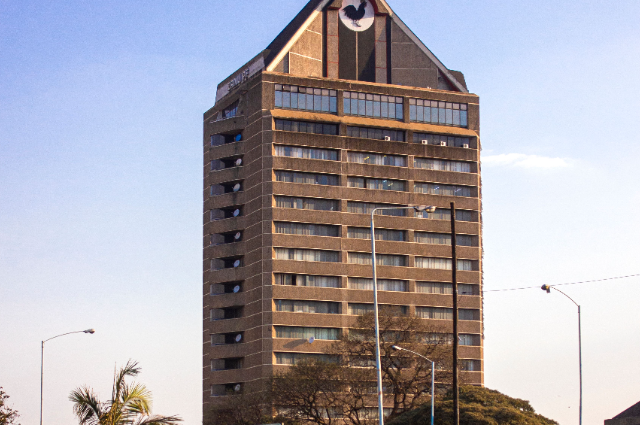
There is something slightly strange about the Eastgate Centre in Harare. It is a large office and shopping complex in the middle of Zimbabwe's capital, but one of the ideas behind its cooling system came from somewhere much smaller: a termite mound.
The building was designed by Zimbabwean architect Mick Pearce in collaboration with engineers Ove Arup & Partners and opened in 1996. Instead of relying on a conventional central air-conditioning system, the design uses airflow, the building's concrete mass, and the difference between daytime and night-time temperatures.
The termite connection is not as simple as "termites built an air conditioner." Termite colonies live in mounds where temperature, humidity, and gases must be managed for the colony and its fungus gardens. The mound contains a complicated network of passages through which air can move. Research has shown that temperature changes during the day and night can help drive these air movements.
Pearce was interested in that basic idea: a structure could influence its own internal environment without relying entirely on mechanical cooling. Eastgate applies the principle on a much larger scale.
The building has thick concrete elements that can absorb heat during the day. At night, when Harare's air becomes cooler, fans help move that cooler air through the building and remove heat stored in the structure. During the hotter part of the day, the mass of the building slows down the rise in indoor temperatures. Warm air is carried upward and out through a series of ventilation ducts and chimneys.
The result is not a building with no technology. That is one of the things that gets lost when Eastgate is described as a "building that cools itself." Fans are still part of the system. The design works because mechanical assistance and passive features are used together rather than treating air-conditioning as the only answer to heat.
And it has made a measurable difference. Arup, one of the engineering firms involved in the project, says Eastgate was designed around reducing energy consumption while maintaining a comfortable indoor environment. Other documentation on the building reports that its passive cooling system can use roughly one-tenth of the energy required for conventional cooling in a comparable building. The figure often quoted as a 90 per cent saving therefore needs to be understood in that specific context rather than as a blanket claim about all of the building's energy use.
There is another interesting part to the story.
The building does not look like a termite mound.
Eastgate has a large atrium, brick walls, concrete structures and a series of chimneys that are visible from outside. Its appearance was also influenced by Zimbabwean architecture, including the stone structures associated with Great Zimbabwe. The termite idea was mainly about how the building handles heat and air, not about copying the shape of an insect's home.
This is what makes Eastgate a useful example of biomimicry, using ideas found in nature to solve human problems. Nature does not always offer a ready-made machine. Sometimes it offers a principle.
In this case, the principle was that a structure could work with changes in temperature and airflow instead of constantly fighting them with more energy.
There is also an important qualification. Scientists now have a more detailed understanding of termite mounds than the explanations that were common when Eastgate was designed. Modern studies suggest that mound structures play an important role in gas exchange as well as temperature regulation. So the old claim that termites simply keep their homes at one perfectly constant temperature is an oversimplification.
That does not make Eastgate less interesting.
If anything, it makes the story better.
A building designed in the 1990s continues to raise a question that is becoming increasingly relevant as cities become hotter and buildings consume more energy: do we always need to overpower the environment to make buildings comfortable?
Eastgate's answer was to look at something much older than modern engineering. A termite mound.
References:
- Arup - Eastgate: Creating More Resilient Buildings Inspired by Nature.
- AskNature - Passively Cooled Building Inspired by Termite Mounds.
- King, Ocko & Mahadevan - “Termite Mounds Harness Diurnal Temperature Oscillations for Ventilation.”