
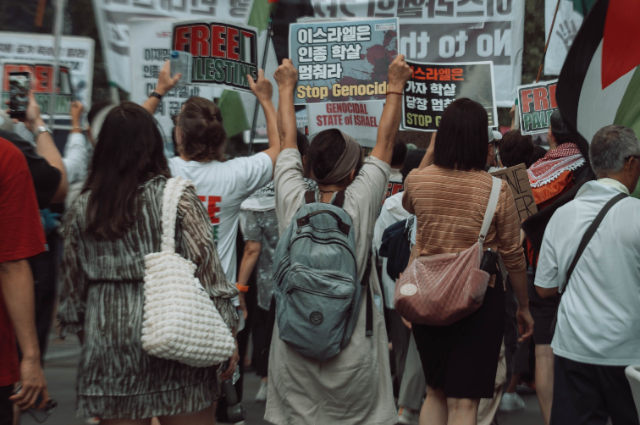
What happens when women stop seeing marriage, dating and motherhood as things they are expected to do?
South Korea has given that question an unusual answer. The 4B movement, whose name comes from four Korean words beginning with “bi”, asks women to reject dating men, sex with men, marriage and childbirth. It is not simply a campaign against men. For its supporters, it is a decision to step away from relationships and social expectations that they believe have repeatedly disadvantaged women.
The movement emerged from South Korea's online feminist spaces in the mid-2010s. Its development is closely associated with communities such as Megalia and later Womad, where women were discussing misogyny, sexual violence, beauty standards and the expectations placed on women. Some of these discussions eventually moved beyond the internet and became part of a much wider rejection of conventional gender roles.
That context matters because it is easy to misunderstand 4B if it is reduced to “women refusing men”.
South Korea has had a particularly intense gender conflict in recent years. Non-consensual filming, online sexual abuse, workplace inequality and arguments over reproductive rights have all contributed to distrust between sections of young men and women. For some women involved in 4B, refusing relationships is therefore not presented as a temporary protest. It is a way of reorganising their lives around independence rather than marriage and family.
Then the movement became a global story.
In November 2024, after Donald Trump's victory in the US presidential election, the term suddenly began appearing everywhere on American social media. Women posted videos saying they were cancelling dates, leaving relationships or considering 4B as a response to concerns about reproductive rights and gender equality. Google searches for the term jumped sharply, and several TikTok videos received millions of views.
But something was lost in that sudden popularity.
The American version of 4B was often presented as though thousands of women had collectively joined an organised movement overnight. That picture is misleading. In South Korea, 4B has never represented all women, and even estimates of its size are difficult. It is better understood as a particular feminist position that became highly visible online than as a mass organisation with a membership card and a fixed structure.
There is also an uncomfortable question surrounding the movement's politics.
Some versions of 4B have been criticised for excluding transgender women and for their hostility towards gay men. That criticism has created an internal debate about where feminist resistance ends, and exclusion begins. Supporters, on the other hand, argue that the movement is about women's right to withdraw from relationships they do not want and should not be forced to justify that choice. The disagreement is part of the movement's story and should not simply be brushed aside.
Then comes the demographic question.
South Korea has one of the world's lowest fertility rates. That movement is centred partly on rejecting childbirth particularly interesting to demographers and policymakers. But it would be misleading to say that 4B caused South Korea's population problem. The country's falling birth rate has much deeper roots, including the high cost of housing and education, demanding work culture, delayed marriage and concerns about the unequal burden of childcare and household work. 4B is better understood as one response to these conditions rather than their single cause.
In fact, the demographic crisis raises a different question: why are some women opting out?
If marriage and motherhood are genuinely attractive and equally shared responsibilities, choosing them should not be a social burden. But if women believe marriage will mean sacrificing their careers, taking on most domestic work or giving up personal freedom, refusing marriage can become a rational personal decision.
That is where 4B becomes more complicated than a slogan.
Is it a feminist movement because it challenges an old expectation that women must marry and have children? Or is it a retreat from relationships that leaves the larger system unchanged?
There is no single answer.
A woman deciding not to marry does not automatically change the laws, workplaces or social structures around her. But a large enough number of women making the same decision can make those structures harder to ignore. Governments can encourage childbirth through financial incentives, but they cannot simply order people to want families.
South Korea's experience, therefore, raises a much bigger question than whether 4B will spread.
If an entire generation begins questioning marriage and motherhood, perhaps the first thing to examine is not why women are refusing those institutions, but what those institutions have come to demand from them.
That may be the reason 4B continues to attract attention far beyond South Korea. Its most uncomfortable message is also its simplest one: people cannot be expected to build families with institutions they do not believe are built for them.
References:
- Lee, Y.-I. (2025). 4B movement: South Korean feminist activist movement. California State University, Sacramento.
- Demopoulos, A. (2024, November 7). ‘No man will touch me until I have my rights back’: Why the 4B movement is going viral after Trump’s win. The Guardian.
- Elliott, V., & Watercutter, A. (2024, November 7). After Trump's victory, the 4B movement is spreading across TikTok. WIRED.