
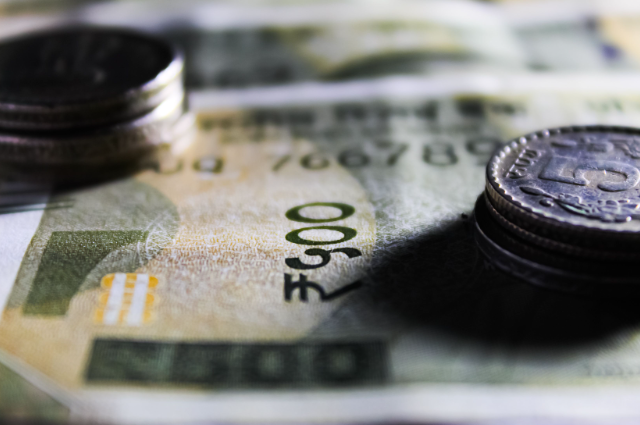
There was a time when ₹100 felt like a large amount of money.
Now, against the US dollar, it is starting to look very small.
In May 2026, the Indian rupee fell into territory that would once have seemed almost unthinkable, crossing ₹96 to the dollar and touching around ₹96.9 intraday. By September, it had moved back somewhat but was still hovering near ₹96. On September 16, it closed around ₹95.96 after briefly touching ₹95.98. The number may move every day, but the direction has become difficult to ignore.
The rupee's fall is not simply a story about one bad trading day.
During the first part of 2026, it lost roughly 7–8% against the dollar, making it one of Asia's weakest major currencies. Reuters reported in May that the rupee had become Asia's worst-performing major currency for the year, with the decline being driven by a combination of foreign outflows, high energy prices and pressure on India's external accounts.
And this is where the story becomes more complicated than “the dollar became stronger.”
India imports a large share of the oil it consumes. When international crude becomes expensive, India needs more dollars to pay for the same quantity of oil. That increases demand for dollars and puts pressure on the rupee. In 2026, the problem became sharper because the conflict involving Iran pushed oil prices higher. By September, Brent crude had moved above $100 a barrel again, and rising oil prices were once more putting pressure on India's trade balance and inflation outlook.
Then there is foreign investment.
Money moves across borders for reasons that have little to do with national sentiment. Investors compare returns, interest rates, risks and opportunities. In 2026, foreign investors pulled a record $24.6 billion from Indian equities during the year, although August brought a strong reversal, with foreign portfolio investors putting $3.1 billion back into Indian shares. The outflows therefore mattered, but they were not a permanent one-way movement.
US trade policy has also been part of the story, although the timeline matters.
The United States had imposed a combined tariff burden of as much as 50% on Indian imports in 2025, creating uncertainty for Indian exporters and investors. But that 50% rate did not remain in place throughout 2026. By August 2026, the tariff burden had been reduced substantially, and Indian exports to the US actually increased in August. So it would be too simple to say that a 50% US tariff directly caused the rupee's entire 2026 decline.
This is important because exchange rates rarely have one villain.
Oil matters. Capital flows matter. Interest rates matter. Trade matters. Expectations matter. And sometimes the dollar itself is moving because investors around the world are looking for safety.
The Reserve Bank of India has also been trying to slow the fall. In September, state-run banks were seen selling dollars, which market participants attributed to RBI intervention. The central bank is not trying to maintain one permanent rupee-dollar number; its interventions are more about preventing sharp or disorderly movements.
But perhaps the more interesting comparison is not with America.
It is with Pakistan.
For years, the Indian rupee has been significantly stronger than the Pakistani rupee. That has not suddenly changed. One Indian rupee still buys several Pakistani rupees. But the distance between the two currencies has narrowed.
In May 2025, ₹1 was worth roughly 3.30 Pakistani rupees. By September 2026, it was around 2.89 Pakistani rupees. That represents a fall of roughly 12% in the INR/PKR exchange rate. In other words, the Indian rupee has lost ground against the Pakistani rupee even though the Pakistani currency remains much weaker in absolute terms.
That distinction matters.
A currency becoming weaker against another currency does not automatically mean that it has become the weaker currency overall. The Indian rupee is still worth substantially more than the Pakistani rupee. What has changed is the rate at which the gap between them is being measured.
And Pakistan's own currency has had a very different recent story.
The Pakistani rupee went through a severe crisis in 2023, but subsequent stabilisation efforts, including support under an IMF programme, helped bring greater stability to the currency. Meanwhile, India's rupee has been facing a different combination of pressures: expensive energy imports, foreign portfolio outflows, trade uncertainty and changing global interest-rate expectations.
So why does the India–Pakistan comparison feel surprising?
Because currency strength is not the same thing as economic strength.
A country's currency can weaken while its economy continues to grow. India can have strong services exports, expanding manufacturing and substantial foreign-exchange reserves while its currency loses value against the dollar. In August 2026, India's total goods and services exports were estimated at $82.68 billion, while foreign-exchange reserves remained a major buffer against external shocks.
The more useful question, therefore, is not simply: “Why has the rupee fallen?”
It is: “What does the fall reveal about India's vulnerabilities?”
A weaker rupee makes Indian goods cheaper for foreign buyers in some circumstances, which can help exporters. Recent data actually showed a strong increase in India's August exports, including a 21% rise in shipments to the United States. But the same depreciation makes imported goods more expensive. For an economy that depends heavily on imported crude oil, that can feed into transportation costs, production costs and eventually household prices.
So the number on the currency board tells only half the story.
₹96 to a dollar sounds dramatic because it is easy to understand. But behind that number are oil tankers, foreign investors, interest rates, trade deficits, central-bank interventions and geopolitical conflicts happening thousands of kilometres away.
The rupee's record low is therefore not just a story about a currency losing value. It is a reminder of how connected an economy is to things it cannot completely control. And perhaps that is what makes ₹96 more significant than ₹96 itself.
References:
- Reuters. (2026, May 13). Indian rupee hits record low as outflows, oil strain worsen rout. Reuters.
- Reuters. (2026, September 16). Rupee languishes at six-week low ahead of Fed outcome, RBI limits losses. Reuters.
- Reserve Bank of India. (2023). Table 138: Exchange rate of the Indian rupee vis-à-vis major currencies. RBI.
- Reuters. (2026, August 31). Foreign buying in Indian stocks hits 23-month high in August. Reuters.
- ExchangeRates.org.uk. (2026). Indian rupee (INR) to Pakistani rupee (PKR) exchange rate history.