
Every generation has a moment that tells it whether the system is listening. For India's young people, that moment may no longer be an election.
It may be an examination.
For years, competitive exams have been presented as the great equaliser. Work hard enough, study long enough, and success will eventually belong to merit. That promise has shaped millions of households. Parents have borrowed money for coaching classes. Students have spent years preparing in cramped rooms, convinced that one examination could change the direction of an entire life.
But promises are fragile.
Every paper leak weakens them.
Every cancelled examination delays them.
Every unanswered question breaks them a little more.
The youth-led movement known as the Cockroach Janta Party (CJP) did not emerge from a traditional political campaign. It grew out of an insult. During court proceedings linked to exam-related issues, the word "cockroach" became a symbol that many young people embraced rather than rejected. What was intended as a dismissal was transformed into an identity- one that reflected anger, resilience and a refusal to disappear from public conversation.
Soon, the movement was no longer only about a name. It became about trust.
Its central demand has been the resignation of Union Education Minister Dharmendra Pradhan, with protesters arguing that repeated examination irregularities have destroyed confidence in recruitment and entrance systems. The demonstrations gained further momentum after social activist Sonam Wangchuk was reportedly hospitalised during the agitation, drawing wider public attention to the protests.
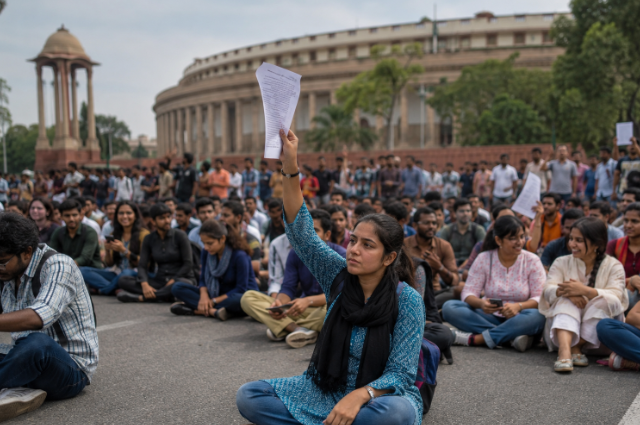
This week, thousands of demonstrators marched towards Parliament.
Television cameras captured scenes of tear gas, barricades and baton charges. Videos circulating online showed protesters being pushed to the ground as police attempted to disperse the gathering. One image, in particular, stayed with many viewers- a woman lying on the road while officers continued moving through the crowd.
Images like these travel faster than explanations.
Within minutes, they become symbols.
To some, they represent the excessive use of force against peaceful demonstrators. To others, they reflect the difficult task of policing large protests in a high-security zone.
The truth of what happened in each confrontation will ultimately depend on evidence, official inquiries and the accounts of everyone involved.
Yet one reality is already beyond dispute.
Thousands of young people chose the streets because they believed the examination hall was no longer enough.
That should concern everyone.
Not because protests are unusual in a democracy.
But because examinations occupy a unique place in India's social contract.
For millions of families, an exam is not merely a test.
It is an investment.
It represents years of sacrifice, postponed dreams and the belief that hard work will be rewarded fairly. When that belief weakens, the damage extends far beyond a single recruitment cycle. It begins to erode confidence in institutions themselves.
The government has responded by offering dialogue, even as police action and detentions have continued. Whether those conversations produce meaningful reforms remains to be seen.
History shows that governments eventually move beyond protests.
Students do not always move beyond disappointment so easily.
An examination can be conducted again.
A leaked paper can be replaced.
Lost time cannot.
Neither can the confidence of a young person who begins to wonder whether effort still matters. That is why this movement is larger than one organisation, one slogan or one political demand.
It asks a question that every democracy must answer- what happens when a generation starts believing that the path promised to them is no longer fair?
The answer cannot come from tear gas.
It cannot come from lathis.
And it cannot come from slogans alone.
It must come from institutions that are transparent enough to earn trust, accountable enough to admit failure and determined enough to ensure that merit is never left wondering whether it had a fair chance.
Because the deepest wound created by a paper leak is not the cancelled examination, it is the quiet doubt it leaves behind: that hard work may no longer be enough.
References
- Reuters – Coverage of the CJP demonstrations, police action, detentions and the government's response.
- The Indian Express – Reporting on the protests, examination paper leak concerns and developments surrounding the movement.
- The Hindu – Coverage of the protests, demands raised by demonstrators and official statements.