
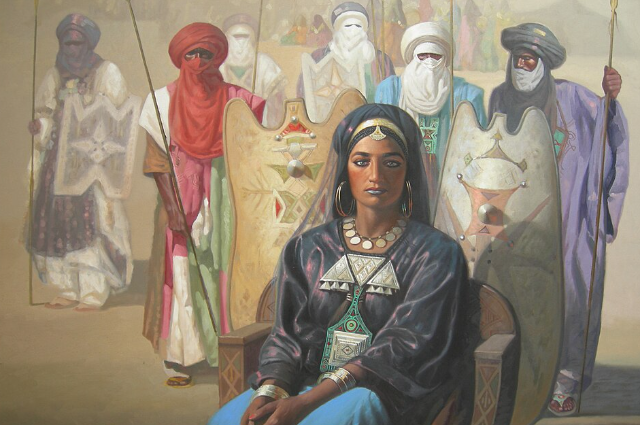
When most people picture a face veil, they imagine a woman.
It is one of those images that feels so familiar that we rarely stop to question it. Across much of the world, conversations about veiling are almost always conversations about women, their traditions, their choices, their rights or the expectations placed upon them.
The Tuareg people of the Sahara turn that assumption upside down.
Among the Tuareg, it is the men who traditionally cover their faces.
From around puberty, many Tuareg men begin wearing a long indigo cloth known as the tagelmust, wrapping it around their nose, mouth and head until only their eyes remain visible. It is one of the community's most recognisable cultural traditions, earning them the nickname "the Blue People of the Sahara" because the indigo dye historically stained both the cloth and the skin of those who wore it.
At first glance, outsiders often assume the practice is linked to Islamic dress codes.
It is not.
While the Tuareg are predominantly Muslim, historians and anthropologists have long noted that the tagelmust predates many of the region's later religious influences and is deeply rooted in Tuareg culture itself. The veil is associated with adulthood, dignity and social conduct rather than a religious obligation.
It also carries an idea that is unfamiliar to many societies.
Among the Tuareg, covering the face has traditionally been viewed as a mark of masculinity.
A young boy may go bare-faced, but adulthood brings different expectations. The veil becomes part of his identity, signalling maturity and self-discipline. In many communities, a man lowers or removes it only among close family members or people he deeply trusts.
The face, in this tradition, is not merely a physical feature.
It is something shared selectively.
Yet the story becomes even more interesting when we look beyond the veil.
While Tuareg men traditionally cover their faces, Tuareg women generally do not.
More importantly, women have historically occupied a position of considerable influence within Tuareg society. Unlike many neighbouring communities, the Tuareg have long followed a matrilineal social system, where family lineage is traced through the mother's line. Property and family heritage have often passed through women, giving them an important role in preserving identity across generations.
Women have also enjoyed levels of mobility and social participation that surprised many early European travellers. They could own property, participate in community life and, in many regions, were more likely to receive formal instruction in reading and writing the Tifinagh script than men.
This does not mean Tuareg society was perfectly equal or free of gender roles.
It wasn't.
Men and women had different responsibilities, expectations and social customs.
But those roles developed according to the community's own history rather than the assumptions outsiders often bring with them.
That is perhaps the most valuable lesson the Tuareg offer.
Gender norms are not universal.
They are cultural.
Practices that appear unusual from one part of the world may feel entirely ordinary in another because they evolved in response to different histories, environments and social structures.
The Sahara itself helps explain part of that story.
For centuries, the Tuareg travelled across one of the world's harshest deserts, guiding caravans through immense stretches of sand. The tagelmust offered practical protection against sun, wind and blowing sand. Over time, what began as a practical necessity also became a cultural symbol, carrying meanings of honour, adulthood and identity that extended far beyond its original purpose.
Culture often works that way.
People first adapt to survive.
Later, those adaptations become traditions.
What begins as necessity gradually becomes identity. Perhaps this is why the Tuareg continue to fascinate anthropologists today.
Not because their customs are strange.
But because they remind us how easily we mistake our own cultural experiences for universal truths.
The expectation that women should veil.
The assumption that inheritance naturally passes through fathers.
The belief that literacy has always been associated with men.
The Tuareg challenge each of these ideas- not through argument, but through centuries of lived experience.
In the end, the most remarkable part of their story is not that Tuareg men wear veils.
It is that a single community can quietly reveal how many of our assumptions about gender, power and tradition were never universal to begin with.
References:
- UNESCO – Tifinagh and the Cultural Heritage of the Amazigh (Berber) Peoples (for the script, literacy and cultural traditions).
- Jeremy Keenan. The Tuareg: People of Ahaggar. (One of the foundational anthropological works on Tuareg society.)
- Encyclopaedia Britannica – "Tuareg." (For matrilineal traditions, the tagelmust and social organisation.)