
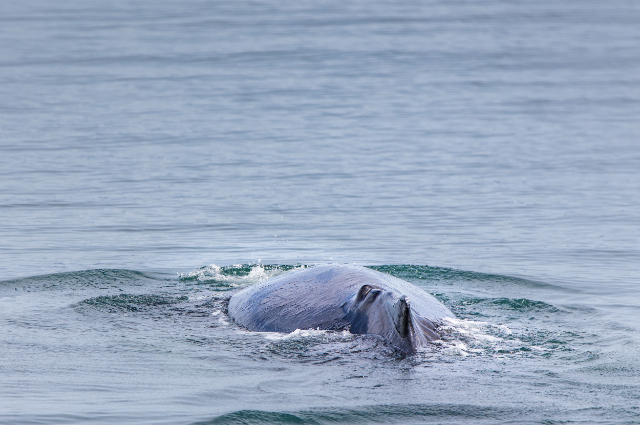
The blue whale is so large that it almost feels unreal.
It can grow to around 100 feet and weigh close to 200 tonnes. Its heart can be roughly the size of a small car. It is the largest animal known to have ever lived on Earth, and yet the story of why whales matter to the planet is not really a story about size.
It is a story about something almost too small to see.
Meet Prochlorococcus.
It is a tiny marine cyanobacterium, barely visible even under a microscope, and one of the most abundant photosynthetic organisms in the ocean. NOAA describes it as the smallest photosynthetic organism known and estimates that it can contribute up to 20% of the oxygen produced in the entire biosphere.
That is an extraordinary amount of influence for something so small.
But Prochlorococcus is only part of a much bigger group. Across the world's oceans, phytoplankton—microscopic organisms that float near the sunlit surface—use sunlight and carbon dioxide to produce energy. In the process, they release oxygen. Scientists estimate that roughly half of Earth's oxygen production comes from the ocean, with marine plankton responsible for much of it.
We tend to imagine forests when we think about the Earth's oxygen.
The Amazon is an obvious image. Trees stretching across thousands of kilometres, leaves absorbing sunlight, entire ecosystems breathing together.
But there is another forest beneath the waves.
It has no trunks. No branches. No leaves.
And it is moving constantly with the ocean.
Phytoplankton are also important because they take carbon dioxide from the atmosphere during photosynthesis. Some of the carbon eventually sinks into deeper waters when organisms die or are eaten, and their remains move down through the ocean. This is part of the ocean's biological carbon pump. NASA estimates that the biological carbon pump transfers around 10 gigatonnes of carbon from the atmosphere to the deep ocean every year.
Now bring the whale back into the picture.
A whale spends part of its life diving into deeper waters to feed. It then has to return to the surface to breathe. Along the way, it moves nutrients between different parts of the ocean. Its waste also contains nutrients such as nitrogen, phosphorus and iron.
Those nutrients are valuable because phytoplankton need them to grow. This process is known as the whale pump.
It sounds almost ridiculous when reduced to its simplest form: a whale eats deep in the ocean, comes back up, and fertilises the water.
But ecosystems often work through relationships that seem strange when separated from the bigger picture.
The International Whaling Commission describes whale waste as a natural fertiliser for phytoplankton, while NOAA explains that whales can move nutrients from deeper waters towards the surface, helping stimulate phytoplankton blooms and carbon capture.
The connection becomes particularly interesting in places where iron is scarce.
Iron is essential for phytoplankton, but large areas of the ocean contain very little of it. Research has found that whale faeces can contain extraordinarily high concentrations of iron compared with surrounding seawater. One study cited by the Smithsonian reported concentrations nearly 10 million times higher than those in seawater.
The whale therefore becomes something more than a large predator.
It becomes a nutrient transporter.
And this is where the climate connection begins.
Marine phytoplankton collectively capture enormous quantities of carbon dioxide. NOAA describes their annual carbon capture as equivalent to roughly four Amazon rainforests. That comparison belongs to phytoplankton as a whole, however—not to whales themselves. What whales may do is help maintain the conditions in which some of that microscopic carbon-capturing life can flourish.
This distinction matters because the science is more interesting when we do not turn it into a superhero story. Whales are not going to solve climate change for us.
Scientists are still studying exactly how large the whale pump's effect is in different oceans and ecosystems. The relationship is strongest in nutrient-limited environments, and it varies between whale species and locations. But there is growing evidence that whales are important ecosystem engineers and that their disappearance can alter marine nutrient cycles. Research in the Southern Ocean, for example, has linked the recovery of baleen whales with the potential restoration of nutrient recycling and primary productivity affected by twentieth-century whaling.
That makes the history of whaling more complicated than a story about losing individual animals.
Commercial whaling removed enormous numbers of whales from the world's oceans. The populations that once moved nutrients through marine ecosystems were drastically reduced. As whale numbers recover in some regions, scientists are beginning to ask not only how many whales the ocean can support, but what ecological functions return when the whales do.
It is an interesting way of thinking about conservation.
We usually protect an animal because it is rare, beautiful, intelligent or important to an ecosystem. But sometimes an animal matters because of all the invisible things it makes possible.
A whale does not produce oxygen in the way a tree does.
It does not capture billions of tonnes of carbon by itself.
Instead, it participates in a chain.
The whale moves. It feeds. It dives. It surfaces. It releases nutrients. Tiny organisms respond. Phytoplankton grow. Carbon is absorbed. The marine food web receives more energy.
The largest animal on Earth is therefore connected to some of the smallest.
And perhaps that is the more remarkable lesson.
Nature does not always work according to our sense of scale. The thing we can see from miles away may depend on something we cannot see at all.
The blue whale may be the giant of the ocean. But somewhere beneath it, in the sunlit water, an organism smaller than a grain of sand is quietly doing its part to keep the planet alive.
References:
- National Oceanic and Atmospheric Administration. (n.d.). How much oxygen comes from the ocean? NOAA Ocean Service.
- National Aeronautics and Space Administration. (2023, June 22). NASA wants to identify phytoplankton species from space. Here’s why. NASA.
- National Oceanic and Atmospheric Administration Fisheries. (2024). Whales and carbon sequestration: Can whales store carbon? NOAA Fisheries.
- International Whaling Commission. (n.d.). Climate change: The value of whales to the ecosystem—carbon sinks and the whale pump.
- Bortolotto, G., et al. (2022). Return of large fin whale feeding aggregations to historical whaling grounds in the Southern Ocean. Proceedings of the Royal Society B.