
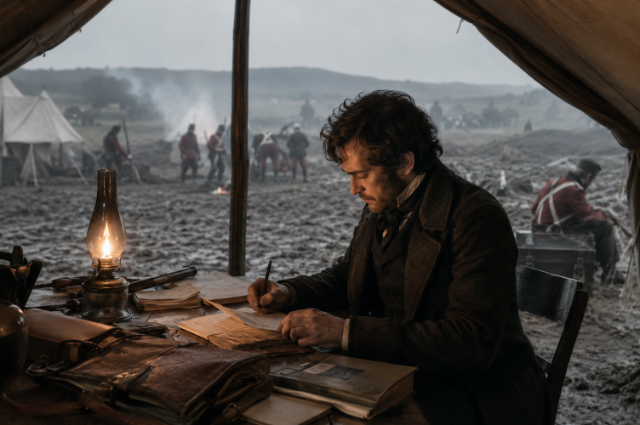
SIR WILLIAM HOWARD RUSSELL
THE ONE WHO DEFINED JOURNALISM, who showed that journalism is ‘for’ and ‘about’ the people. By Minal Fatima. The pioneering Irish journalist William Howard Russell is famously known for his remarkable journalism during the 1854 Crimean War. He is known as someone who finally spoke for the people.
While the government painted the war as glorious, Russell saw soldiers dying of cholera, freezing. without equipment, and being sentenced to death by incompetent commanders. His brutal, honest words shocked Britain, toppled a government, inspired Florence Nightingale, and permanently changed how the world reports war.
Reporting primarily for the London Times, he revolutionised news coverage by providing vivid, eyewitness accounts of 19th-century conflicts directly from the battlefield.
THE YOUNG WILLIAM
William Howard was born on 28 March 1820, at Lily Vale, in the parish of Tallaght, county Dublin. His father, John Russell, came from a family which had been long settled in county Limerick, and was agent in Dublin for a Sheffield firm. His mother was Mary, daughter of John Kelly, a grazier, who owned a small property at Lily Vale.
In the early years of Russell's life, misfortune broke up the business of his father, who migrated to Liverpool, where he tried more than one occupation. Young William Russell was brought up first by his grandfather Kelly, and then in Dublin by his grandfather William Russell. John Russell's wife and younger son, John Howard Russell, both died in Liverpool.
Originally, William Howard Russell was a maths teacher at Kensington Grammar School, though every now and then, he wrote for The Times on the side. In all the time he wrote for The Times, William covered major events such as the trial of Daniel O’Connell. Due to his amazing work, the editor of The Times, John Delane, was so impressed that he hired Russell as a full-time employee in 1843. He continued working for The Times until 1845, when he began writing for The Morning Chronicle, though he rejoined The Times later that year.
THE MAJOR EVENT THAT CHANGED THE COURSE OF HIS LIFE
In February 1854, Delane informed Russell that a “short excursion had been arranged for him to accompany the Guards, who had just been ordered to Malta” during the Crimean War. However, at first Russell was hesitant to take this opportunity, since he knew working on this would take longer than the three-month timeline that Delane gave him – and indeed he was correct; he spent 22 instead of 3 months.
Russell began reporting the realities of the war to the British public through some of the major events of the Crimean War such as the Siege of Sevastopol and the Charge of the Light Brigade. His coverage of the Crimean War earned him a lasting reputation as the ‘first Special Correspondent’
WHAT WAS THE CRIMEAN WAR?
The Crimean War (1854-56) was fought by an alliance of Britain, France, Turkey and Sardinia against Russia. It was the only major European conflict the Army engaged in between 1816 and 1914. It started with Russia’s invasion of the Turkish Danubian principalities of Moldavia and Wallachia (now Romania). Britain and France both wanted to prop up the ailing Ottoman Empire and resist Russian expansionism in the Near East. Although Russia fought a largely successful war against the Turks in Armenia, and British and French fleets operated in the Baltic Sea, it was the events in the Crimea that had the biggest impact on Britain.
THE MAIN QUESTION IS: WHY WERE WILLIAM HOWARD RUSSELL’S REPORTS SO SIGNIFICANT?
The mid nineteenth century witnessed a paradigm shift in technology, lowered cost, and the importance of both the newspaper and war reporting as a whole. While the concept of war was certainly not new, as Britain had been involved in wars for centuries before, how the war was narrated to and interpreted by the British public was certainly, by the look of Russell's reports. Hence, the Crimean War was considered and has long been considered the “first mass media war” – in which the events reported were true and unfolded right as they happened.
During Russell’s time in Crimea, he frequently interviewed the soldiers and troops to obtain authentic firsthand accounts of the madness of the war. His reports heavily influenced the public with the way he talked about soldiers and their forgotten reality. He emphasised the emotions and gruesome pain these soldiers had suffered; this signified the bravery of these soldiers – the bravery that hardly gets noticed as the news covers it. While the world adapted to the painting of war as a glorious act of justice, Russell redefined its strokes by brushing up on the suffering of young soldiers. The soldiers who died of diseases or froze to death. He spoke to the world that journalism is not only about ‘reporting news to the public’ but rather it's about reporting the news with emotion and empathy – in this case, it was about looking at the soldiers suffering due to their governments.
Russell’s dreadful graphic description of the sufferings of the British troops is deeply demonstrated in the excerpt from his report on ‘The Siege of Sebastopol’ published in the Times on 12 February 1855.
Although Russell's excellence was not accepted by everyone, since despite his work being widely read, Russell’s candid reporting on the undeniable horrors of war was not always well received. Russell’s lack of patriotism and assaults on Lord Raglan did not impress Queen Victoria, who stated that ‘his infamous attacks against the army have disgraced our newspapers.’
Though these criticisms meant less to him or the public, there is and was little doubt that Russell’s reports in The Times contributed to bringing the harsh reality of combat to light. Russell’s candid yet critical reporting on the events in Crimea exposed the public to the reality of battle for the very first time. Due to Russell, the bridge between war and the general public was built, which ultimately set a legacy for William's brilliance and brutal honesty.
Horrified by media reports, the public demanded better care for wounded troops, prompting the government to involve Florence Nightingale in reforming battlefield medicine. During the Crimean War, she gained fame as an expert nurse manager and educator by organising treatment for the wounded in Constantinople.
In May 1895, Russell was knighted for his revolutionary journalism, later earning the personal favour of King Edward VII, who named him a Commander of the Royal Victorian Order (CVO) on 11 August 1902. Bestowed directly by the monarch without government intervention, the intimacy of the honour was captured during the ceremony when the King warmly instructed, “Don’t kneel, Billy, just stoop.” Russell passed away on 10 February 1907 and was buried in London’s Brompton Cemetery, his monumental career later chronicled in a biography by John Black Atkins, the Manchester Guardian’s first special correspondent.
Ultimately, Russell’s enduring legacy rests on his pioneering telegraph reports from the Crimea, which bridged the gap between the home front and distant battlegrounds by exposing the unvarnished reality of war for the very first time.
And hence, he became the one who defined journalism.
Resources: