
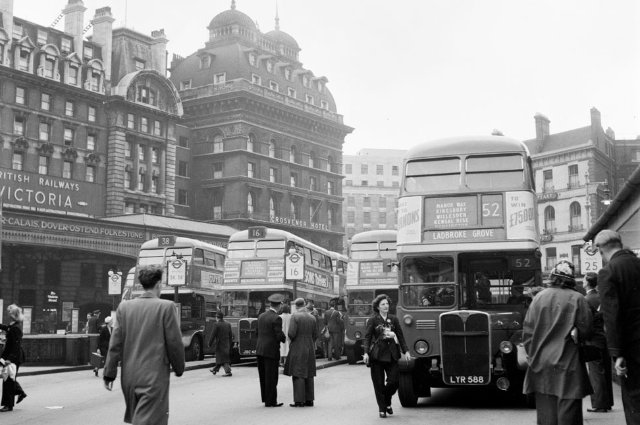
There used to be a bus you could catch from London that would drop you off in Calcutta, nearly 8,000 miles away. Not a flight with a layover. Not a cruise. An actual bus, with wheels, that you boarded at Victoria Coach Station and sat on for fifty days while it made its way across two continents.
I found this hard to believe the first time I read about it, too. But it ran on and off for almost twenty years.
Where It All Started
It began in April 1957 with a service called The Indiaman, run by a London company, Garrow-Fisher Tours. The first bus pulled out of Victoria Coach Station on the 15th, driven by a man named Oswald Joseph Garrow-Fisher, with about twenty passengers on board. From there it was Belgium, then West Germany, Austria, Yugoslavia, Bulgaria, Turkey, Iran, Afghanistan, West Pakistan, and finally Calcutta.
Fifty days. One bus. Roads that went from fine to barely there, depending on the country. Garrow-Fisher later talked about creeping along a narrow cliff road near the Turkey-Soviet border, and having to shove wooden planks under the wheels to drag the bus out of soft sand in the Iranian desert.
It wasn't some obscure local curiosity either. The New York Times covered it at the time, which tells you how unusual the whole idea felt even then.
A one-way ticket cost £85, and the return leg was a bit cheaper at £65. Adjusted for today, that's somewhere around £2,000 for the one-way trip. Steep, until you remember what it actually paid for: fifty days of food, a place to sleep, and passage through half a dozen borders most people back home couldn't have pointed to on a map.
Then Came Albert
The Indiaman got the whole thing going, but it didn't stay the only option for long. Over the next two decades, more than thirty operators ran some version of this route. Out of all of them, one bus is still remembered by name: Albert.
Albert wasn't built for this originally. It started out as a regular single-decker that got wrecked in an accident. A British traveller called Andy Stewart bought the damaged bus and rebuilt it from scratch into a full double-decker, with a sleeping area, a small dining space, somewhere to read, and an open observation deck on top. He named it Albert after the man he'd bought it from, and started running it as Albert Tours. Over the years, it completed around fifteen round trips between London and Calcutta, with connecting legs that went as far as Sydney.
Stewart talked about it in a way that stuck with me. He said something like, anyone can fly to the other side of the world, but where's the adventure in that. And by most accounts, Albert really did earn its reputation. It crossed roughly 150 borders in its lifetime and, wherever it went, it drew crowds. A green and cream double-decker rolling through the middle of Calcutta or along the Turkish coast wasn't just a bus passing through. It was a bit of a spectacle.
The fare for the longer route connecting through to Sydney ran about £145, which back then was close to the price of a decent secondhand car in Britain. For that, you got a seat across half the planet.
It Was Part Of Something Bigger
This bus wasn't happening in a vacuum. It was one piece of the Hippie Trail, the overland route thousands of young people from Europe, the US, and Australia took through Asia during the sixties and seventies, chasing cheaper living, different ideas, and a kind of freedom their parents hadn't really had access to.
A couple of those travellers ended up changing the entire travel industry without really meaning to. In 1972, Tony and Maureen Wheeler left London and made their way overland toward Australia, hopping between whatever cheap transport they could find along the way. By the time they landed in Sydney, they were nearly broke, but they had a stack of notes on how to actually do the trip. Those notes became a slim little guidebook called Across Asia on the Cheap, which is more or less where Lonely Planet started. The Wheelers weren't riding Albert specifically, but they were on the same road, the same one that buses like Albert had spent years turning into something an ordinary person could actually book a ticket for.
That's really what made this route matter. Before the fifties, an overland trip across Asia was the kind of thing explorers wrote books about. By the seventies, it was something a twenty-something with some savings and a bit of nerve could just decide to do.
Why It Stopped
Nothing lasts forever, and this route ran straight into a stretch of the world falling apart.
Through the seventies, things got harder along almost every leg of it. Iran was building toward the 1979 revolution. Afghanistan was sliding toward the instability that would end in the Soviet invasion. On top of that, visas got harder to secure, fuel prices spiked after the 1973 oil crisis, and insurance for operators trying to run buses through all this became close to impossible to get. At some point, it just stopped making sense as a business.
By 1976, the last full trips had already happened. Albert Tours wound down. Other operators folded quietly, one after another. Buying a bus ticket from London to Calcutta went from being unusual but doable to being something people only talked about in the past tense. Travellers heading east started booking cheap charter flights instead, the so-called bucket shop tickets that basically took over from here.
Someone's Trying To Bring It Back
Here's the part that surprised me most. In 2020, an Indian travel company called Adventures Overland, started by Tushar Agarwal and Sanjay Madan, announced they wanted to revive the idea: a bus from Delhi to London, about 20,000 kilometres, through 18 countries, over roughly 70 days. It was inspired directly by the old Hippie Trail buses, and it got picked up by outlets all over the world, CNN included.
Then the timing turned out to be terrible. The trip was supposed to leave in May 2021, but COVID shut down borders across Myanmar and China, two countries the route depended on, and the launch kept getting pushed back. By 2023, the company had scaled things down and started running a shorter version instead, from Istanbul to London, while still saying they hope to eventually run the full Delhi to London leg.
For now, the original route Albert used to run, straight through Iran, Afghanistan, and Pakistan, is still off the table. If anything, that part of the world has gotten harder to cross overland since the seventies, not easier. Nobody's found a workaround yet. The full Delhi to London bus hasn't been scrapped exactly. It's just been forced to take the long way round, at least until the world lets it try the short way again.
Would You Have Gone?
There's something almost comforting about this story, and also a little sad. It's a reminder that the world used to be more stitchable together than it is now, that you could once just decide to drive from London to Calcutta if you had the patience and a bus that mostly worked. That version of the trip isn't coming back anytime soon. But every attempt at reviving it, however roundabout, is really just people chasing the same pull that put twenty strangers on a bus at Victoria Station in 1957.
Would you have gotten on, not knowing what fifty days on those roads would actually be like? I like to think I would have. Somewhere out there, a version of that bus is probably still waiting for someone reckless enough to try it again.
Sources
- Wikipedia, "London–Calcutta bus service": https://en.wikipedia.org
- Wikipedia, "India–United Kingdom bus routes": https://en.wikipedia.org
- Wikipedia, "Adventures Overland": https://en.wikipedia.org
- Secret LDN, "The Bus Service From London To India Was Once The Longest Bus Route In the World": https://secretldn.com
- Messy Nessy Chic, "All Aboard the Giant Hippie Bus from London to Calcutta": https://www.messynessychic.com
- GetBengal, "The bus route between Calcutta and England that crossed 150 borders": https://www.getbengal.com
- Mohammed Abbasi, "The London – Calcutta Bus Service": https://mmabbasi.com
- CNN Travel, "The Hippie Trail: An interactive history of the road trip that inspired Lonely Planet": https://www.cnn.com
- Lit Hub, "How Lonely Planet Founders Tony and Maureen Wheeler Revolutionised the Way We Travel": https://lithub.com
- CNN Travel, "New bus trip will take you from Delhi to London": https://edition.cnn.com
- Frommer's, "Would You Take a 70-Day Bus Trip from India to the U.K.?": https://www.frommers.com