
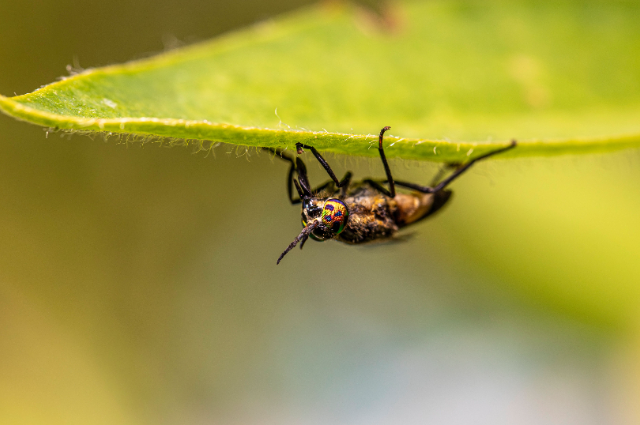
In April, a rancher near La Pryor, Texas, noticed something wrong with a three-week-old calf. A wound near its umbilical cord wasn't healing. It was growing. By June 3, lab results confirmed the rancher's worst fear: New World screwworm, a parasite the United States hadn't seen breeding on its own soil since 1966, was back.
Sounds like the opening scene of a horror film, doesn't it? It's also, quietly, one of the more unsettling food supply stories of the year.
A fly that doesn't wait for you to die
Most fly maggots are nature's clean-up crew. They eat what's already dead. The New World screwworm never got that memo. Its scientific name is Cochliomyia hominivorax. Translate that from Latin, and you basically get "man-eater." Not exactly subtle, but it fits. Here's how it works: a female fly tracks down an open wound, or sometimes just a damp spot like a nostril or an eye, and lays her eggs right into it. She can drop close to 500 eggs in one go. A day later, those eggs hatch, and the maggots get straight to work, chewing into living flesh and burrowing deeper as they grow, which is actually where the "screw" in screwworm comes from. Then it gets worse. The rotting smell coming off that wound draws in even more flies looking to lay eggs of their own. A tiny scrape can turn into a serious wound in just a couple of days.
Livestock end up especially exposed because ordinary ranch life creates exactly the kind of openings this fly is hunting for. Dehorning, shearing, ear tagging, even just herding cattle in and out of a corral can all of it can break the skin. A newborn calf's healing umbilical cord is basically an open invitation. Left untreated, an infestation can kill an animal in days, and in rare cases, it infects people too. Last August, a case actually showed up in a person, a Maryland resident who'd just gotten back from a trip to El Salvador. It was the first human case linked to this whole outbreak. Officials moved fast to reassure everyone that the general public wasn't really at risk, and the good news is, the person recovered just fine.
How America already beat this once
Now here's a part of the story I actually love. Back in the 1950s, USDA scientists realised they didn't need to spray harsh pesticides everywhere to beat this fly. They needed the fly's own biology to work against it.
Female screwworms mate exactly once in their entire life. So researchers started breeding flies by the millions in dedicated facilities, sterilising the males with radiation, then releasing them by the truckload, and eventually by aircraft, over infested regions. When a wild female mated with a sterile male, none of her eggs ever hatched. Repeat that across enough generations, and the population simply collapses on itself.
It worked, and it worked well. The US declared itself screwworm-free in 1966. Mexico followed through the 1970s, and by the early 2000s, Central America had finished the job too. Entomologists still call the sterile insect technique one of the great agricultural wins of the last century. By the 2000s, the fly's entire range had been pushed all the way down to a narrow stretch of land near the Panama-Colombia border, where a standing wall of sterile flies held the line for roughly twenty years.
What let the barrier break
Then, starting around 2023, cases started showing up in Panama again. From there, it just kept moving. Costa Rica, Nicaragua, Honduras, and by late 2024, it had reached farms in southern Mexico. Fast forward to mid-2026, and it had already crossed into Texas, then New Mexico.
Two things seem to be driving this comeback, and honestly, they feed off each other.
The first is old-fashioned smuggling. Investigations by the think tank InSight Crime describe an illegal cattle trade running out of protected forest reserves in Nicaragua, Honduras, and Guatemala, moving through Central America and into Mexico with little to no real health screening along the way. Researchers have been warning for years that this trafficking is what's quietly speeding the parasite's return to territory it had already been cleared from, since infested animals can cross borders that inspectors simply never see.
The second is climate. Screwworm is a tropical bug at heart. It's always needed warmth to survive, and a hard freeze is basically its kryptonite. But scientists tracking the spread say warmer temperatures are letting the fly push into places it couldn't handle before. The cold snaps that used to kill off any stray populations at the edges of its range just aren't showing up the way they used to, or hitting as hard when they do. Under tropical conditions, the fly's entire life cycle, egg to adult, can wrap up in as little as three weeks, and the humid, warm-enough days it needs are showing up further north than they used to. So the eradication program didn't really fail on its own merits. The climate just started handing the parasite more room to work with.
Why your grocery bill might notice
This isn't a story that stays neatly inside a Texas quarantine zone. American beef prices had already climbed to a record 9.64 dollars a pound back in April, up thirteen per cent from the year before, mostly because years of drought had shrunk the national cattle herd to its smallest size in seventy-five years. Screwworm showed up at about the worst possible moment for an industry that was already stretched thin.
To be fair, health officials have been firm that this isn't a food safety issue in the way something like salmonella would be. The USDA has stated plainly that screwworms don't infest meat, fruit, or vegetables, and any infected animal gets caught during inspection long before it reaches the food supply. The real damage is economic. Every outbreak adds extra labour, extra vet visits, and a slower path back to rebuilding herd sizes, which analysts expect will keep prices elevated rather than trigger one dramatic spike. Some industry estimates put potential losses in the billions if containment doesn't hold.
The fightback, round two
The response underway right now is essentially a bigger, faster version of the same 1950s playbook. The USDA has committed to building the country's first domestic sterile-fly production facility, at a former air base in Edinburg, Texas, eventually meant to churn out up to 300 million sterile flies a week. There's also a modernised facility coming back online in Mexico, and continued shipments from the existing plant in Panama in the meantime. Quarantine zones now go up around every confirmed case, and Texas has set up a dedicated hotline for ranchers to report anything suspicious.
Whether all of this moves fast enough is still an open question. Building a new fly factory takes years, not months, and the parasite isn't exactly waiting around while the concrete cures.
The bigger lesson hiding in a maggot
There's something almost humbling about this whole situation. Screwworm eradication was one of the proudest wins in the history of American agriculture, a problem solved so thoroughly that most ranchers alive today had never actually seen a case until this year. It's a good reminder that ecological victories aren't permanent installations. They're more like a garden fence. Something that needs constant tending, because the moment attention drifts and the climate quietly shifts the rules of the game, nature tends to find the gap and walk right back through it.
References:
- NPR, "The U.S. confirms its first human case of New World screwworm. What is it?" https://www.npr.org
- CNN, "Flesh-eating screwworm has reached the US, a comeback driven by organised crime" https://www.cnn.com
- CNN, "What to know about the New World screwworm" https://www.cnn.com
- CNN Business, "What screwworm means for your beef prices" https://www.cnn.com
- CNBC, "U.S. confirms second Texas screwworm case, Canada restricts livestock imports" https://www.cnbc.com
- Yale Climate Connections, "What to know about the New World screwworm fly and its reappearance in the US" https://yaleclimateconnections.org
- Weather.com, "Flesh-eating screwworm moves beyond Texas; How the warming climate is helping this parasite" https://weather.com
- PBS News, "Political blame game follows as screwworm parasite threatens cattle in Texas" https://www.pbs.org
- InSight Crime, "First US Screwworm Case Spotlights Contraband Cattle in Mexico" https://insightcrime.org
- Scientific Reports (Nature), "The reemergence of the New World screwworm and its potential distribution in North America" https://www.nature.com/articles/s41598-025-04804-9