
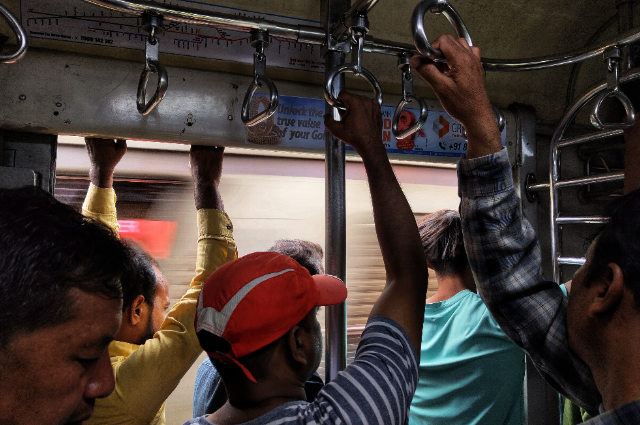
It was raining in a way that only Mumbai knows, transforming the roads into rivers and forcing every commuter to fight for a dry inch near the train door.
Mayank Lohar, a twenty-two-year-old boy who used to sell things for a living, worked out of an office in Andheri. Each evening, he used to make the same long trip home to Virar. That wasn’t an unusual thing. As lakhs of people do it daily, the same route, the same crowd, the same fatigue settling into their shoulders by the time the train leaves Churchgate.
On the night of June 23, he boarded the first-class compartment of Train No. 90663. It travels from Churchgate to Nallasopara. The train departed at 10:05 pm. Rain was coming in through the open door. Someone wanted it left open. Mayank wanted it shut.
That's it. That's the whole disagreement. A door.
Somewhere Between Andheri And Borivali
Arguments like this happen on every local, every single day. Someone wants the window down, someone wants it up. Someone wants the fan speed changed. Usually it ends with a shrug, a muttered word, maybe someone shifting to another corner of the compartment.
This one didn't end that way.
Somewhere between Andheri and Borivali, it turned violent. A knife came out. Mayank was stabbed in the stomach while the train was still moving.
Sit with that for a second. Not on a lonely street. Not in some dark corner where at least you could run. Inside a train, packed with other passengers who were probably looking at their phones or watching the rain a minute before. There’s no stepping outside a local train mid-journey; you’re trapped in the compartment, experiencing whatever unfolds around you, alongside everyone else.
When the train finally stopped at Borivali, the attacker jumped off Platform No. 6 before it had fully come to a halt and vanished into the station crowd.
Mayank was rushed to hospital. Vineet Abhishek was Western Railway's Chief Public Relations Officer. He later stated medical help reached him immediately. Unfortunately, it wasn't enough. He didn't survive.
The Manhunt That Actually Worked
Here's the one part of this that offers some small relief.
Officers went through more than 400 CCTV cameras across the city. Pieced together a timeline, tracked movement, and matched faces. Within hours, they found him. Roshan Suvarna, 30, was picked up from Kurla, arrested before the day had even properly ended.
Fast police work doesn't undo what happened. It doesn't give Mayank his evening back, or his next twenty years. But it matters, at least, that this didn't just disappear into the pile of cases nobody solves.
This Isn't The First Time This Year
What makes this harder to shake off is that it isn't an isolated moment. It's the second stabbing of its kind on Mumbai's Western Railway suburban network within the same year.
Alok Singh, a professor from NM College in Vile Parle, was the victim before. He was stabbed multiple times at Malad railway station. That time, the dispute was also over something equally ordinary. How people were boarding and exiting a crowded train. The accused, 27-year-old Omkar Shinde, was arrested within twelve hours. He was caught on CCTV footage fleeing across a foot overbridge.
Two men. Two arguments most of us would forget within minutes if we happened to be standing nearby. A door in one case, a boarding dispute in the other. And in both cases, someone didn't just walk it off.
That's the part worth sitting with longer than the headlines do.
What A Local Train Actually Runs On
There's a strange kind of closeness that happens on a crowded Mumbai local. People who haven't lived here might not fully get it. You're pressed against strangers for forty minutes, sometimes longer. Someone's bag digs into your shoulder. An elbow finds your ribs. You share the gust of wind through the open door. The smell of wet clothes on a rainy evening.
Nobody plans this closeness. Nobody signs up for it. It happens to millions of people at once every single day. And it works most of the time. Because everyone silently agrees to put up with it. Doors stay open for the people who need air. People shift half a step to let someone else squeeze in. Nobody says thank you. Nobody needs to. It runs entirely on an agreement nobody wrote down.
But an unwritten agreement only holds as long as everyone has something left to give it. And a Mumbai local at 10 pm, after a full day of work, after money worries and traffic and everything else that doesn't show on a person's face, isn't exactly where people have the most patience to spare. On an ordinary day, a shut door stays a shut door. On a bad one, for the wrong person, it becomes the one thing they feel they can still control, and they hold onto it in a way nobody could have predicted five minutes earlier.
None of that excuses what happened to Mayank. Nothing does. A twenty-two-year-old who spent his day selling things to strangers, just trying to get home, did not deserve to die over a coach door. Somewhere, a family is sitting with an empty chair now, and no explanation is good enough to fill it.
Whose Job Is It To Keep The Trains Safe?
Rajiv Singhal, a member of the Zonal Railway Users' Consultative Committee, didn't hold back. He said passenger safety is meant to be the job of RPF and GRP personnel, but that too many of them are busy on their phones instead of watching for exactly this kind of trouble as it builds.
Western Railway pushed back gently. Officials pointed out that stations and trains already have CCTV, alarm chains, panic buttons, and helpline numbers. They also added that the response once the attack happened was as fast as it could be.
Maybe both things are true at once. The infrastructure can exist and still not be enough to stop a knife from coming out in twenty seconds of anger.
A video of the stabbing has since made its way online. People are angry. There are fresh demands for better in-coach surveillance, more visible security, quicker response times. All fair asks. None of them answers the harder question sitting underneath this whole story.
The Question This Story Actually Leaves Behind
Cameras can catch a crime after it happens. They can't catch the moment right before, when a tired man decides a shut door is worth more than it is. No amount of CCTV changes what's going on inside someone's head on their worst evening.
So the real question isn't just about railway security. It's about how much we're all carrying onto these trains without realising it. And how little it takes for that weight to spill over onto a total stranger who just wanted to close a door.
None of us would pick up a knife over something like this. But almost all of us have snapped at someone over something small, something we forgot about by the next morning. Usually it just costs a sorry. This time it cost someone's life.
For now, two families are living with a loss that started as an argument over nothing much at all. Two accused men are in custody now, waiting to see what the courts decide. And tomorrow evening, millions of people will get on the same crowded trains again, standing right next to strangers they'll never know the names of, just hoping the door doesn't become an issue this time.
References:
- Free Press Journal, "Mumbai Local Murder Case: Accused Arrested For Stabbing 22-Year-Old Salesman To Death On Moving Churchgate-Nalasopara Train," June 24, 2026: https://www.freepressjournal.in
- Free Press Journal, "Mumbai Local Train Stabbing Over Door Dispute Kills 22-Year-Old, Accused Arrested After 400-CCTV Hunt," June 24, 2026: https://www.freepressjournal.in
- DNA India, "Who is Omkar Shinde? 27-year-old man arrested in 12 hours for stabbing professor multiple times at Maharashtra's Malad station over minor dispute": https://www.dnaindia.com