
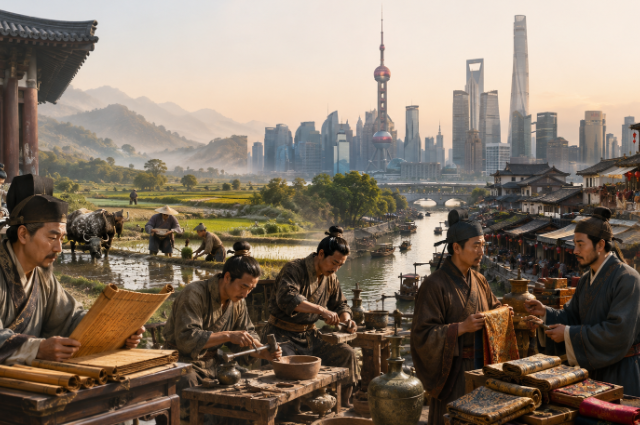
Mobility is characteristic of civilisation. With the rise and fall of civilisations, something most definitely morphs. The conception of power, status or faith - three cardinal points upon which any society rests- experiences a sift. When regimes change, something breaks or reshapes in the conception of political or economic power, social status or faith. This change is usually predicated on ideologies about how society should run, how individual persons should behave, what beliefs should be encouraged and what factors determine what stations people may occupy in life.
Ancient Chinese society, like many other societies, was no different. Ideologies developed to deal with prevailing national circumstances as dynasties rose and fell. Ancient officials, aristocrats, scholars and thinkers often fashioned philosophical designs that, in their view, best satisfied national necessities. One such necessity was the need for local production, and another, the desire for societal order. These two factors over time influenced the systems of social control and communal relations.
What is now considered a caste system was first a system of ideals. Originating in the Spring and Autumn Period, it was a means of social engineering. Later on, the ideals would be measured by a compilation of Confucian teachings in the 6th-century BC Zhou dynasty, where feudal states in the Zhou kingdom enjoyed little control from the dynasty. Confucius, a renowned teacher of the era, emphasised the preservation of historically accepted social norms - filial piety, morality, righteousness and justice. His ideas greatly influenced political thought in his age and beyond, becoming a bedrock for the formalisation and codification of the four occupations system, amongst other things.
The idea of “four occupations”, called shi-nong-gong-shang, was about stratifying economic roles and weighing their significance. The four occupations were: scholar, farmer, craftsman/artisan and merchant. Confucian scholars classified these roles in a perceived order of importance. Scholars were at the top of the ladder while merchants were at the bottom. In the middle of the hierarchical system were farmers and artisans, the former ranking second and the latter third.
The rationale behind the hierarchy was simple. Scholars(shi) produced much of what formed the intellectual fabric of the empire. Scholarly thought was not only of aid to the emperor, but also helped in promoting order in families and the society at large. A distinguished scholar not only brought honour to himself, but to his family and the nation. Hence, scholars were at the helm of affairs. Next to them were farmers(nong).
Without food production, could the state survive? Farmers were the ones behind the production of food, which is the lifeblood of the state. Thus, land owners and farmers were regarded highly for their contribution to societal sustainment. In the same vein, artisans(gong), persons who put their skill to work in the production of other materials needed for daily and national utilisation, were given due regard on account of their skillfulness. On the other hand, merchants(shang) sat at the end of the line.
Despite trade being the silk rope that tied all loose ends of the fabric together, Confucian thought regarded trade as often exploitative and not of so much significance, something the state should strive to do without. This was because, essentially, traders didn't produce any item. Instead, they sold foodstuffs produced by farmers and the craftworks of artisans. Most importantly, the merchants didn't sell for nothing. They engaged in trade for profit. Thus, it was believed that their moral compass was definitely corrupted due to their relentless pursuit of wealth. This cemented their place as last on the list.
In the Han dynasty, Confucian scholars codified the four occupations system into an inflexible hierarchy. This affected merchants in no small way. The government became wary of merchants due to their large fortunes. Hence, certain restrictions were placed on merchants and their activities. They could sell silk but not wear it. They could own fortunes but not land. They were forbidden to ride horses or hold weapons. Their children were not allowed to hold public office. While the restrictions on the use of silk and riding of horses were strictly applied, the restrictions on ownership of land and holding of public office were often ineffective.
Under Emperor Wudi, an Imperial University was established to train students of Confucianism and test their capabilities in order to pick brains fit for the running of the state. However, it wasn't until the Sui Dynasty that the system began to thrive on a true meritocracy. Imperial exams were introduced to test would-be officials on literary subjects. Local schools, called Jinshi, were created to train and test people on Confucian classics.
By the Song dynasty, the system had crystallised so that nearly all officials of high office and prestige were produced through the Jinshi system. Because it was a meritocracy, the Jinshi system was open to persons of other strata aside from the shi or scholars. Artisans’ children, farmers’ children and even children of merchants could sit for the imperial exams, pass and become officials. Thus, there was room for upward social mobility and expansion of the shi class.
It was not out of place then to find afterwards that the social strata, though formal and rigid in its making, was becoming malleable. In a typical family of merchants, you could now find scholars. By the Ming and Qing dynasties, merchants had inevitably risen in prestige due to their infiltration of the shi class. Meanwhile, the four occupations stratification was quietly being eroded.
The imperial exams system reached its peak and crystallised into a final form by the Qing dynasty. The exams gave people of all occupational castes an opportunity to attain elitism. However, this era would not last forever. In 1905, due to the effects of the Industrial Revolution and incompatibility of the Confucian Jinshi system with growing demands for professionals, especially in the fields of science and technology, the imperial exams were abolished. This marked the legal collapse of the occupational caste system of China.
Despite the legal abolition of the caste system, the 2000-plus old culture has remained ingrained in the fabric of Chinese society. However, it has evolved in unexpected ways. The occupations have been reshuffled like cards, disrupting the original order of the shi-nong-gong-shang.
As of 2023, China had over 47.63 million students at higher-educational institutions. About 10.42 million students were enrolled in universities, colleges and vocational schools nationwide. This number was higher than recorded in the year preceding. In fact, the Chinese Ministry of Education put the estimated percentage increase in the number of students in higher institutions at 2.32 per cent year on year. The gross enrollment ratio in China's higher education was put at a high percentage of 60.2.
In the same year, 61 higher education institutions were established, bringing the total number of institutions of higher learning in the country to 3,074. To tackle the influx, there was a 4.91 per cent rise in the number of full-time teachers in higher education. This brought the total number to a total of 2.07 million full-time teachers in higher education. With nearly 13 million students applying for enrollment in higher institutions of learning in 2026, the scholar dream is still very much alive.
However, the situation is not the same for farmers and artisans. The hukuo registration system, originally established to promote venturing into agriculture and production of food for the masses, has become a systemic barrier limiting the quality of life of farmers and migrant workers. Stratified into the urban and the rural, one's birthplace becomes a determinant of access to opportunities.
Rural hukuo holders are systemically disadvantaged in areas of education, healthcare and employment opportunities. Strategically condemned to remain in the fields, farmers are stuck with agriculture, and agriculture promises a lower standard of living. Migrating to the city, farmers would have to give up their lands. Furthermore, they wouldn't be able to enjoy access to public education in the city or to public healthcare benefits, as their hukou does not permit such. While reforms are underway, the situation persists.
On the other hand, the once despised shang has risen to occupy the top of the hierarchy. Merchants, or businesspeople, owners of companies and conglomerates, are the new elites. With their fortunes, they can afford to live large and enjoy prestige from all and sundry. Their economic power extends even to the political sphere. Proximate to the corridors of power, they are the crème de la crème of society.
The new four occupations system is reflective of the old. An occupational caste, the four occupations system promoted the subjugation of merchants. In modern society, the tables have turned. Those formerly at the bottom now occupy the high table. Coming closely behind, the scholar dream still exists and provides returns for a number of people. However, the once revered farmers experience systemic discrimination and a poorer standard of living due to the introduction of the hukuo. The old caste was based on occupation. The new caste is based on birth location. In this new system, only wit and fortune matter.
REFERENCES
- “A Guide to Social Class in Modern China”. ChinaFile. 2014 Apr 28. Available from: https://www.chinafile.com
- "Indian netizens allege China has a 'caste system'”, Global Times. 2026 Jun 18. Available from: https://www.globaltimes.cn
- “Criteria Exam 2017-18: Analysis of Institutional Changes and Impacts”, Studocu. 2019 Nov 1. [Document reposted] Available from: https://www.studocu.com
- “A Window on China's Past: Imperial Examination System”, China.org.cn. Available from: http://www.china.org.cn
- Trillo A, “To What Extent Does the Hukou System Represent a Caste System in Modern China? University of Manchester[Dissertation]”, Available from: https://documents.manchester.ac.uk
- “Fewer Students Are Taking China's College Entrance Exam,” Caixin Global. 2026 Jun 5. Available from: https://www.caixinglobal.com
- “China Has Over 47 Million Higher-Education Students in 2023”, Official Website of the Ministry of Education of the People's Republic of China, 2024 Mar 4. Available from: http://en.moe.gov.cn
- Jalalud Din, “The impact of Confucianism on ancient Chinese society and governance”, International Journal of Foreign Trade and International Business, 2024 April 3. Available from: https://www.foreigntradejournal.com
- “Ancient Four Occupations to Modern Hukou Divisions: Inside the Chinese 'Caste System' highlighted by Indian netizens in pushback against CCP’s anti-India propaganda”, OP India. 2026 June 19. Available from: https://www.opindia.com