
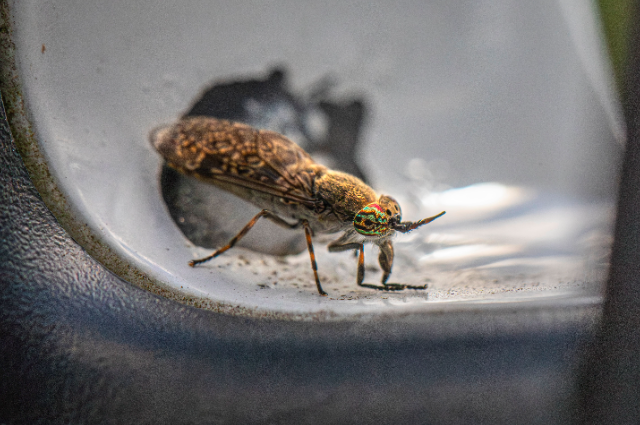
The resurgence of screwworm is quite surprising. A flesh-eating parasite, screwworm was first eradicated in the United States way back in 1966. Its current rise in places like Mexico, with more than 5000 reported cases as of August 2025, Central American countries, and recently, in the United States, not only holds implications for public safety but also poses significant challenges to economies.
In a scientific analysis by Alicea Hibbard, published in 2025 by the American Society for Microbiology (ASM), it was explained that the parasite is produced by the larvae of the Cochliomyia hominivorax blowfly. The screwworm got its name from its feeding habits. It is said to burrow into the flesh of warm-blooded animals, feeding on living tissues. The bug’s feeding pattern makes it one of the world's most destructive livestock pests. The U.S Department of Agriculture (USDA) similarly describes the New World screwworm (NWS) as “a serious pest that affects livestock, pets, wildlife, and less commonly, people and birds.”
According to the department, the size of an adult screwworm fly is about the same as a common housefly, or slightly bigger. But the pest’s handwork, however, is by no means little. The fly’s larvae invade open wounds or natural body openings, pierce into living tissue, feed on the flesh and continue to develop there. A female screwworm fly, producing about 100 to 300 eggs on a fleshy opening, could hatch several larvae, which would feed on wounds until they mature and fall off to complete their metamorphosis.
The larvae’s presence in an open wound is the beginning of an immediate infection cycle. For animals like cattle, sheep, goats, horses, pigs, dogs and wildlife animals like deer, the outbreak of screwworm poses several economic consequences. The infestation disrupted Mexican cattle exports, with losses valued at $1.3bn between 2024 and 2025, according to the Mexican National Agricultural Council. For the United States, where its Department of Agriculture has confirmed no fewer than 32 animal cases in Texas and New Mexico, the parasite's reappearance is a serious concern, as its effects extend across livelihoods, industries and food production systems.
For ranchers and farmers whose livestock eventually become the meat consumed, a screwworm outbreak is a pathway for daunting animal husbandry challenges that can ultimately influence meat prices. This is because treating infected animals would require veterinary care, medication and additional labour, which, by implication, would increase production costs. In the same manner, deaths among unsaved livestock can decimate herd sizes, farmers' incomes, limit livestock movement, particularly where ranching is yet to be a practice, as well as cause trade restrictions for fear of cross-infestation.
Also, as infected animals lose weight, produce less milk or die from severe infestations, the aftermath of a screwworm outbreak includes that it leaves only a few healthy livestock for slaughter, reducing overall meat production and tightening supplies. This disruption in production can also ripple through the entire supply chain, from ranches to processors, retailers and finally to consumers. Even worse is the fact that the economic implications are significant against the backdrop of the current elevated beef prices in places like the U.S.
The Federal Reserve Bank of Dallas stated that beef prices rose by 57 per cent since 2020 and by a further 3 per cent during the first four months of 2026. The bank, referencing a recent estimate by the USDA, noted that consumers' price elasticity of demand could fall by 7 per cent if there is a 10 per cent increase in price. In other words, the public demand for meat tends to be relatively strong even when prices rise. The resulting short supply of livestock could then push beef prices higher and increase both the pressure and demand for alternative proteins. In short, as predicted by the US Department of Agriculture (USDA), if left unchecked, screwworm threatens $100bn in economic activity linked to the cattle and livestock industries.
As another contributor, warmer temperatures in affected areas could expand the habitat of insects and parasites, while increasing the likelihood of the resurgence of pests and diseases. This was how, as history would have it, in 1972, the United States experienced one of its worst screwworm outbreaks after lax quarantine measures coincided with warm and moist weather in Mexico and the U.S. At the time, Texas confirmed about 90,000 cases, which was a dramatic increase from just 444 the previous year, with infestations reported in nearly every county.
Hence, the urgency to address the current screwworm outbreak and its far-reaching implications becomes non-negotiable. Scientists, governments, ranchers and the wider public should recognise that major insect outbreaks require large-scale and coordinated responses that should be aimed at both eradication and prevention. For a pest that killed an estimated 180,000 livestock in several Texas counties in 1935, the task of eradication isn’t daunting for a second time; rather, it is pressing.
As the records say, the strategy that decimated the widespread screwworm outbreak in the U.S. was the Sterile Insect Technique (SIT), developed by American entomologists Edward Knipling and Raymond Bushland. The thoughtful and scientific efforts involved mass-rearing, sterilising and releasing male screwworm flies into the wild, where they mated with the females that could only mate once and produce no offspring any longer. Combined with strict surveillance and livestock inspections, the technique became one of the world's most successful pest-eradication initiatives.
As the screwworm bug resurges while scientific measures for eradication are put in place, the world must remember that it is not enough to eradicate diseases once. Surveillance and prevention are equally necessary to prevent future outbreaks and massive economic costs.
References:
- Ranchers herd it all as fewer cattle pressure beef prices; screwworm lurks - Dallasfed.org https://share.google/wD44KLOLBZTlRmiNG
- https://asm.org
- https://www.texastribune.org
- https://www.nal.usda.gov
- https://www.bbc.com/news/articles/c7v9vz1gd76o
- https://edition.cnn.com
- https://www.aljazeera.com
- https://www.cdc.gov/new-world-screwworm/about/index.html
- https://www.aphis.usda.gov
- https://www.aljazeera.com
. . .