
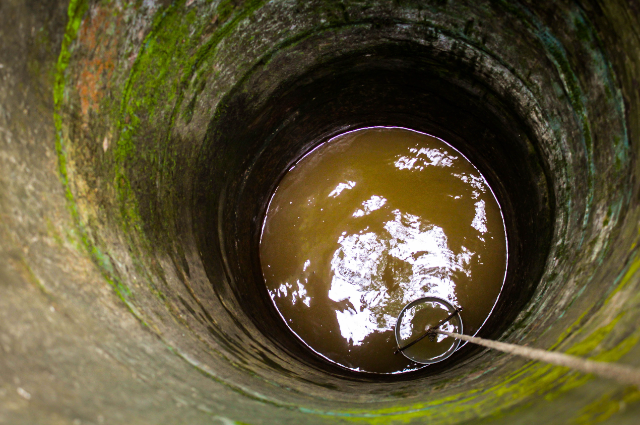
A strange well in Gujarat's Morbi district has drawn crowds, speculation, and more than one mystery to the area. What is it that causes the water to ripple and swell like the waves of the ocean?
A well on the farm of Pranjivan Sadariya in Virparda village has seen an odd occurrence since August 2. Water has been seen surging and swelling out of the well's mouth, in strange patterns that suggest the rolling waves of the sea.
After the water began running out of the well, videos of the strange sight have gone viral on social media, prompting hundreds of people to come to the village to see this strange "miracle". For days, people have come to the area in droves to see the unusual sight, with reports of people coming from nearby villages as well and cars stopping to see the display.
Was it an earthquake? Some thought that the cause behind the strange sight was seismic activity of some sort, considering the well's location in seismically active Kutch. Were there some geologic formations responsible for this? Was it the wind? Was it supernatural forces? These questions and more flew across social media as people tried to decide what could cause such a phenomenon. However, the local authorities investigating the issue say that there is no evidence pointing towards an earthquake being the cause behind the waves.
According to Pranjivan Sadariya, the owner of the land, it was behaving oddly since he had arrived on the scene on August 2. The well, he noted, had begun overflowing. This well was dug only three months ago, and so had not been around long. According to reports, these strange surges of water have not been constant, as the well displayed this behaviour for two days in a row, then stopped for a day, then started again. The authorities investigating the matter have found little reason to point towards any one theory as being the cause behind the oddity.
One of the more popular theories regarding the possible cause behind the well's odd behaviour was that it was an earthquake. Morbi and much of Kutch are in a seismically active zone, and so such a theory had weight behind it. However, the local authorities investigating the case noted that there was no evidence pointing towards an earthquake's occurrence.
To this end, the Institute of Seismological Research in Gandhinagar was contacted to determine whether or not an earthquake could be the cause behind the oddity. The Institute determined that there was no possible way that an earthquake could be responsible for the waves in the well.
Morbi's District Geologist J. S. Vadher noted that the waves could not be caused by an earthquake. This is an important finding, as wells are often affected by seismic activity.
The vibrations caused by an earthquake can and do affect underground water sources, changing the pressures of an aquifer and causing the water levels in a well to change and fluctuate.
With the theories of the cause behind the well's odd behaviours being disproven one by one, the authorities investigating the case turned towards another theory: that the cause of the well's behaviours was changes in its groundwater.
According to the early theories put forth by the local authorities, it was changes in the groundwater that caused the oddity in the well. The monsoon season can and does have a large effect on groundwater levels in the region, as rainwater infiltrates the soil and rock and replenishes aquifers. This process is necessary for the survival of the region's wells, as most are dependent on the aquifers for their water. However, these changes to the groundwater are far from simple affairs.
The changes to the water levels in the well in Virparda were far more extreme than normal, as the water began surging out of the well in waves. This could very plausibly be caused by changes to the water pressure underground.
According to the local authorities investigating the case, it was this force that caused the change to the well's behaviour. However, while these theories may explain the cause behind the fluctuating levels of water in the well, they fail to explain the waves themselves.
The strange sight of rolling waves in the well has led some to believe that it was something they knew of as a seiche. One of the easiest examples to picture is that of a bathtub: if one were to fill it with water and then disturb the surface of the water in some way, the water would begin to oscillate, or move back and forth. This is the most basic example of a seiche, though they can occur in lakes as well as wells.
Seiches can be caused by a number of factors, including changes in air pressure, wind, and, as mentioned previously, earthquakes. In the case of wells, seiches can be caused by changes to the groundwater pressures and vibrations of the ground. It is entirely possible that the cause of the well's odd behaviours truly is a seiche of some sort. However, describing the oddity as a "well seiche" would be, as of right now, premature.
The overflow of the well can also be explained by the early theories put forth by the authorities investigating the case. If the increase in the level of groundwater is steep enough, it can cause the water level in a well to rise to the brim, spilling out of the well.
The cause behind the wave-like motions of the water in the well is a mystery to scientists.
In order to determine the cause behind the wave-like motions of the water in the well, scientists will have to analyse some factors. Scientists will need to examine rainfall, groundwater levels, underground geology and pressure changes to determine what is causing the waves. Once these questions have been answered, it may be possible to determine the single cause behind the wave-like motions of the water in the well.
The oddity in the well has understandably attracted a great amount of attention. People were intrigued by the strange sight of rolling waves in a well and tried to determine the cause behind it. However, the speed at which information spreads on the internet is far greater than the speed at which it can be verified. This can lead to theories becoming popular before being proven wrong, which can lead to misinformation.
Speculation over the cause behind the wave-like motions of the well in Virparda ranged from supernatural causes to seismic activity. Some even tied the oddity to the Arabian Sea, suggesting that the waves were caused by the tides of the ocean somehow finding their way into the well. While interesting, this theory has no basis in reality.
It is the task of scientists to determine what these factors are, what their individual effects are, and how they combine. This process can be difficult, which is why the local authorities investigating the oddity in the well have asked for outside scientific assistance. After determining that the early theories put forth were insufficient in explaining the wave-like behaviours of the well, the local authorities investigating the case contacted outside experts for assistance.
What the outside experts do to investigate the case will be interesting to see, as they will have to determine what the cause behind the wave-like motions of the well truly is. It is their task to determine how the groundwater in the well interacts with the outside world, what factors influence the behaviour of the water in the well, and how these factors combine.
For now, the waves in Virparda's well remain unexplained. Monsoon rains and rising groundwater may help explain why the well overflowed, while a seiche is one possible explanation for the unusual movement of the water. But without further geological and hydrological investigation, neither can be confirmed as the cause.
What began as a strange sight on a farmer's land has become a viral mystery, but the answer is likely to be found not in supernatural forces or the distantArabian Sea, but somewhere beneath the ground. Until experts complete their investigation, the well's unusual waves remain an intriguing reminder of how much remains hidden beneath the surface
References