
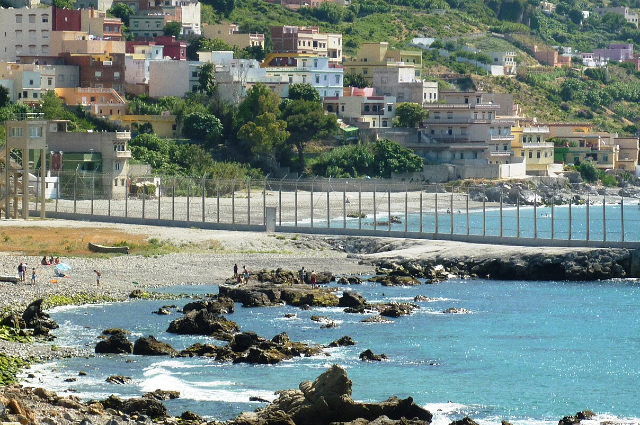
For years, Spain’s northern African exclave of Ceuta has been one of the EU’s most heavily guarded frontiers. Separated from Moroccan territory by a militarized fence and a narrow strip of water, the Spanish territory has been a coveted destination for migrants determined to reach Europe. Ceuta is one of two Spanish territories located on the North African coast, making it one of the few places where migrants can attempt to enter the European Union directly from Africa without crossing the Mediterranean to mainland Europe. Its location has made it a recurring focal point for migration into Spain.
However, this summer, the EU’s strict migration controls were severely tested when thousands of migrants attempted to reach Ceuta by swimming, bringing a recent legal ruling into the centre of the crisis.
What caused this sudden wave of migration toward Spain? At the heart of the crisis is a recent ruling by the Supreme Court, which may have created a loophole in Spain’s migration laws.
On June 29, the Supreme Court of Spain ruled that the so-called rechazo en frontera, or border rejection procedure, could no longer be applied to migrants intercepted while in the sea and attempting to reach Ceuta or Melilla, another heavily guarded region in Spain’s North African region.
The court ruled in July that the special procedure only applied to migrants attempting to reach Spain overland, and that existing surveillance equipment such as drones and motion sensors were not considered physical border-containment structures such as fences.
The ruling created a distinction between people climbing over the fence and people attempting to reach Spain by sea, which meant that the latter category of migrants could no longer be rejected using the special procedure. This did not mean that migrants arriving by sea were automatically allowed to remain in Spain. Instead, they had to be processed under the ordinary procedures established by Spanish immigration law, which provide greater procedural safeguards than the immediate border-rejection mechanism. The distinction is important because rechazo en frontera allows authorities to immediately reject certain people attempting to cross the border, while the ordinary return procedure provides additional legal safeguards. Therefore, the ruling did not make sea crossings legal or guarantee migrants the right to remain in Spain; it changed how authorities were required to process people intercepted at sea.
As early as the end of July, hundreds of migrants attempted to reach Ceuta by swimming across the narrow strait separating Morocco and Spain. By the beginning of August, authorities in Ceuta had already registered over 1,500 migrants who managed to reach Ceuta by sea in the past few days, among them many children. The movement was also fuelled by information circulating on social media. Reports indicated that posts and messages among potential migrants created the impression that Spain’s migration rules had changed and that reaching Ceuta by sea offered a greater chance of avoiding immediate rejection. While some of the information was inaccurate, it appears to have contributed to the sudden increase in attempted crossings. The legal change was not the only factor behind the sudden movement. Reports also pointed to social media and messaging platforms as an important source of information for potential migrants. Posts circulating online reportedly gave some people the impression that Spain had relaxed its migration controls or that swimming into Ceuta offered a better chance of entering the country. Although some of these claims were inaccurate, the rumours appear to have helped accelerate the movement.
The number of migrants reaching Ceuta by sea grew exponentially in the following days and weeks.
Authorities in Ceuta eventually estimated the number of migrants who had entered or attempted to enter the territory via the sea at as high as 72,000 people. Unfortunately, the difficult situation of the migrants in Ceuta was not the only consequence of the crisis. Many of the migrants who attempted to reach Spain via the sea were injured during the crossing, while others lost their lives due to the dangerous conditions of the crossing.
Spain responded by reinforcing the border and deploying additional security forces to prevent further crossings. The sudden migrant influx not only created difficult conditions for the locals and the newly arrived migrants, but it also triggered heated political debates on both sides of the Strait of Gibraltar. Moroccan authorities also increased efforts to prevent migrants from reaching the coastline opposite Ceuta. As the controls tightened, the flow of new arrivals slowed, while many of those who had already reached the enclave returned to Morocco. By early August, only a fraction of the people involved in the mass movement remained in Ceuta, although the authorities continued to face difficulties in accommodating unaccompanied minors.
In particular, the Italian government imposed temporary border controls on Spanish citizens seeking to enter Italy, with the Italian foreign ministry citing migration-security reasons. The Spanish government strongly opposed these restrictions, arguing that they were based on a distorted view of the migratory situation, in part because most of the migrants who had entered Ceuta were subsequently sent back.
The experience of this summer has shown that even relatively minor changes to immigration legislation can have serious consequences. Now Spain is faced with the challenge of finding ways to deal with a sudden influx of migrants and finding a balance between protecting its borders and international obligations under international law.
The events in Ceuta have shown how quickly migration routes can change when legal or physical barriers change. Spain now faces the difficult task of balancing border security with its obligations under international and European law.
For migrants attempting to reach Europe, the lesson is equally clear: when one route becomes harder to use, another can emerge. In Ceuta this summer, that alternative route was the sea.
References: