
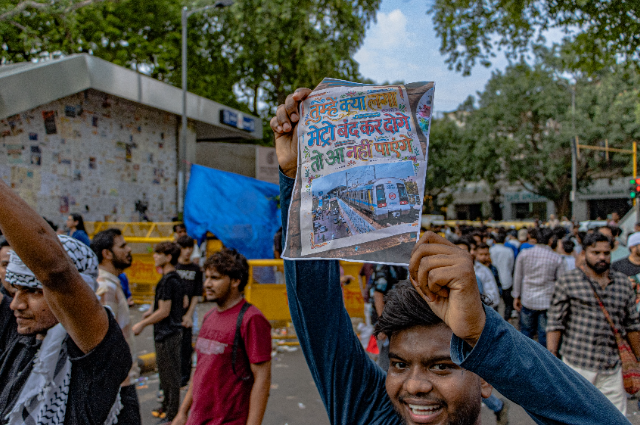
Hundreds of students have gathered at one end of Ranchi’s Jaipal Singh Munda Stadium to demand answers over alleged irregularities in Jharkhand’s recruitment examinations. Brahmanand Kumar Mahato sits largely by himself on the other end, waiting for an appointment he says he earned years ago.
He was among the candidates who qualified in the Jharkhand Staff Selection Commission’s (JSSC) Keetpalak, or silkworm rearer, recruitment examination in 2023. Yet his appointment is still stalled. According to his relative, Mahato had been selected for the post but is among around 30 candidates whose appointments have remained in abeyance. The candidates approached the Jharkhand High Court in November 2025, but the matter remains pending.
For Mahato, the protest is hence about more than one disputed examination. It is about what happens after a candidate has done everything the system asks of them – studied, appeared for the examination and qualified – only to find that the job itself remains out of reach.
The current agitation began after controversy surrounding the 14th Jharkhand Public Service Commission Combined Civil Services Examination, held in April 2026. Hundreds of aspirants have hence been camping at Jaipal Singh Munda Stadium in Ranchi, alleging irregularities and paper leaks in JPSC and JSSC examinations. The protest formally began on July 25 under the banner of the JPSC-JSSC Reforms Manch and gradually expanded beyond the 14th JPSC examination to encompass wider concerns about recruitment in the state.
Among the issues raised by candidates is the circulation of an allegedly suspicious OMR sheet following the declaration of the JPSC preliminary results. Aspirants questioned how a candidate who appeared to have attempted only a limited number of questions could qualify.
The protesters have demanded the cancellation of the 14th JPSC preliminary examination, an independent investigation and wider reforms in the recruitment system. Some have specifically sought a probe by the Central Bureau of Investigation (CBI) or by a panel of retired High Court judges from outside Jharkhand.
The state has already initiated a Crime Investigation Department (CID) investigation. By August 7, the CID had arrested 19 people in connection with alleged irregularities linked to the recruitment examinations.
What makes the Ranchi protest unusual is that it has not remained a single, unified movement. The stadium has developed two major hunger-strike stages, with another protester sitting independently beneath the statue of Jaipal Singh Munda. Three leaders associated with the regional Jharkhand Loktantrik Krantikari Morcha (JLKM) have been fasting on one stage, while four unaffiliated protesters have been holding another hunger strike. Mahato has continued his fast separately.
The division is not only geographical. The students have repeatedly insisted that their movement should remain apolitical. Yet political parties and their student organisations have steadily entered the protest space.
Leaders and supporters associated with the BJP, Congress and their student wings have visited the stadium. The BJP-affiliated ABVP held a separate protest march and burned an effigy of Chief Minister Hemant Soren, while leaders of the Congress-affiliated NSUI and Indian Youth Congress met protesters at the stadium.
The competing political presence has created an awkward contradiction – the protesters want political leaders to amplify their demands, but they do not want the movement itself to become an extension of party politics.
“We don’t want to be the stage for a party; we want it for the students,” a member of the protest’s core committee told ThePrint.
The government has attempted dialogue as well. Ranchi officials invited a five-member delegation of protesters for talks, but students initially objected to a closed-door format, arguing that discussions concerning the movement should take place openly and involve students.
The disagreement reflects a deeper problem of trust. For students who have spent years preparing for government examinations, simply being told that an investigation is underway may not be enough. They want to know what happened, who was responsible and whether the recruitment system can be trusted the next time they sit for an examination.
That is where Mahato’s story becomes different from that of most protesters around him. Many of the students at the stadium are still waiting for a chance to enter government service. Mahato is waiting for the government to honour a selection he says he has already earned.
Yet his appointment is still stalled. Unlike the larger groups at the stadium, he often sits beneath an umbrella or makeshift covering while rain falls around him – with comparatively few people gathered beside him. His situation exposes another side of the recruitment crisis – clearing an examination does not always mean getting the job.
The Ranchi agitation has increasingly become a protest about the credibility of Jharkhand’s entire recruitment system. Aspirants have raised concerns over several JPSC and JSSC examinations and have demanded greater transparency, including access to OMR sheets, answer records and cut-offs. Rather than a single stage speaking with one voice, it has produced multiple groups, hunger strikes and competing political approaches.
That fragmentation could weaken the movement, but it also reveals the range of frustrations that have brought people to the stadium. There are first-time protesters and candidates who have appeared for examination after examination. There are young aspirants worrying about their future and older candidates saying years of preparation have already been consumed by recruitment delays. And there is Mahato, sitting somewhat apart from them, waiting for a government appointment connected to an examination he cleared three years ago.
The question at Jaipal Singh Munda Stadium is therefore larger than whether one examination should be cancelled. It is whether a young person in Jharkhand can still believe that preparing honestly, clearing an examination and waiting patiently will eventually lead to a government job. For Mahato, that wait has already lasted long enough.
References
- https://theprint.in
- https://www.ndtv.com
- https://indianexpress.com
- https://www.ndtv.com
- https://www.newindianexpress.com