
The Rashtriya Swayamsevak Sangh (RSS) was established in Nagpur on 27th September 1925 and has now reached its centenary in 2025. The RSS has grown from a small group of volunteers to a large network with branches throughout India and affiliated organisations such as the Bharatiya Janata Party (BJP), Vishva Hindu Parishad (VHP) and Akhil Bharatiya Vidyarthi Parishad (ABVP). Unlike the position of the General Secretary (Sarkaryavah), who is voted by the representative body, the Sarsanghchalak is chosen by the current leader. Usually, they will consult senior functionaries and choose their successor.
The first two leaders chose their successors ahead of their deaths. However, it was the third leader, Deoras, who started the trend of declaring a successor whilst alive.
Six Sarsanghchalaks
Keshav Baliram Hedgewar (1925-1940)
Keshav Baliram Hedgewar, a doctor from Nagpur, founded the RSS in 1925. The goal was to organise Hindu society and create a disciplined group of volunteers. The RSS began with volunteers meeting up in shakhas. Before becoming an RSS leader, Hedgewar had some political background. He became involved in the Indian nationalist movement and took part in the Jungle Satyagraha in 1930, which led to his imprisonment. Whilst in the RSS, he temporarily passed the leadership onto Laxmanrao Paranjape as he thought he would be arrested. Hedgewar chose Golwalkar as his successor ahead of his death on 21st June 1940.
Madhav Sadashiv Golwalkar (1940-1973)
Golwalkar, known as Guruji, became the leader of the RSS for 33 years. This is the longest anyone has held the position. During his time in office, the RSS expanded. However, his time in office was during a critical time. After Mahatma Gandhi was assassinated by Nathuram Godse on 30th January 1948, the Indian Government banned the RSS on 4th February. Golwalkar was arrested and the reason given was due to fears of violence and activities by RSS members.
The RSS denied this, and the ban was lifted in July 1949. This was after they promised to put more detail into their constitution and ensure they were committed to legal activities.
Golwalkar has left a controversial legacy. Supporters say he stabilised the RSS and created a strong organisational structure. However, critics say his writings around nationality, minorities and culture show he had a narrow view of Indian Nationalism. Golwalkar chose Deoras as his successor ahead of his death on 5th June 1973.
Madhukar Dattatraya Deoras (1973-1994)
Balasaheb Deoras, known as the third Sarsanghchalak, led the RSS during the emergency imposed by Prime Minister Indira Gandhi’s government (1975-1977). During this time, the RSS was banned, and many members were arrested. Deoras focused more on outreach. He publicly opposed untouchability and spoke about how caste discrimination was not compatible with Hindu society. The RSS began to engage with members of different communities; however, there were still issues of caste and hierarchy.
Deoras made one of the most significant decisions by choosing to declare his successor whilst he was alive. He chose Rajendra Singh as his successor in March 1994 as he was becoming unwell. During Deoras’ time in office, there were events of the Babri Masjid being demolished in Ayodhya on 6th December 1992. The RSS was banned again in December of that year.
Rajendra Singh (1994-2000)
Rajendra Singh, known as Rajju Bhaiya, became the fourth Sarsanghchalak in March 1994. He was a physicist who studied and taught at Allahabad University. He gave up his career and worked full-time for the organisation. He was also from Uttar Pradesh, meaning there was a geographical change. During his time in office, the RSS gained more political visibility nationally, especially with the expansion of the BJP. He stepped down in March 2000 due to health issues and chose K.S. Sudarshan as his successor.
Kuppahalli Sitaramayya Sudarshan (2000-2009)
K.S. Sudarshan became the fifth Sarsanghchalak in March 2000. This was during the time of the National Democratic Alliance government led by the BJP and Prime Minister Atal Bihari Vajpayee. Sudarshan focused on putting more emphasis on indigenous economic ideologies, cultural nationalism and self-sufficiency. He also engaged with members of other religions such as Muslims and Christians to promote dialogue. During his time in office, there were still disagreements about the relationship the RSS had with the BJP. Sudarshan stepped down in March 2009 and chose Mohan Bhagwat as his successor. Bhagwat had been the General Secretary (Sarkaryavah) since 2000, meaning he had lots of experience with the organisation.
Mohan Bhagwat (2009-present)
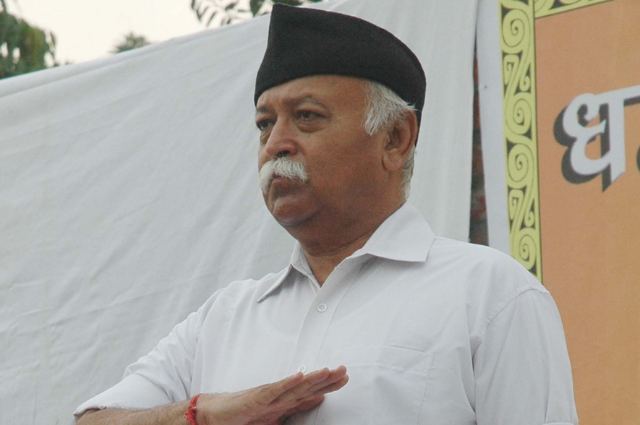
Mohan Bhagwat became the sixth Sarsanghchalak in March 2009. Born in Chandrapur, Maharashtra, in 1950, he studied Veterinary Science. During his time in office, the RSS have increased their outreach. They have given talks, done social work and engaged with different sections of society. Bhagwat has spoken out against caste discrimination and said that caste should not matter when choosing a leader. He spoke about how any caste Hindu could become Sarsanghchalak in February 2026. However, 5 out of 6 leaders have been Brahmins. This has caused questions about how eligible they really are. The RSS reached its centenary in 2025, meaning there was more focus on its history and influence. Bhagwat’s time in office has also meant there has been more scrutiny of the RSS.
In June 2026, Karnataka minister Priyank Kharge asked the RSS for information on their registration, office bearers, finances and tax. However, Bhagwat claimed this was a political move. He said they were not secret and that Hindu Dharma is not registered.
The current Sarsanghchalak will choose their successor. However, after Deoras’ death, their names became public. In 1994, Deoras broke this trend and chose Singh as his successor whilst he was alive. Singh then chose Sudarshan in 2000, and Sudarshan chose Bhagwat in 2009. The RSS have a voting system for their General Secretary. The Akhil Bharatiya Pratinidhi Sabha (ABPS) is the highest representative body. They vote on who becomes General Secretary to manage the day-to-day running of the organisation. They are very different roles. The Sarsanghchalak provides the main ideological guidance for the organisation. The Sarkaryavah has a more hands-on role.
The history of the RSS cannot be fully understood without looking at how they have interacted with the Indian Government. They have been banned 3 times since independence. Once in 1948 after Gandhi was assassinated, once during the emergency (1975) and once after the demolition of the Babri Masjid (1992). Each time, the ban was lifted (1949, 1977 and 1993).
There has also been much debate about the RSS’ role in the freedom struggle. Individual members of the RSS did get involved in nationalistic causes. However, critics say the organisation as a whole did not play as big a role in the independence movement as it did not do so to the same extent as the Congress or other key anti-colonial organisations.
The assassination of Gandhi is also a sensitive topic. Godse’s link to Hindu Nationalist organisations such as the RSS has been looked at by historians. The RSS have denied any connection to the assassination.
There has been much debate about the ideology of Hindutva. Supporters say it is a cultural way of seeing Indian identity with a focus on civilisation, social work and national unity. Critics say it can cause issues with placing too much focus on Hindu identity in a religiously diverse country. There are concerns about minority rights, caste and religion.
Hedgewar created the foundation, Golwalkar stabilised it, Deoras expanded their outreach, Singh and Sudarshan saw more changes, and Bhagwat has led it through their centenary. Whilst there have been issues with choosing who becomes the leader, the RSS have influence from their shakhas, affiliated organisations and volunteers. As they enter their second century, how they deal with these issues will determine their future and the ongoing debate around their role in India.
References:
- https://indianexpress.com
- https://indianexpress.com
- https://new.rss.org/Encyc/2025/8/14/background-evolution
- https://indianexpress.com
- https://www.cambridge.org
- https://indianexpress.com