
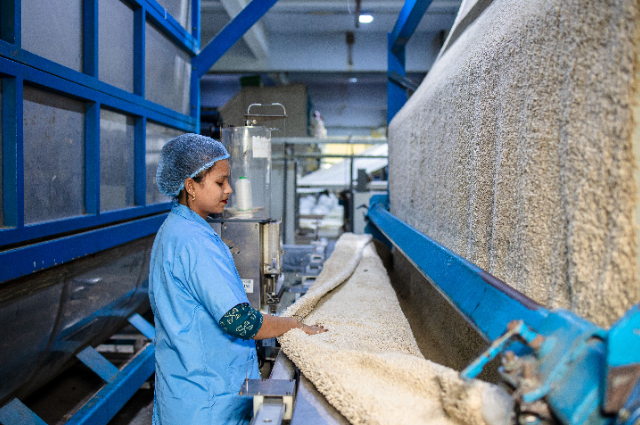
When Sharayu Daftary entered India's industrial world, women were still expected to stay out of the factory floor and the boardroom. Born in 1933 into a prominent industrial family, she grew up around a business legacy, but was denied entry into the family enterprise due to the belief that women did not belong in it. Instead of seeing an end to her professional ambitions, Daftary built something of her own.
At the age of 25 in 1958, she founded Bharat Radiators with a capital of ₹2 lakh and five workers. What began as a small automobile-components enterprise became the defining institution of her professional life. Her association with the company lasted for 68 years, an unusually long corporate relationship that continued until her death in May 2025 at the age of 91.
Daftary's decision to build Bharat Radiators was influenced by the limitations placed on women in business. Although she was born into the Walchand Hirachand family, she would have inherited a position in the industrial empire that he had built. But she was not allowed to join the family enterprise. Instead, she chose to build an independent enterprise.
In 1958, she founded Bharat Radiators with five employees and ₹2 lakh in capital. The company operated in the automobile-components sector, manufacturing radiators and related products, in a time when India's industrial base was just emerging.
For Daftary, however, the factory was not just business. Her own understanding of industrial leadership was tied to the relationship between management and workers. She had experience of working on the factory floor herself, giving her an understanding of the production process, as well as of the people running it. In a 2001 interview with Jain Spirit, Daftary discussed the company's labour relations, noting that Bharat Radiators had gone for decades without a strike, go-slow or loss of manpower. That emphasis on industrial harmony became a notable part of the way her leadership was remembered.
Daftary's influence eventually expanded to Bharat Radiators. In 1971, she became the first woman president of the Automotive Components Manufacturers Association of India (ACMA), serving as president from 1971 to 1972. Her election was significant not only because she headed an industry association, but because the automobile-components sector was overwhelmingly male-dominated. A decade later came another landmark. In 1981, Daftary became the first woman president of the Indian Merchants' Chamber (IMC). The organisation describes her as its first woman president, and also as the first woman to head a chamber of commerce in India.
The achievement was significant, as chambers of commerce were among the country's most established institutions to represent business and industry. Leadership roles in such organisations reflected the overwhelmingly male nature of India's corporate sector.
Her presidency marked an important step towards greater representation of women in India's business institutions. She later returned to the IMC presidency in 2000, making her relationship with the organisation span several decades. Her institutional influence extended to the Federation of Indian Chambers of Commerce and Industry (FICCI), where she became the first woman to serve on its executive committee. After decades of industrial and institutional work, Daftary received the Padma Shri in 2004 for her contribution to trade and industry. The award placed formal recognition behind a career that had already stretched across nearly five decades.
By then, her professional journey had traversed several stages of India's economic development — from the early years of industrialisation after Independence to the transformation of Indian manufacturing, and the growth of women's participation in professional and corporate life.
An integral part of Daftary's life existed outside the conventional business narrative. She was a practising Jain and was associated with the Dakshin Bharat Jain Sabha. She also edited Jain Bodhak, a publication associated with Jain thought and community life.
Her understanding of Jainism was tied to her views on women's position in society. In a 2001 interview published in Jain Spirit, Daftary rejected the idea that equality for women was simply a concession. Instead, she argued that equality and dignity were already intrinsic to Jain philosophy. Her interpretation of Jainism was significant in the context of her own life. She had experienced gender-based restrictions at the beginning of her professional journey, but she had spent the following decades demonstrating that women could participate in industrial leadership without having to give up their cultural or religious identity.
Daftary's approach to leadership was also defined by an emphasis on people rather than institutions. Her long association with Bharat Radiators meant that she witnessed several generations of employees pass through the company. Her comments on labour relations reflected an approach in which the workforce was treated as central to the stability of the enterprise. Her experience of the factory floor also set her apart from the image of an industrialist operating from a corporate office. She understood manufacturing not only as an economic activity, but as a workplace involving people whose cooperation was essential to the survival of a business.
The most striking number associated with Daftary's career is perhaps not the year she became the first woman president, or the year she received the Padma Shri. It is 68. Her association with Bharat Radiators lasted for 68 years — from the company's founding period in 1958 until 2025. In an age in which corporate leadership involves frequent movement between organisations, such longevity is unusual. In Daftary's case, it is even more remarkable because the company was not an inheritance, but an enterprise she created after being denied entry into the family business.
Sharayu Daftary died in May 2025 at the age of 91. Her death marked the end of a career in the first decade after India's Independence, and continued through some of the country's most dramatic economic and social changes. She had seen India's industrial economy grow from a heavily regulated system to liberalisation and a more globally integrated market. Through these, her professional identity was always tied to the company she had founded in 1958.
Above all, there was the entrepreneur whose association with the company she founded endured for nearly seven decades.
Her professional story began with exclusion. She was denied entry into a business that bore her family's name. Instead, she built a company that bore a legacy of her own. Nearly seven decades later, she had not just titles. She had created a sustained presence in Indian industry, as women fought for entry into the spaces that she eventually came to lead. Sharayu Daftary's legacy is not just that she was first. It is that she stayed — building, leading and participating in Indian industry over 68 years, long enough to see the barriers that had excluded her begin to change.
References:
- https://wiki.sizzltek.com
- https://www.jainsamaj.org
- https://www.factsnippet.com
- https://m.economictimes.com