
For decades, South Korea’s demographic crisis has been linked to unaffordable housing, unstable jobs, expensive education and the rising cost of raising children. But a separate conversation has emerged around women who are actively choosing to reject traditional family life.
That conversation has fuelled renewed international interest in 4B, a radical feminist movement that rejects dating, sex, marriage and childbirth with men.
The movement is often presented abroad as a simple “sex strike” against men. In reality, its origins and politics are considerably more complicated. 4B emerged from a wider wave of South Korean digital feminism that challenged misogyny, gender violence and expectations surrounding marriage and motherhood. Its relationship with the country's record-low fertility rate is equally complicated: the movement may reflect many of the frustrations behind South Korea's demographic crisis, but it cannot be blamed for causing that crisis.
4B refers to four principles whose Korean names begin with “bi,” signifying rejection or refusal.
The principles reject:
Biyeonae — dating or romantic relationships with men
Bisekseu — sexual relationships with men
Bihon — heterosexual marriage
Bichulsan — childbirth
Together, these principles represent a rejection of the traditional expectation that women should eventually build their lives around heterosexual marriage and motherhood.
Academic research has described 4B as more than a refusal of sex or dating. For some women who adopt the lifestyle, it represents a broader rejection of institutions they see as patriarchal.
The history of 4B is sometimes simplified into the claim that it began in 2015 during the MERS outbreak. That is not quite accurate. What began in 2015 was Megalia, an influential online feminist movement that emerged amid an explosion of misogynistic discourse in South Korea. During the Middle East Respiratory Syndrome outbreak, online users blamed Korean women for helping spread the disease. Women responded by “mirroring” misogynistic language, reversing the genders in offensive comments to expose their sexism.
Megalia became one of the most influential forces in South Korea's new wave of digital feminism. It helped popularise confrontational online activism around misogyny, beauty standards, sexual exploitation and violence against women.
4B itself emerged later, generally in the mid-to-late 2010s, within this broader feminist environment. It emerged within the same broader feminist environment as movements such as “Escape the Corset,” which challenged restrictive beauty standards.
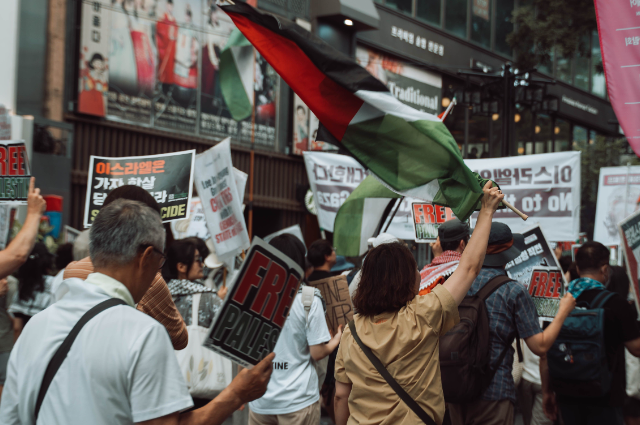
The rise of 4B cannot be separated from the wider anger surrounding gender-based violence in South Korea. It developed during a period of growing feminist activism around misogynistic violence, sexual harassment, non-consensual filming and online sexual exploitation.
South Korea saw major protests over “spycam” crimes, in which women were secretly filmed in toilets, changing rooms and other private spaces. For some women, the 4B response was therefore not simply ideological. Avoiding relationships with men was presented as a form of personal autonomy and, in some cases, self-protection.
Is 4B responsible for South Korea's low birth rate? This is where international coverage often becomes misleading. South Korea's low fertility rate and 4B share a broader context of changing attitudes toward marriage, motherhood and gender roles.
But that does not mean 4B caused South Korea's demographic crisis. Official figures show a modest improvement: South Korea recorded about 254,500 births in 2025, while its total fertility rate rose to 0.8. But deaths still exceeded births by roughly 110,000.
The crisis therefore remains profound, even if describing the birth rate as continuously “plummeting” is no longer entirely accurate. More importantly, South Korea's fertility decline began long before 4B became widely known.
OECD research identifies structural causes including expensive housing, insecure employment, education costs, labour-market competition and the financial burden of raising children.
For many South Korean women, motherhood can carry a significant career penalty. Women may face discrimination at work, interruptions to employment and disproportionate responsibility for childcare and domestic labour. Some women reject marriage and motherhood as an explicit feminist position. Others may want relationships or children but feel unable to afford them or unwilling to accept the gender inequalities that often accompany them.
The 4B movement did not create these conditions. It is better understood as one of the clearest expressions of the frustration they have produced. Blaming feminism for falling birth rates can obscure the deeper problem. If women are increasingly reluctant to marry or have children, the answer may not simply be to pressure them into doing so.
Financial incentives may not solve the problem if women continue to associate marriage with reduced professional independence and unequal domestic work. The fertility crisis therefore raises an uncomfortable question for policymakers: What if women are not rejecting motherhood itself, but rejecting the conditions under which motherhood is currently expected to happen?
Its participants do not ask the state to make traditional heterosexual family life more attractive. They reject the expectation that women must pursue that life at all.
For years, 4B remained largely a South Korean phenomenon, known primarily within feminist and academic circles outside the country. That changed dramatically in November 2024.
After Donald Trump's 2024 election victory, discussion of 4B surged on social media, with some American women encouraging rejection of dating, sex, marriage and childbirth with men. The resurgence was linked to anxiety over reproductive rights and a broader political backlash against feminism.
However, describing the American reaction as the beginning of a unified US version of 4B would be an exaggeration. The online conversation was far larger than the number of people known to have permanently adopted the lifestyle. The viral revival was therefore better understood as a highly visible feminist reaction among particular online communities rather than a movement representing American women as a whole.
The ideas behind 4B have also travelled across East Asia, although they have changed significantly in the process. In China, related ideas have circulated through radical feminist communities, particularly in forms associated with 6B4T, an expanded set of principles influenced by South Korea's 4B movement. Feminist activism in China operates under far tighter restrictions, and communities promoting radical feminist ideas have faced censorship. In 2021, online groups associated with 6B4T on the platform Douban were shut down or restricted. More recent research suggests that these ideas have not simply disappeared. Instead, they have been adapted and reinterpreted by Chinese feminist communities as forms of personal autonomy and, in some cases, quiet resistance to state expectations surrounding marriage and childbirth.
This makes it misleading to say that 4B has simply been “exported” to China. In South Korea, refusing heterosexual relationships can be a visible feminist statement. Under tighter political control, similar choices in China can take on a quieter and more coded form.
One of the most serious debates surrounding the wider radical feminist environment from which 4B emerged concerns trans inclusion. Some strands of South Korean radical feminism have adopted trans-exclusionary positions, a trend documented in recent academic research. However, it would be inaccurate to declare that every woman who identifies with 4B necessarily shares those views.
4B is not a centrally organised movement with a single membership list, leadership structure or universally agreed political programme. Still, the controversy is significant because it exposes a larger tension within feminist politics: Who is included when a movement defines itself around the category of “women”? Critics argue that excluding transgender women reproduces marginalisation, while supporters of trans-exclusionary feminism view sex-based categories as central to women's oppression.
Perhaps the biggest philosophical question surrounding 4B is whether personal refusal can truly create political change. Critics argue that refusing relationships with men does little to change institutions: patriarchal workplaces, unequal family laws, economic discrimination and sexual violence do not disappear when individuals opt out of heterosexual relationships.
From this perspective, 4B risks becoming a form of personal retreat presented as political activism.
Supporters argue that marriage, reproduction and unpaid domestic and emotional labour depend on women's participation. Refusing that participation, therefore, can itself be political. One view emphasises collective organisation, law, protest and institutional reform; the other argues that changing individual behaviour can undermine social expectations.
4B alone cannot solve gender inequality. But its existence has helped force conversations about why some women no longer see heterosexual marriage and motherhood as automatically desirable futures. The renewed global fascination with 4B has created another problem: visibility is often mistaken for size.
4B has received increased international attention since the 2024 US election, with its ideas spreading into discussions in the United States, China and elsewhere.
But there is little evidence that 4B has become a massive, centrally organised global movement. Many people may encounter 4B online without permanently adopting all four principles; someone may reject marriage, for example, without identifying as a 4B feminist.
This flexibility makes the movement difficult to measure.
The international interest in 4B is ultimately about more than whether women will date men. It is about a growing conflict between traditional expectations and the lives many women now want — or feel they can realistically have. South Korea's demographic crisis is often framed as a numerical emergency: too few babies, too many elderly people and an economy facing population decline.
What does it mean when a growing number of women no longer see marriage and motherhood as the inevitable centre of a successful life? South Korea's fertility crisis is driven by economics, housing, employment, education costs and gender inequality. 4B is only one small part of that much larger story.
South Korea's fertility crisis is driven by economics, housing, employment, education costs and gender inequality; 4B is only one part of that larger story. For its critics, it raises difficult questions about isolation, political effectiveness and exclusion. And for governments worried about falling birth rates, it delivers an uncomfortable reminder: A society cannot assume that women will continue participating in institutions simply because those institutions have historically depended on them.
When the conditions of marriage, work and motherhood feel unequal, refusing them can become not just a personal choice, but a political language of its own.
References:
- https://www.oecd.org
- https://en.wikipedia.org/wiki/Megalia
- https://www.theguardian.com
- https://mods.go.kr
- https://thediplomat.com
- https://doi.org/10.1080/14680777.2026.2635497
- https://www.tandfonline.com
- https://abcnews.com
- https://onlinelibrary.wiley.com/doi/10.1111/fare.70030
- https://www.researchgate.net